
E-mail or email is a common question for writers, students, business professionals, and website owners. Many people see both spellings online and wonder which one is correct.
The simple answer is that both forms are correct. However, one version is more popular today.
Language changes over time. As technology becomes part of daily life, some words become shorter and easier to write. The word “email” followed this trend.
In this guide, you will learn the difference between e-mail and email, their history, real-life examples, common mistakes, and expert writing tips. By the end, you will know which spelling works best for your audience and writing style.
Quick Summary Box
- Both e-mail and email are correct spellings.
- Email is the modern and preferred version.
- Most style guides now recommend email.
- Businesses, websites, and marketers usually use email.
- Consistency matters more than the spelling choice.
- Use one version throughout your content.
What Is Email?
Email stands for electronic mail.
It is a method of sending and receiving digital messages through the internet.
People use email for:
- Business communication
- Personal messages
- Marketing campaigns
- Customer support
- Online account verification
Examples:
- I sent an email to my manager.
- Please check your email inbox.
- The company emailed the receipt.
What Does E-Mail Mean?
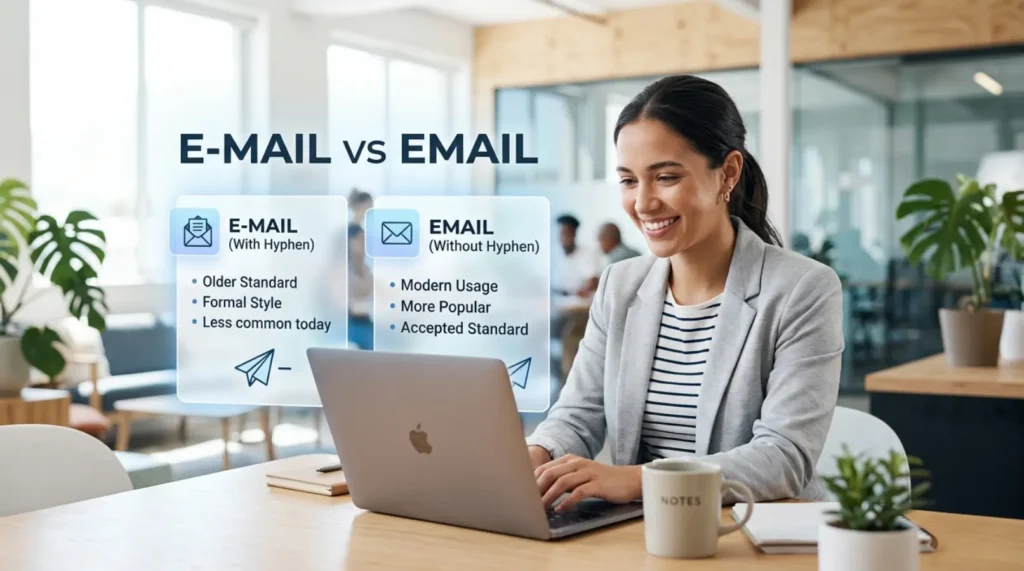
E-mail means exactly the same thing as email.
The term originally included a hyphen because it combined two words:
- Electronic
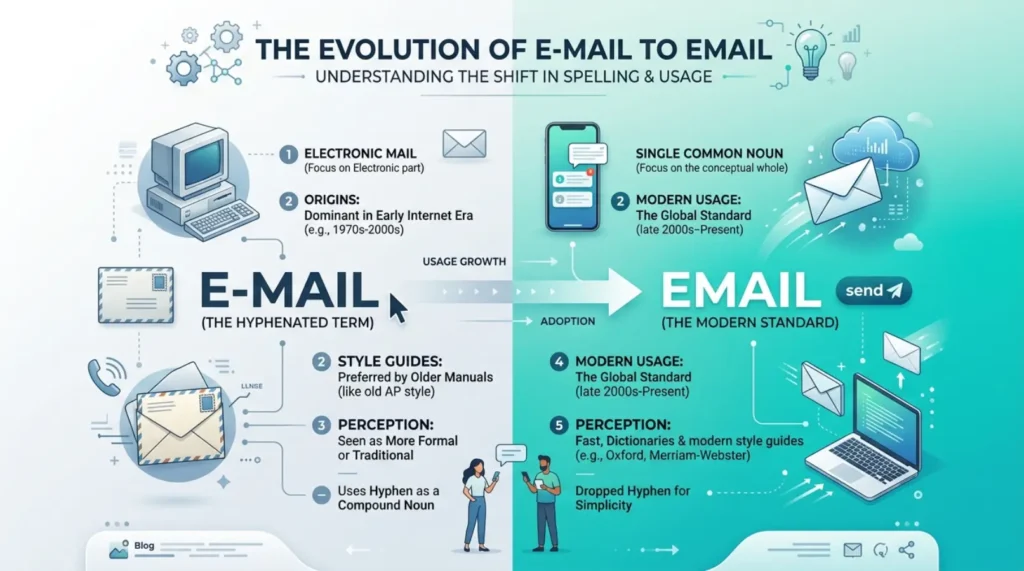
Early technology documents often used “e-mail” because it followed traditional English word-building rules.
Example:
- Please send an e-mail before Friday.
The meaning remains identical.
E-mail or Email: Which Is Correct?
Both spellings are correct.
However, email has become the standard form in modern English.
Most major dictionaries and style guides now favor “email.”
Quick Answer
| Term | Correct? | Common Today? |
| Yes | Less common | |
| Yes | Most common |
For modern writing, choose email unless your organization requires “e-mail.”
Why Did E-Mail Become Email?
Language naturally evolves.
Many words lose hyphens over time.
Examples include:
| Older Form | Modern Form |
| Web-site | Website |
| On-line | Online |
People prefer shorter and simpler words.
As email became part of everyday communication, the hyphen gradually disappeared.
What Do Major Style Guides Recommend?
Most professional writing guides now use email.
Common Recommendations
| Style Guide | Preferred Form |
| AP Style | |
| Microsoft Style Guide | |
| Google Documentation | |
| Oxford Dictionary | |
| Merriam-Webster |
These recommendations have helped make “email” the dominant spelling.
Real-Life Examples of Email Usage
You can find the word email almost everywhere.
Business Example
“Please email the report by 5 PM.”
Marketing Example
“Our email campaign increased sales by 20%.”
Education Example
“Students must submit assignments through email.”
Customer Service Example
“Contact support by email for assistance.”
Modern organizations overwhelmingly prefer “email.”
Email vs E-Mail Comparison Table
Featured Snippet Comparison
| Feature | ||
| Meaning | Electronic mail | Electronic mail |
| Correct Spelling | Yes | Yes |
| Modern Usage | Very common | Less common |
| SEO Preference | Stronger | Weaker |
| Business Usage | Preferred | Rare |
| Style Guide Support | High | Limited |
Winner
For most situations, email is the better choice.
When Should You Use Email?
Use email when:
- Writing blog posts
- Creating website content
- Sending business communications
- Publishing marketing materials
- Writing academic content
- Creating social media posts
This version feels modern and natural.
When Might E-Mail Still Be Used?
Some organizations continue using e-mail because of:
- Older branding guidelines
- Legacy documentation
- Historical publications
- Internal style preferences
If a company style guide requires e-mail, follow that rule consistently.
Common Mistakes People Make
Many writers make small errors when using the term.
Mistake 1: Switching Between Both Spellings
Incorrect:
- Email marketing is effective.
- Our e-mail newsletter launches tomorrow.
Choose one style and stay consistent.
Mistake 2: Capitalizing Incorrectly
Incorrect:
Use capitalization only when starting a sentence.
Mistake 3: Adding Extra Hyphens
Incorrect:
- e–mail
- e mail
Correct:
Tips for Using Email Correctly
Follow these simple tips.
Be Consistent
Use one spelling throughout your article.
Follow Brand Guidelines
Some companies have specific writing standards.
Prefer Modern Usage
Most readers expect “email.”
Think About SEO
Search engines recognize both versions, but “email” appears more frequently in modern searches.
Email in Daily Life
Email remains one of the most important communication tools.
People use email to:
- Apply for jobs
- Receive invoices
- Reset passwords
- Communicate with customers
- Share business updates
- Subscribe to newsletters
Even with messaging apps, email remains essential.
Synonyms and Related Terms
Using related keywords helps SEO and readability.
Synonyms
- Electronic mail
- Digital message
- Online mail
- Internet message
Why Email Matters for Businesses
Email remains a powerful communication channel.
Benefits include:
- Direct customer contact
- Low marketing costs
- Strong return on investment
- Easy automation
- Professional communication
Many companies consider email marketing one of their most valuable digital assets.

Expert Insights: Best Practice for Modern Writing
Professional writers, editors, and SEO specialists generally recommend email.
Why?
- It matches modern usage.
- Readers recognize it instantly.
- Major style guides support it.
- It creates cleaner content.
- It aligns with current search trends.
For websites, blogs, and business content, email usually delivers the best user experience.
EEAT Recommendation
If you publish professional content:
- Use “email.”
- Follow a recognized style guide.
- Stay consistent across all pages.
- Review content regularly for consistency.
These practices improve trust and readability.
Frequently Asked Questions (FAQs)
Is email or e-mail correct?
Both are correct. However, email is the preferred modern spelling.
Which spelling is more common today?
Email is far more common in websites, businesses, and publications.
Does Google prefer email or e-mail?
Google understands both. However, email appears more frequently in modern content.
Why was e-mail used originally?
The hyphen connected the words “electronic” and “mail.”
Should businesses use email or e-mail?
Most businesses should use email because it aligns with modern writing standards.
Is email one word?
Yes. In modern English, email is generally treated as one word.
Do dictionaries accept both spellings?
Yes. Most dictionaries recognize both forms.
Can I use both spellings in one article?
It is better to choose one version and remain consistent.
Conclusion
The debate over e-mail or email has a simple answer: both spellings are correct. However, language has evolved, and email is now the preferred choice in modern writing. Most businesses, publishers, style guides, and digital marketers use the shorter version because it feels cleaner and more natural.
If you create website content, blog posts, marketing materials, or professional documents, email is usually the best option. The key is consistency. Pick one spelling and use it throughout your content.
For most readers today, email is the standard form. Using it can improve readability, align with current writing practices, and help maintain a professional appearance across your content.