
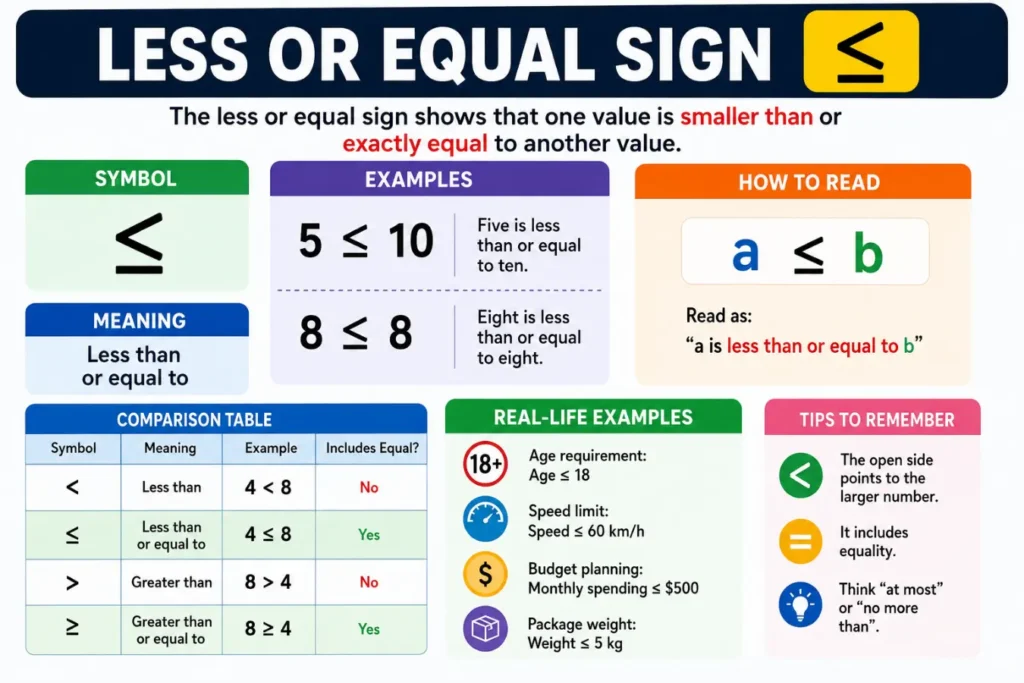
The less or equal sign is a common math symbol used in schools, workplaces, and daily life. It helps compare two numbers or values. This symbol shows that one value is either smaller than or exactly equal to another value.
Many students see this sign in math problems. However, some people still confuse it with other comparison symbols. Learning it is easy when you understand its meaning and purpose.
In this guide, you will learn what the less or equal sign means, how to use it correctly, and where it appears in real life. You will also discover common mistakes, practical examples, and helpful tips.
By the end of this article, you will understand the less or equal sign with confidence.
Quick Summary Box
- Symbol: ≤
- Meaning: Less than or equal to
- Purpose: Compare two values
- Example: 5 ≤ 10
- Read as: Five is less than or equal to ten
- Can mean: Smaller than OR exactly equal to
- Common use: Math, science, programming, finance, and statistics
What Is the Less or Equal Sign?
The less or equal sign (≤) is a mathematical symbol.
It shows that one number is:
- Smaller than another number, or
- Equal to another number
Example
7 ≤ 10
This statement is true because 7 is smaller than 10.
10 ≤ 10
This statement is also true because both numbers are equal.
Less or Equal Sign Definition
The less or equal sign combines two ideas:
- Less than (<)
- Equal to (=)
Together, they create the symbol:
≤
This means a value does not exceed another value.
Simple Definition
A number is less than or equal to another number when it is either smaller or exactly the same.
How to Read the Less or Equal Sign
You can read the symbol ≤ as:
- Less than or equal to
- Smaller than or equal to
- At most
- No more than
Examples
| Expression | Read As |
| 3 ≤ 8 | Three is less than or equal to eight |
| 12 ≤ 12 | Twelve is less than or equal to twelve |
| x ≤ 20 | X is less than or equal to twenty |
Less or Equal Sign Symbol
The symbol looks like this:
a\le b
Most keyboards do not have a direct key for it. Therefore, people often use:
<=
in programming or plain text.
Examples
- Mathematical notation: x ≤ 5
- Computer notation: x <= 5
Both represent the same idea.
Real-Life Examples of the Less or Equal Sign
The less or equal sign appears in many everyday situations.
Age Requirements
Children aged 12 years or less can enter for free.
Age ≤ 12
Speed Limits
A road may require vehicles to travel at:
Speed ≤ 60 km/h
Budget Planning
You may decide:
Monthly spending ≤ $500
Product Weight
A package may have:
Weight ≤ 5 kg
These examples show why the symbol is useful.
Less Than vs Less or Equal Sign
Many learners confuse these symbols.
Comparison Table
| Symbol | Meaning | Example | Includes Equal Value? |
| < | Less than | 4 < 8 | No |
| ≤ | Less than or equal to | 4 ≤ 8 | Yes |
| > | Greater than | 8 > 4 | No |
| ≥ | Greater than or equal to | 8 ≥ 4 | Yes |
Example
- 5 < 5 → False
- 5 ≤ 5 → True
The second statement is true because equality is allowed.
How to Use the Less or Equal Sign in Math
This symbol appears in many math topics.
Algebra
x ≤ 10
This means x can be:
- 10
- 9
- 8
- 7
- And any smaller number
Graphs
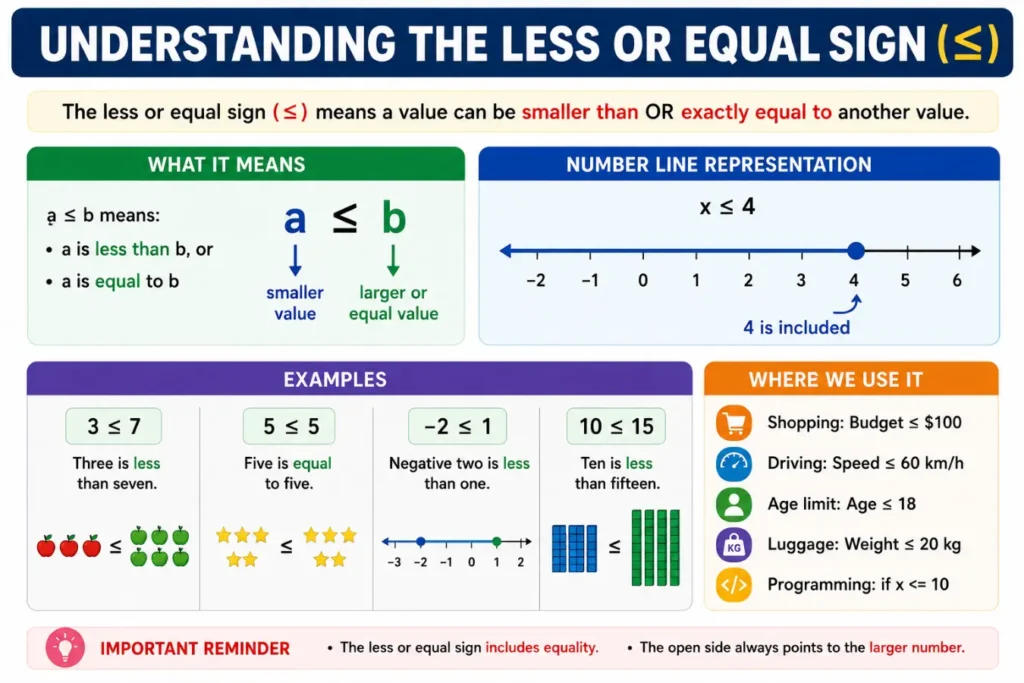
When graphing inequalities, the less or equal sign often uses:
- A solid dot
- A shaded region
Example:
x ≤ 4
The graph includes the number 4.
Word Problems
A school club may allow:
Members ≤ 50
This means the club can have 50 members or fewer.
Less or Equal Sign in Programming
Programmers use the less or equal sign frequently.
Most coding languages write it as:
<=
Example
if score <= 100:
print(“Valid score”)
This checks whether the score is 100 or less.
Common Programming Languages
- Python
- JavaScript
- Java
- C++
- PHP
All use <= for less than or equal to.
Less or Equal Sign in Statistics
Statistics often uses inequalities.
Examples
- Test scores ≤ 80
- Income ≤ $50,000
- Probability ≤ 1
Researchers use these symbols to define ranges and limits.
This makes data easier to analyze.
Common Mistakes When Using the Less or Equal Sign
Many beginners make similar errors.
1. Confusing It With Less Than
Incorrect understanding:
5 ≤ 5 is false
Correct understanding:
5 ≤ 5 is true
2. Reversing the Symbol
Incorrect:
10 ≤ 5
Correct:
5 ≤ 10
3. Forgetting Equality
Some people think the symbol only means “less than.”
However, equal values are also allowed.
4. Mixing Up ≤ and ≥
Remember:
- ≤ means less than or equal to
- ≥ means greater than or equal to
Easy Tricks to Remember the Less or Equal Sign
Think of the Smaller Side
The open side points toward the larger number.
Example:
5 ≤ 10
The larger number is 10.
Remember “At Most”
If you see:
x ≤ 20
Think:
“At most 20.”
Visual Memory Trick
The symbol contains:
- A less-than sign
- An equal sign
This reminds you that both conditions are accepted.
Why the Less or Equal Sign Matters
This symbol helps people make decisions.
It sets limits and boundaries.
Examples
- Budget limits
- Safety standards
- Age restrictions
- Scientific measurements
- Computer programming rules
Without comparison symbols, many calculations would become confusing.
Expert Insights
Mathematics depends on clear comparisons.
The less or equal sign helps define exact limits while allowing flexibility. This makes it useful in education, engineering, finance, data analysis, and software development.
Experts recommend learning comparison symbols early because they appear throughout higher-level mathematics and real-world problem solving.
Understanding the symbol correctly prevents errors in calculations and decision-making.
Frequently Asked Questions (FAQs)
What does the less or equal sign mean?
It means a value is either smaller than or exactly equal to another value.
What is the symbol for less than or equal to?
The symbol is ≤.
How do you type the less or equal sign?
Many systems use ≤. In programming, people often type <=.
Is 5 less than or equal to 5?
Yes. The values are equal, so the statement is true.
What is the difference between < and ≤?
The symbol < excludes equality. The symbol ≤ includes equality.
Where is the less or equal sign used?
It is used in math, science, statistics, engineering, finance, and programming.
Can the less or equal sign include negative numbers?
Yes. It works with positive numbers, negative numbers, fractions, and decimals.
What is another way to say less than or equal to?
You can say “at most” or “no more than.”
Conclusion
The less or equal sign is one of the most important comparison symbols in mathematics. It shows that a value can be smaller than another value or exactly the same. The symbol appears in algebra, statistics, programming, finance, and everyday situations.
Learning this symbol is simple once you understand that it combines the ideas of “less than” and “equal to.” Real-life examples such as budgets, age limits, and speed restrictions make its purpose easy to see.
Whether you are a student, teacher, programmer, or professional, understanding the less or equal sign helps you interpret information accurately. Remember that the symbol ≤ always allows equality, making it different from the standard less-than sign.
The key takeaway is simple: if a value is smaller or exactly equal, the less or equal sign is the correct symbol to use.