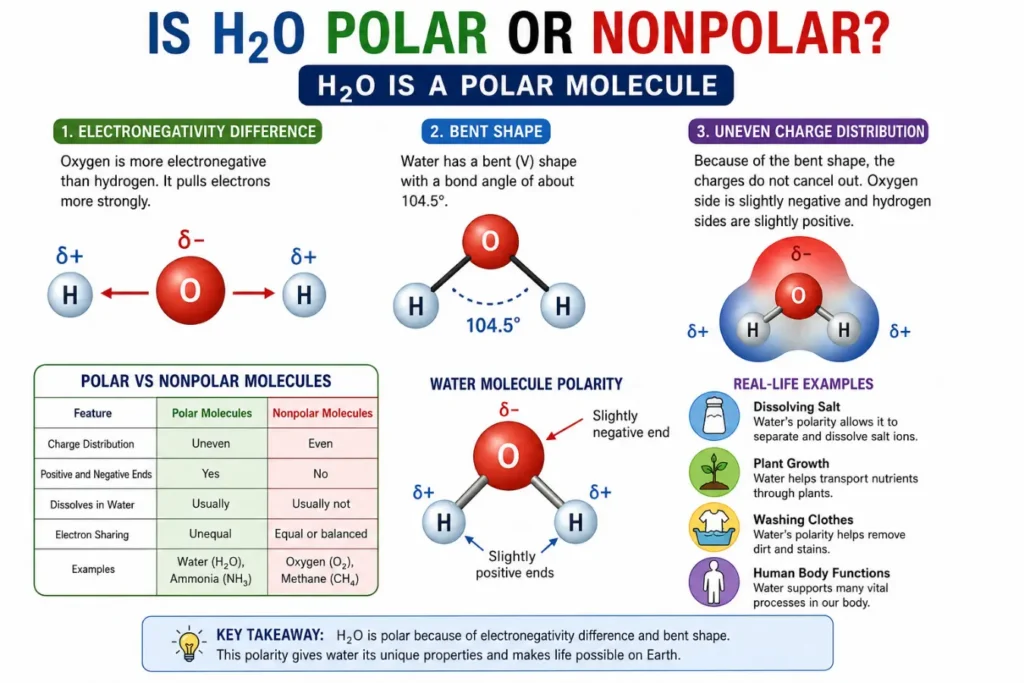
Is H2O polar or nonpolar? The short answer is that H2O is a polar molecule. Water has a unique structure that creates an uneven distribution of electrical charge. This makes one side of the molecule slightly positive and the other side slightly negative.
Water’s polarity explains many of its important properties. It helps water dissolve salt, support life, and move nutrients through living organisms. Scientists study water polarity because it affects chemistry, biology, and everyday life.
Many students confuse bond polarity with molecular polarity. However, understanding the shape of the water molecule makes the answer simple.
In this guide, you will learn why H2O is polar, how it compares with nonpolar molecules, and why polarity matters in the real world.
Quick Summary Box
Featured Snippet Answer
- H2O (water) is a polar molecule.
- Oxygen attracts electrons more strongly than hydrogen.
- This creates partial positive and partial negative charges.
- Water has a bent shape, not a straight shape.
- The uneven charge distribution makes H2O polar.
- Water can dissolve many ionic and polar substances.
- Polarity gives water many unique properties.
What Is H2O?
H2O is the chemical formula for water.
It contains:
- Two hydrogen atoms
- One oxygen atom
Water is one of the most important substances on Earth. Every living thing depends on it.
Because oxygen and hydrogen interact differently, water behaves in special ways.
What Does Polar Mean?
A polar molecule has an uneven distribution of electrical charge.
One part of the molecule carries a slight positive charge. Another part carries a slight negative charge.
This happens when atoms share electrons unequally.
Key points:
- Polar molecules have positive and negative ends.
- They can attract other charged particles.
- They often dissolve in water.
Water is one of the best-known examples of a polar molecule.
Is H2O Polar or Nonpolar?
The Direct Answer
H2O is polar.
Water becomes polar because of two main reasons:
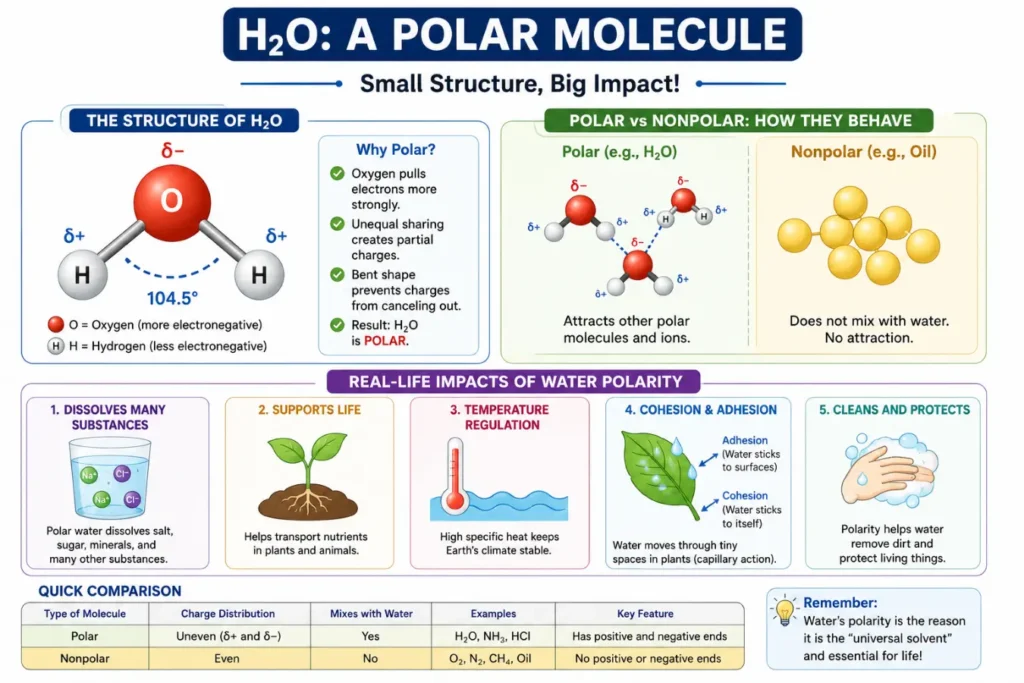
- Oxygen is more electronegative than hydrogen.
- The molecule has a bent shape.
Together, these factors create an uneven charge distribution.
As a result, water has a positive side and a negative side.
Why Is H2O a Polar Molecule?
Electronegativity Difference
Electronegativity measures how strongly an atom attracts electrons.
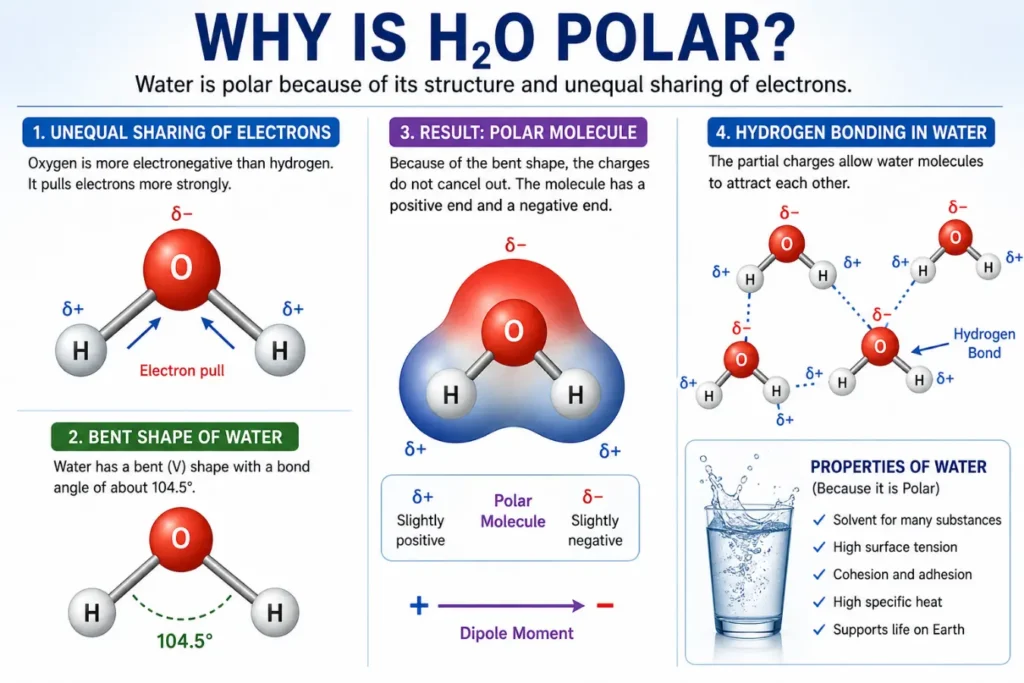
Oxygen attracts shared electrons more strongly than hydrogen.
This causes:
- Oxygen to become slightly negative (δ−)
- Hydrogen atoms to become slightly positive (δ+)
The unequal sharing creates polar bonds.
How Does the Shape of Water Affect Polarity?
Shape plays a major role.
Water does not form a straight line. Instead, it has a bent or V-shaped structure.
The bond angle is about 104.5 degrees.
Because of this bent shape:
- The bond dipoles do not cancel out.
- The charges remain unevenly distributed.
Therefore, the entire molecule becomes polar.
If water were perfectly linear, it might not be polar.
Understanding Water Polarity in Simple Words
Imagine a tug-of-war.
Oxygen pulls harder than hydrogen.
The electrons spend more time near oxygen.
As a result:
- Oxygen side becomes more negative.
- Hydrogen side becomes more positive.
This imbalance creates polarity.
That is why water acts like a tiny magnet.
Polar vs Nonpolar Molecules
Comparison Table
| Feature | Polar Molecules | Nonpolar Molecules |
| Charge Distribution | Uneven | Even |
| Positive and Negative Ends | Yes | No |
| Dissolves in Water | Usually | Usually not |
| Electron Sharing | Unequal | Equal or balanced |
| Examples | Water, Ammonia | Oxygen Gas, Methane |
Water clearly belongs to the polar category.
Real-Life Examples of Water Polarity
Water polarity affects daily life.
1. Dissolving Salt
Salt dissolves easily in water.
The charged parts of water attract sodium and chloride ions.
2. Washing Clothes
Water helps remove dirt and stains.
Its polarity interacts with many substances.
3. Plant Growth
Plants absorb water and nutrients through roots.
Polarity helps transport these nutrients.
4. Human Body Functions
Blood contains mostly water.
Water polarity helps move minerals and nutrients throughout the body.
Why Does Water Dissolve So Many Substances?
Scientists often say:
“Like dissolves like.”
This means:
- Polar substances dissolve in polar solvents.
- Nonpolar substances dissolve in nonpolar solvents.
Since water is polar, it dissolves:
- Salt
- Sugar
- Alcohol
- Many minerals
However, water does not dissolve oil very well.
Oil is nonpolar.
Common Mistakes About H2O Polarity
Students often make these mistakes.
Mistake 1: Looking Only at Atoms
Some people think water is nonpolar because it contains hydrogen.
The molecular shape must also be considered.
Mistake 2: Ignoring Electronegativity
The difference in electron attraction creates polarity.
Without considering electronegativity, the answer becomes inaccurate.
Mistake 3: Confusing Bond Polarity and Molecular Polarity
A molecule can contain polar bonds.
However, the overall molecule may still be nonpolar if the charges cancel out.
Water’s charges do not cancel.
Tips to Identify Whether a Molecule Is Polar
Use these simple steps.
Step 1: Check Electronegativity
Ask:
Do the atoms attract electrons differently?
If yes, the bond may be polar.
Step 2: Examine Molecular Shape
Look at the molecule’s geometry.
Step 3: Check Charge Cancellation
If the dipoles cancel, the molecule is nonpolar.
If they do not cancel, the molecule is polar.
This method works for most molecules.
Properties of Water Caused by Polarity
Water’s polarity creates several unique properties.
High Surface Tension
Water molecules attract each other strongly.
This allows some insects to walk on water.
Cohesion
Water molecules stick together.
Adhesion
Water sticks to other surfaces.
High Boiling Point
Water remains liquid over a wide temperature range.
Excellent Solvent
Water dissolves many substances needed for life.
Synonyms
When studying water polarity, you may see these related terms:
- Polar molecule
- Molecular polarity
- Water polarity
- Dipole moment
- Polar covalent bond
- Electronegativity
- Bent molecular shape
- Charge distribution
- Hydrogen bonding
- Solvent properties of water
These terms often appear in chemistry textbooks and exams.
Expert Insight: Why Water Polarity Matters
Water polarity is one of the most important concepts in chemistry.
Without polarity:
- Cells could not function properly.
- Nutrients would not move efficiently.
- Many chemical reactions would stop.
- Life as we know it would not exist.
Scientists use water polarity to understand biological systems, environmental processes, and industrial applications.
Understanding this concept builds a strong foundation for chemistry and science education.
Frequently Asked Questions (FAQs)
Is H2O polar or nonpolar?
H2O is polar because oxygen attracts electrons more strongly than hydrogen.
Why is water considered a polar molecule?
Water has polar bonds and a bent shape. The charges do not cancel out.
Is oxygen more electronegative than hydrogen?
Yes. Oxygen attracts shared electrons much more strongly.
Can polar molecules dissolve in water?
Most polar substances dissolve easily in water.
Why does oil not mix with water?
Oil is nonpolar, while water is polar.
Does water have positive and negative ends?
Yes. Oxygen forms the negative end, and hydrogen forms the positive end.
What shape does the water molecule have?
Water has a bent or V-shaped structure.
Is water more polar than carbon dioxide?
Yes. Carbon dioxide is nonpolar overall because its dipoles cancel out.
Conclusion
So, is H2O polar or nonpolar? The answer is simple: H2O is polar. Oxygen attracts electrons more strongly than hydrogen, creating an uneven charge distribution. In addition, water’s bent molecular shape prevents the charges from canceling out. These factors make water a polar molecule.
Water polarity explains many everyday phenomena. It helps dissolve substances, transport nutrients, and support life on Earth. Understanding this concept also makes learning chemistry much easier.
Remember this simple rule: water has positive and negative ends, so it is polar. Once you understand electronegativity and molecular shape, identifying polar molecules becomes much easier.