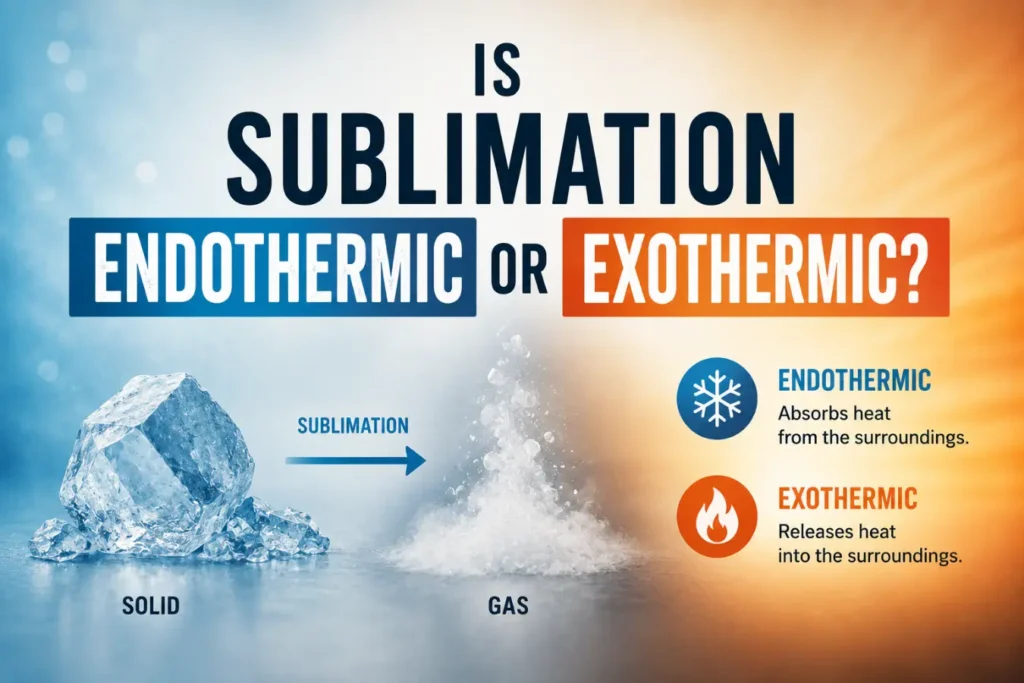
Is sublimation endothermic or exothermic is a common science question in chemistry. This topic often confuses students because it involves a phase change. However, it can be clearly understood with simple science rules.
In this process, a solid changes directly into gas without becoming liquid. This change needs energy. That is why students often get confused.
In this guide, you will learn the correct answer in very simple words. You will also see examples, diagrams in explanation form, and real-life uses. We will break everything into small parts. This will help you understand easily, even if science is difficult for you.
Quick Summary Box (Featured Snippet)
- Sublimation is a phase change process
- Solid changes directly into gas
- It always absorbs heat energy
- So, sublimation is endothermic
- Energy is needed to break solid bonds
- Example: dry ice turning into gas
- Example: naphthalene balls disappearing
- It is opposite of deposition
What is Sublimation? (Simple Definition)
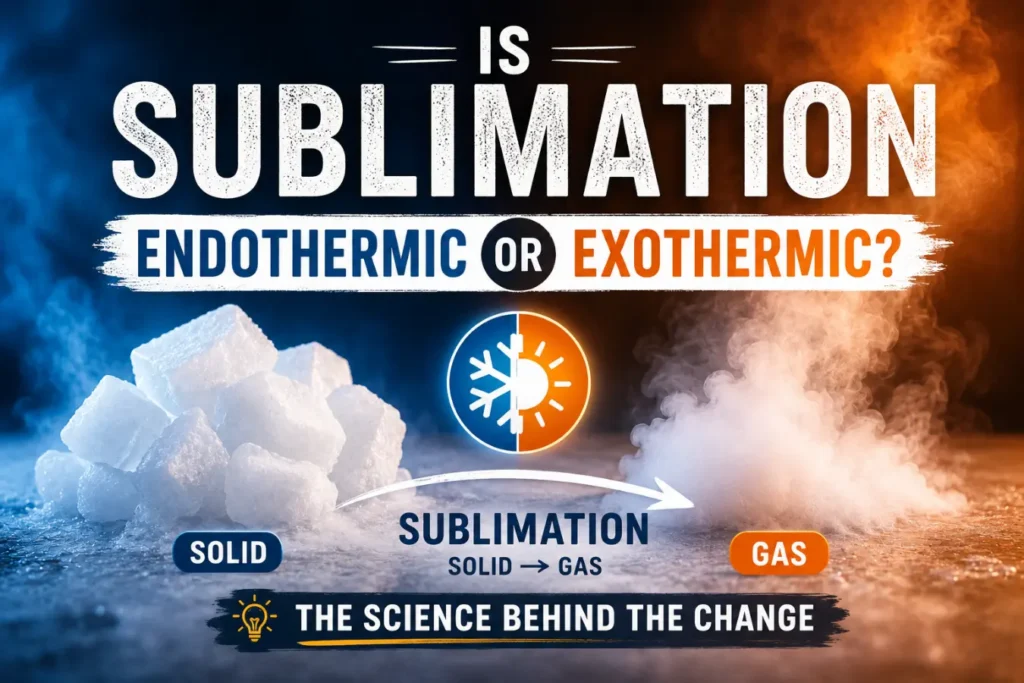
Sublimation is a process where a solid turns directly into gas. It does not pass through the liquid stage.
This happens when particles gain enough energy to break free.
Simple meaning:
Solid → Gas (direct change)
Example:
- Dry ice (solid CO₂) turns into gas
- Iodine crystals form purple vapor
This process is important in chemistry and physical science.
Is Sublimation Endothermic or Exothermic?
The correct answer is:
👉 Sublimation is endothermic
Why?
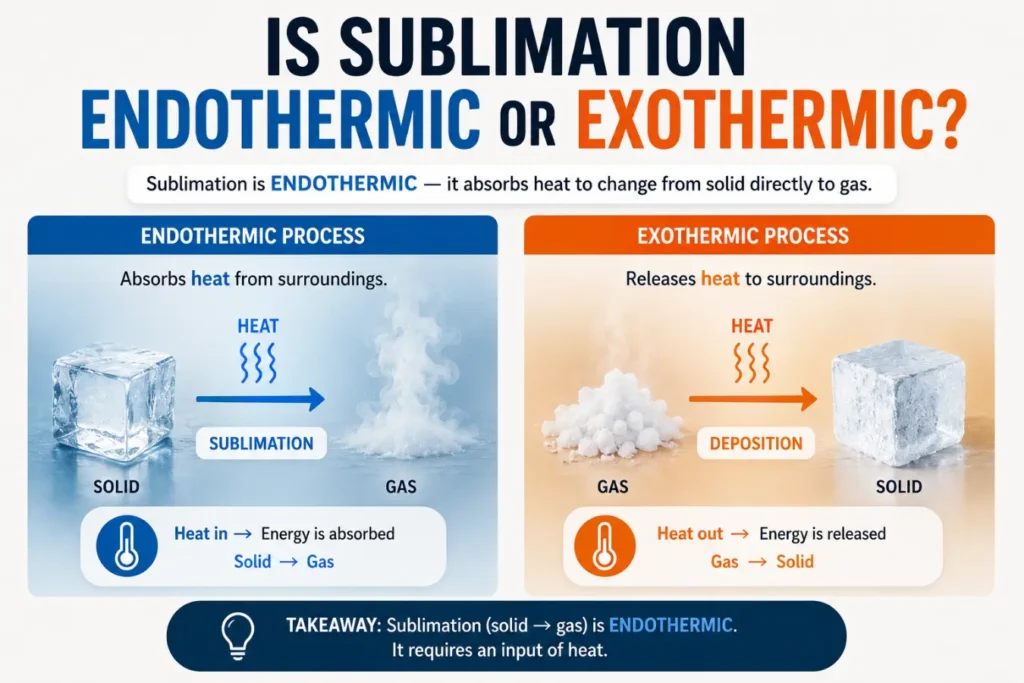
Because the substance absorbs heat energy from surroundings.
When heat is added:
- Solid particles gain energy
- They break bonds
- They escape into gas form
So, energy goes into the system. That is why it is endothermic.
Key idea:
- Endothermic = absorbs heat
- Sublimation = needs heat
- Therefore, sublimation = endothermic
Why Sublimation is Endothermic (Easy Explanation)
To understand better, think of particles in a solid.
In solids:
- Particles are tightly packed
- They vibrate in fixed positions
During sublimation:
- Heat energy increases vibration
- Particles break free
- They become gas
This requires energy input.
So, the system takes energy from surroundings.
That is why is sublimation endothermic or exothermic has a clear answer: endothermic.
Real-Life Examples of Sublimation
1. Dry Ice (CO₂)
- Solid dry ice turns into gas
- No liquid is formed
- Used in fog effects
2. Naphthalene Balls
- Used in wardrobes
- Slowly disappear into gas
- Leaves smell behind
3. Camphor
- Burns slowly without liquid stage
- Used in religious rituals
4. Iodine Crystals
- Solid iodine turns purple vapor
- Seen in chemistry labs
These examples show sublimation clearly in daily life.
Sublimation vs Other Phase Changes (Comparison Table)
| Process | Type of Energy | Change | Example |
| Sublimation | Endothermic | Solid → Gas | Dry ice |
| Melting | Endothermic | Solid → Liquid | Ice |
| Boiling | Endothermic | Liquid → Gas | Water |
| Freezing | Exothermic | Liquid → Solid | Water |
| Deposition | Exothermic | Gas → Solid | Frost |
Key point:
All processes that need heat are endothermic.
Common Mistakes Students Make
Mistake 1: Thinking sublimation is exothermic
Many students think gas release means energy release. This is wrong.
Mistake 2: Confusing with evaporation
Evaporation needs liquid stage. Sublimation does not.
Mistake 3: Mixing deposition and sublimation
They are opposite processes.
Mistake 4: Forgetting energy direction
Sublimation always absorbs energy.
Tips to Remember Easily
Trick 1: “SUB = UP”
Solid goes UP to gas.
Trick 2: Think heat is needed
No heat = no sublimation.
Trick 3: Break bonds idea
Breaking needs energy → endothermic
Trick 4: Dry ice clue
Dry ice always needs heat to disappear.
Usage in Daily Life
Sublimation is not just theory. It is used in real life.
1. Cooling systems
Dry ice is used for cooling transport.
2. Air fresheners
Naphthalene sublimates slowly.
3. Laboratory experiments
Used to separate compounds.
4. Food industry
Freeze drying uses sublimation process.
Synonyms and Related Terms
In science, related terms include:
- Phase change
- Solid to gas transition
- Heat absorption process
- Physical change
- Vaporization without liquid stage
Related concepts:
- Endothermic process
- Latent heat of sublimation
- Deposition (reverse process)
- Thermodynamics
Expert Insight (EEAT Section)
In thermodynamics, sublimation is classified as a high-energy endothermic process. It requires enough energy to overcome strong intermolecular forces.
Experts in chemistry explain that sublimation only happens when vapor pressure becomes high enough at a given temperature.
This topic is important because it helps students understand:
- Energy transfer
- Phase changes
- Real-world chemical behavior
Understanding is sublimation endothermic or exothermic also builds strong chemistry fundamentals for exams and competitive tests.
Why This Topic Matters
This concept is important because:
- It appears in exams
- It builds chemistry basics
- It helps understand energy flow
- It explains real-life processes
- It is used in industries
Many students lose marks due to confusion in phase changes. Learning this clearly improves results.
FAQs (People Also Ask)
1. Is sublimation endothermic or exothermic?
Sublimation is endothermic because it absorbs heat.
2. Why is sublimation endothermic?
Because energy is needed to break solid bonds.
3. What is an example of sublimation?
Dry ice turning into gas is a common example.
4. Is sublimation opposite of deposition?
Yes, deposition is the reverse process.
5. Does sublimation release energy?
No, it absorbs energy from surroundings.
6. Is ice sublimation possible?
Yes, under low pressure and cold conditions.
7. What state changes occur in sublimation?
Solid directly changes into gas.
8. Is camphor sublimation or evaporation?
Camphor undergoes sublimation.
Conclusion
Understanding is sublimation endothermic or exothermic is simple when you learn the basics of energy transfer. Sublimation is always an endothermic process because it needs heat to change solid directly into gas.
This process plays an important role in science, daily life, and industry. Moreover It helps explain how substances change state without melting.
Always remember one simple rule:
👉 If heat is absorbed, it is endothermic.
So, sublimation clearly falls into the endothermic category. Once you understand this idea, phase changes become very easy to learn and remember.