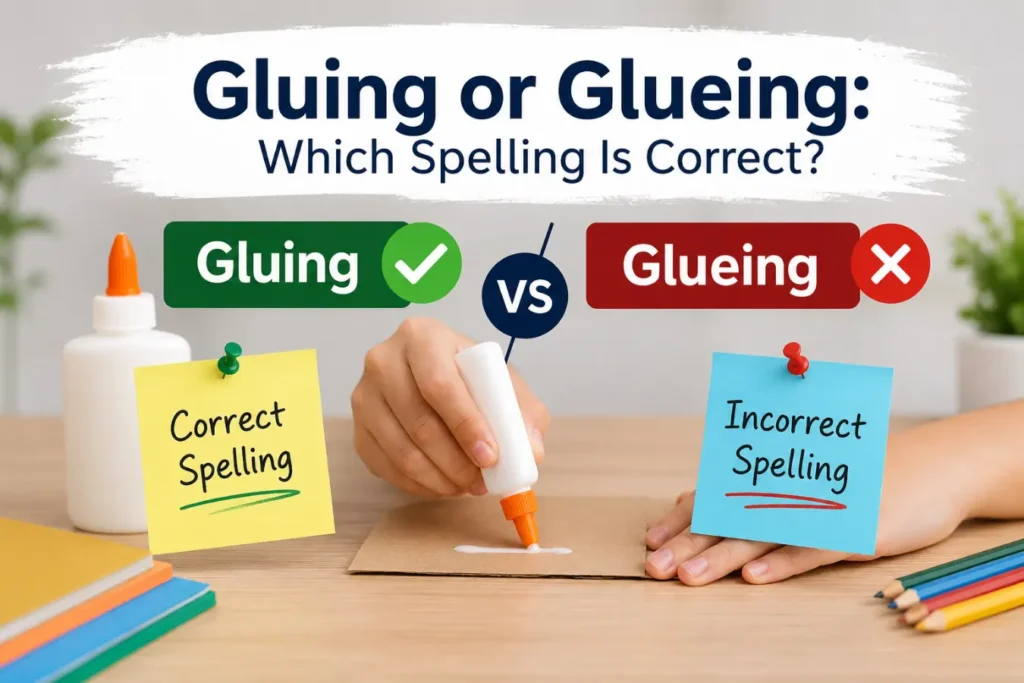
Gluing or glueing is a common spelling question that confuses many English writers. Both forms appear online, but only one is widely accepted in modern English.
English spelling often creates uncertainty. Some words drop letters before adding a suffix. Others keep them. Because of this, many people wonder whether they should write gluing or glueing.
The good news is that the rule is simple. Once you understand it, you can avoid mistakes in school, work, and everyday writing.
In this guide, you’ll learn the correct spelling, why it works, common mistakes to avoid, and examples you can use right away. Whether you’re a student, writer, teacher, or English learner, this article will help you use the word correctly every time.
Quick Summary Box
- Correct spelling: Gluing
- Less common spelling: Glueing
- Modern standard English uses: Gluing
- Meaning: Joining materials together using glue
- Used in: School projects, crafts, woodworking, repairs, and construction
- Recommended for writing: Gluing
- Accepted by major dictionaries: Gluing
What Does Gluing Mean?
Gluing means joining two or more objects together with glue.
However, the word comes from the verb glue, which means to stick things together using an adhesive.
Examples
- I am gluing the broken vase.
- She is gluing paper onto cardboard.
- They spent the afternoon gluing decorations together.
In each example, glue acts as the material that creates a bond.
Gluing or Glueing: Which Spelling Is Correct?
The correct and preferred spelling is gluing.
Most dictionaries, style guides, and grammar experts recommend using gluing.
Correct
✅ Gluing
Less Preferred
⚠️ Glueing
While glueing occasionally appears in older texts or informal writing, it is not the standard spelling in modern English.
Why Is “Gluing” the Preferred Spelling?
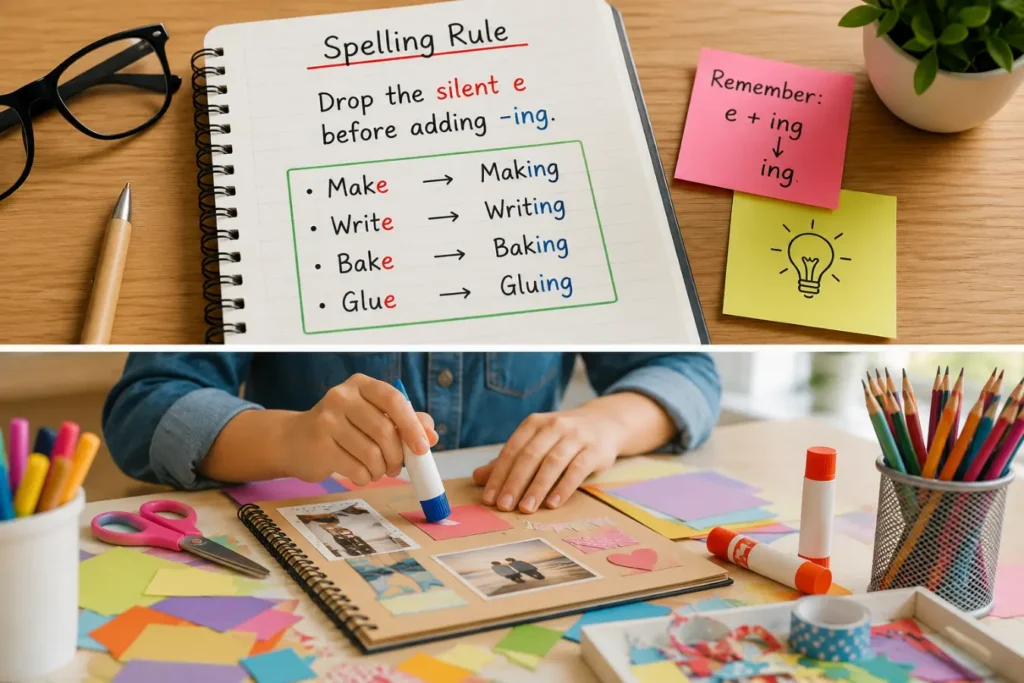
English verbs that end in -e often drop the final e before adding -ing.
Examples
| Base Verb | + ing Form |
| Make | Making |
| Write | Writing |
| Bake | Baking |
| Move | Moving |
| Glue | Gluing |
The same spelling rule applies to glue.
Therefore:
- Glue + ing = Gluing
This follows a common English grammar pattern.
Why Do Some People Write “Glueing”?
People often write glueing because they want to preserve the original word glue.
Since removing the final e may look unusual, writers sometimes assume the letter should remain.
However, standard English spelling rules remove the final e before adding -ing.
That is why gluing remains the preferred form.
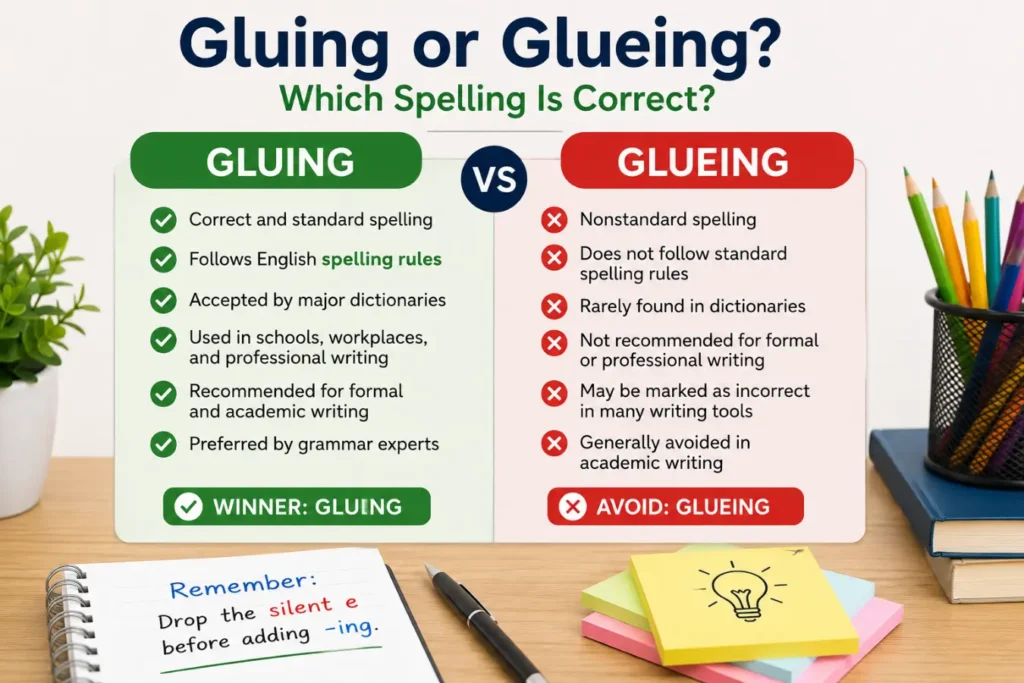
Gluing vs Glueing Comparison Table
| Feature | Gluing | Glueing |
| Modern standard spelling | ✅ Yes | ❌ No |
| Found in major dictionaries | ✅ Yes | Rare |
| Recommended for formal writing | ✅ Yes | ❌ No |
| Common in schools and workplaces | ✅ Yes | ❌ No |
| Grammar-guide approved | ✅ Yes | Usually not |
| SEO and professional content | ✅ Yes | ❌ Avoid |
Winner: Gluing
Examples of Gluing in Sentences
Seeing the word in context makes learning easier.
Everyday Examples
- The children are gluing pictures into their notebooks.
- He spent the weekend gluing model airplanes together.
- We are gluing the labels onto the boxes.
- She enjoys gluing craft materials for school projects.
- The carpenter is gluing wooden panels together.
Workplace Examples
- The technician is gluing the components into place.
- Workers are gluing protective layers onto the surface.
- The packaging team is gluing the cartons shut.
Common Mistakes People Make
Many writers make similar spelling errors.
Mistake #1: Using Glueing in Formal Writing
❌ The students are glueing their projects.
✅ The students are gluing their projects.
Mistake #2: Assuming All Verbs Keep the Final E
Many English verbs drop the final e.
Examples:
- Make → Making
- Move → Moving
- Bake → Baking
- Glue → Gluing
Mistake #3: Trusting Autocorrect Too Much
Some software may not immediately flag glueing.
Always check a reliable dictionary when unsure.
Easy Trick to Remember the Correct Spelling
Use this simple rule:
If a verb ends with a silent “e,” remove the “e” before adding “-ing.”
Examples:
- Drive → Driving
- Write → Writing
- Bake → Baking
- Glue → Gluing
Remembering this pattern makes spelling much easier.
How Gluing Is Used in Daily Life
The word gluing appears in many activities.
Arts and Crafts
Children often spend time gluing paper, beads, and decorations.
Home Repairs
People use gluing techniques to fix broken items.
Woodworking
Carpenters rely on gluing for strong wood joints.
Construction
Builders use industrial adhesives for large projects.
Manufacturing
Factories use automated gluing systems for packaging and assembly.
Because of these uses, the word appears frequently in everyday communication.
Related Words and Forms
Understanding related forms improves vocabulary.
| Word | Meaning |
| Glue | Adhesive substance |
| Glued | Already attached |
| Gluing | Attaching with glue |
| Glues | Third-person singular form |
| Glue stick | Solid adhesive tool |
| Super glue | Fast-acting adhesive |
Synonyms
These words may appear in similar contexts:
Synonyms
- Sticking
- Bonding
- Attaching
- Joining
- Fastening
- Securing
- Connecting
These related terms help search engines understand the topic.
Expert Insight: Why Correct Spelling Matters
Correct spelling improves communication.
When you use standard English, readers understand your message faster. Proper spelling also builds credibility.
Correct spelling helps students earn better grades. It also creates a polished impression in professional settings. In addition, bloggers and website owners can build more trust by using standard English.
Search engines also favor high-quality, well-written content. Using accepted spellings improves readability and user experience.
That is why most experts recommend using gluing consistently.
Frequently Asked Questions
Is gluing or glueing correct?
Gluing is the correct and preferred spelling in modern English.
Why is it gluing and not glueing?
English usually drops a silent e before adding -ing.
Is glueing wrong?
It is generally considered nonstandard and is rarely recommended.
What does gluing mean?
It means joining objects together using glue.
Do dictionaries recognize gluing?
Yes. Major dictionaries list gluing as the standard spelling.
Is gluing used in British English?
Yes. British English also commonly uses gluing.
How do you spell glue in the present participle form?
The correct form is gluing.
Can I use glueing in academic writing?
No. Use gluing for formal and academic writing.
Featured Snippet Answer
Gluing or Glueing: Which Is Correct?
Gluing is the correct spelling in modern English. It comes from the verb glue and follows the rule of dropping the final silent e before adding -ing. While glueing may appear occasionally, gluing is the accepted form in dictionaries, schools, workplaces, and professional writing.
Conclusion
The debate over gluing or glueing has a simple answer. Gluing is the correct spelling and the form recommended by dictionaries, grammar guides, and professional writers. It follows the standard English rule that removes a silent e before adding -ing.
Although you may occasionally see glueing, it is not the preferred spelling in modern English. Using gluing helps your writing look clear, accurate, and professional.
Whenever you describe attaching objects with glue, choose gluing with confidence. Following this simple spelling rule will help you avoid mistakes and improve your English writing skills.