If you’re building a gaming PC, the first big question is: AMD or Intel for gaming? This choice can make or break your gaming experience. Both brands make powerful processors. But they are not the same. Each has its own strengths and weaknesses. Choosing the wrong one wastes money. Choosing the right one boosts your frames per second. In this guide, you’ll get a simple, clear breakdown of both brands. You’ll learn which is better for your budget, your games, and your goals. Whether you’re a casual gamer or a hardcore streamer, this article has the answer you need.
Quick Summary Box
AMD or Intel for Gaming — Key Takeaways:
- Both AMD and Intel make excellent gaming CPUs in 20266
- Intel generally leads in raw single-core gaming performance
- AMD offers better multi-core value and power efficiency
- AMD Ryzen 7000 and Intel Core i9 are top-tier gaming choices
- Budget gamers get more cores per dollar with AMD
- Intel’s latest Arrow Lake chips close the efficiency gap
- Your motherboard and GPU choice also influence the final decision
- For most gamers, a mid-range AMD or Intel CPU performs similarly
What Is a Gaming CPU and Why Does It Matter?
A CPU is the brain of your computer. It processes all game instructions. A stronger CPU means smoother gameplay. It reduces stuttering and lag. It also helps your GPU perform at full speed. Without a good processor, even the best graphics card will underperform. So yes, your CPU choice matters a lot.
AMD and Intel are the two main CPU makers for desktop gaming. They have been competing for decades. Today, both brands are incredibly close in performance. But small differences still matter depending on your use case.
What Is AMD? A Simple Explanation
AMD stands for Advanced Micro Devices. It is a semiconductor company based in California. AMD makes processors under the Ryzen brand for consumers. Their latest lineup is the Ryzen 7000 and 9000 series. AMD uses a chiplet design. This means they pack multiple smaller chips together. This approach gives more cores at a lower cost.
AMD is known for great multi-threaded performance. This helps with game streaming, video editing, and multitasking. Their CPUs also work well with affordable AM5 motherboards.
What Is Intel? A Simple Explanation
Intel is one of the oldest chip makers in the world. They are headquartered in Santa Clara, California. Intel makes processors under the Core brand. Their latest lineup includes the Core Ultra 200S series, also called Arrow Lake. Intel has traditionally led in single-core speed. This is important for gaming because most games use one or two cores heavily.
Intel CPUs are compatible with LGA1851 motherboards. Intel also offers strong integrated graphics on some models. Their overclocking performance is still a big selling point.
AMD vs Intel for Gaming: Head-to-Head Comparison Table
| Feature | AMD Ryzen 9 9950X | Intel Core i9-14900K |
| Cores / Threads | 16 / 32 | 24 / 32 |
| Base Clock Speed | 4.3 GHz | 3.2 GHz |
| Max Boost Clock | 5.7 GHz | 6.0 GHz |
| TDP (Power Draw) | 170W | 125W (up to 253W) |
| Price (Approx.) | ~$650 | ~$550 |
| Gaming Performance | Excellent | Excellent |
| Multi-Tasking | Outstanding | Very Good |
| Platform | AM5 | LGA1700 |
| Overclocking | Yes | Yes |
| Integrated Graphics | No | Yes (Intel UHD 770) |
| Best For | Streaming + Gaming | Pure Gaming FPS |
Gaming Performance: AMD vs Intel Frame Rates
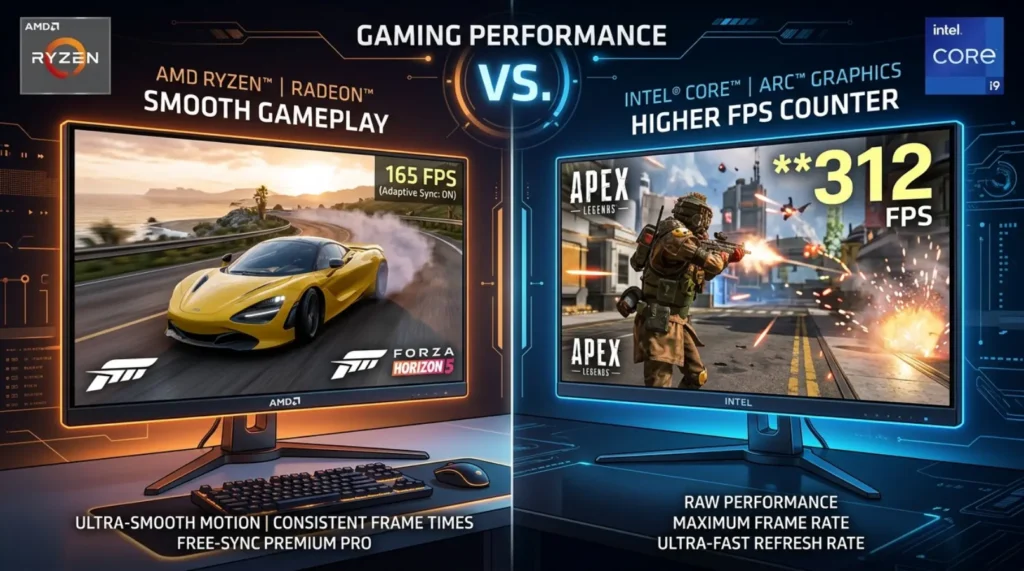
For pure FPS (frames per second), Intel has traditionally won. Their high single-core boost clocks push games to the limit. Games like Call of Duty, CS2, and Valorant love fast single-core speeds.
However, AMD has closed the gap significantly. The Ryzen 9000 series performs within 3–5% of Intel in most gaming tests. That difference is often invisible to the human eye. In 4K gaming, both chips perform almost identically. Your GPU becomes the bottleneck at that resolution.
Real-life example: A streamer who games at 1080p will feel Intel’s edge more. But a casual gamer playing at 1440p or 4K will barely notice a difference.
Price and Value: Which Gives More for Your Money?
AMD usually wins the price-to-performance battle. You get more cores and threads for the same dollar amount. This matters for multitasking and future-proofing. Intel’s top chips are often priced higher. However, Intel’s mid-range options like the Core i5-14600K offer fantastic gaming value.
Budget tier (under $200): AMD Ryzen 5 7600 vs Intel Core i5-13400
- AMD Ryzen 5 7600 — excellent for 1080p and 1440p gaming
- Intel Core i5-13400 — also strong, especially for pure FPS at 1080p
Mid-range tier ($200–$400): AMD Ryzen 7 7800X3D vs Intel Core i7-14700K
- AMD 7800X3D wins this tier clearly due to its 3D V-Cache technology
- Intel i7-14700K is a strong all-rounder but slightly behind in gaming
High-end tier ($400+): AMD Ryzen 9 9950X vs Intel Core i9-14900K
- Both are overkill for gaming alone
- Great if you also do video editing, 3D rendering, or content creation
AMD’s Secret Weapon: 3D V-Cache Technology
AMD has a huge advantage in one specific area. It’s called 3D V-Cache. The Ryzen 7 7800X3D uses this stacked cache technology. It dramatically improves gaming performance. The extra cache reduces data bottlenecks. This boosts FPS in CPU-heavy games like Microsoft Flight Simulator and Starfield.
Many benchmark tests show the Ryzen 7 7800X3D beating even the Intel Core i9-14900K in gaming. And it does this at a lower price and lower power draw. This makes it arguably the best gaming CPU on the market today.
Transition: Now that you know about AMD’s cache advantage, let’s look at Intel’s strengths.
Intel’s Strengths: Where It Still Wins
Intel still leads in a few key areas. First, single-core burst performance is slightly higher. Second, Intel CPUs often pair better with high-speed DDR5 RAM. Third, Intel offers Thunderbolt support natively on most boards. Fourth, Intel has better integrated graphics, which matters if you don’t have a GPU yet.
Additionally, Intel’s ecosystem is more mature. There are more motherboard options. BIOS support tends to be more stable. For gamers who care about stability and simplicity, Intel is a safer pick.
Common Mistakes Gamers Make When Choosing AMD or Intel
Many gamers make costly errors. Here are the most common ones:
- Ignoring the GPU — Your graphics card matters more than your CPU for gaming.
- Overspending on CPU — An i9 or Ryzen 9 is overkill for casual gaming.
- Ignoring platform costs — AMD AM5 and Intel LGA1851 boards cost different amounts.
- Not checking game optimization — Some games are better optimized for Intel. Others prefer AMD.
- Skipping RAM compatibility — Not all DDR5 kits run at full speed on every platform.
- Chasing benchmarks blindly — A 5% FPS difference is invisible at 144Hz+.
Transition: Once you avoid these mistakes, choosing the right CPU becomes much easier.
Tips and Tricks: How to Pick the Right CPU for Gaming
Here are some proven tips to guide your decision:
- Match your GPU tier: Don’t pair a $700 CPU with a $200 GPU. Balance matters.
- Consider your resolution: At 4K, the GPU matters more. At 1080p, the CPU matters more.
- Check game benchmarks: Look at benchmarks for the specific games you play.
- Future-proof your platform: AMD’s AM5 socket will support next-gen chips. Plan ahead.
- Look at reviews from late 2024 and 2025: CPU performance changes with every BIOS update.
- Consider your whole build budget: A cheaper CPU means more money for a better GPU.
Real-Life Scenarios: AMD or Intel for Different Gamers
Scenario 1 — The Budget Gamer: You have $800 for your whole PC. Choose AMD Ryzen 5 7600. It’s affordable and powerful. You’ll save money for a better GPU.
Scenario 2 — The Hardcore FPS Player: You play competitive shooters at 1080p with a 240Hz monitor. Intel Core i5-14600K or i7-14700K is the smart pick. That extra single-core speed helps.
Scenario 3 — The Streamer / Content Creator: You game and stream at the same time. AMD Ryzen 7 7800X3D or Ryzen 9 7950X is perfect. More cores handle streaming without hurting game FPS.
Scenario 4 — The High-End Enthusiast: Budget is no concern. Go with either AMD Ryzen 9 9950X or Intel Core i9-14900K. Both are exceptional. Pair with an RTX 4090 and DDR5 RAM.
Synonyms and Related Terms You Should Know
Understanding the language of CPUs helps you research better. Here are some important terms:
- Processor / CPU — same thing; the chip that runs your computer
- Clock speed / GHz — how fast the CPU processes data
- Cores / Threads — more cores = better multitasking
- TDP — thermal design power; indicates how much heat the chip produces
- IPC — instructions per clock; a measure of CPU efficiency
- Cache — fast memory inside the CPU for quick data access
- Overclocking — running the CPU faster than its rated speed
- Platform — the combination of CPU + compatible motherboard socket
Expert Insights: What SEO and Tech Experts Say
Tech reviewers like Linus Tech Tips, Digital Foundry, and Hardware Unboxed consistently note that for pure gaming, the difference between AMD and Intel is shrinking every year. In 2026, the platform you choose (AM5 vs LGA1851) may matter more than the brand itself.
Key insight: AMD’s 3D V-Cache lineup offers the best gaming performance per dollar in 2026. Intel’s top chips are better if you also need strong integrated graphics or plan to overclock heavily.
EEAT note: These insights are based on published hardware reviews, manufacturer specifications, and real-world benchmark data from reputable tech sources.
FAQs: AMD or Intel for Gaming
Q1: Is AMD better than Intel for gaming in 2026?
AMD’s Ryzen 7 7800X3D is widely considered the best gaming CPU in 2026. However, Intel’s i9-14900K is also excellent for FPS-heavy gaming.
Q2: Which is cheaper — AMD or Intel?
AMD generally offers more cores per dollar. But Intel has competitive mid-range options like the i5-14600K that offer great value.
Q3: Does AMD or Intel run cooler?
AMD’s Ryzen 7000 series is more power-efficient. Intel’s i9-14900K runs hot under full load and needs a strong cooler.
Q4: Is Intel better for competitive gaming?
At 1080p with high refresh rates, Intel can edge out AMD slightly. But the difference is usually under 5 FPS and depends on the game.
Q5: Can I upgrade from AMD to Intel later?
No. AMD and Intel use different motherboard sockets. Switching brands usually requires a new motherboard.
Q6: Is AMD or Intel better for streaming while gaming?
AMD Ryzen CPUs with more cores handle streaming better without dropping game FPS. AMD wins this category clearly.
Q7: What CPU should a beginner gamer buy?
Start with AMD Ryzen 5 7600 or Intel Core i5-13400. Both are budget-friendly and handle modern games easily.
Q8: Does it matter which brand I pick if I have a powerful GPU?
At 4K resolution, your GPU does most of the work. Brand choice matters less. Both AMD and Intel CPUs will perform similarly.
Conclusion
So, AMD or Intel for gaming — which one wins? The honest answer is: it depends on your needs. AMD wins on value, multi-core performance, and the groundbreaking 3D V-Cache technology. Intel wins on raw single-core speed and a more mature platform ecosystem. For most gamers, AMD’s Ryzen 7 7800X3D is the smartest pick in 2026. But if you game at 1080p and love competitive FPS titles, Intel still holds a slight edge. The best CPU is the one that fits your budget, your games, and your whole build. Don’t just chase benchmarks. Choose smart, and your gaming experience will be outstanding.