
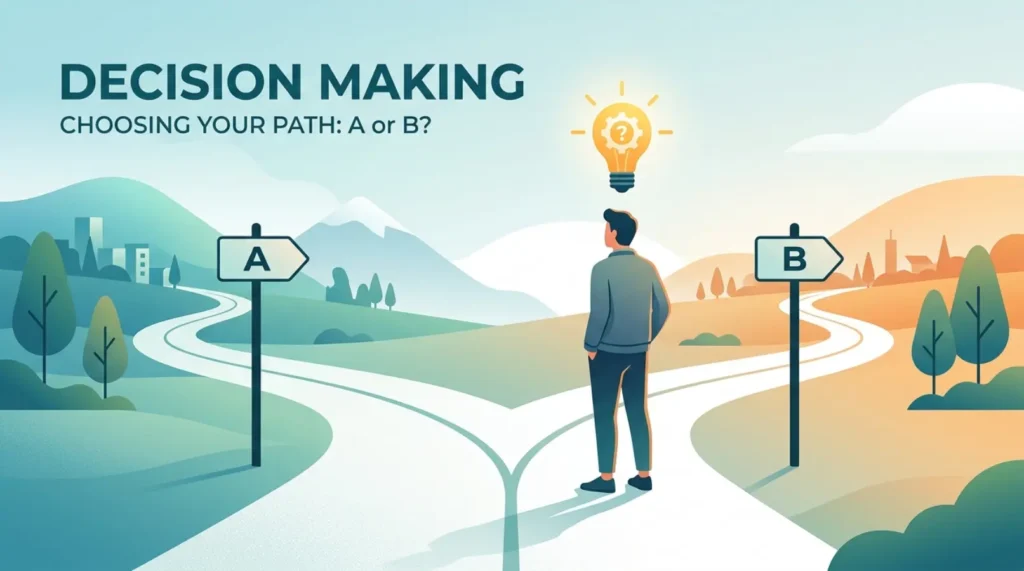
Choosing between A or B is one of the most common decisions people face every day. From small daily choices to big life decisions, picking the right option matters. Many people feel stuck when two choices look equally good. But with the right approach, you can decide clearly and confidently. In this guide, we break down everything you need to know. You will learn the difference, see real examples, and get expert tips. By the end, making a decision between A or B will feel simple and stress-free.
Quick Summary Box — Featured Snippet Target
What does “A or B” mean?
- “A or B” refers to a choice between two available options.
- Option A and Option B are the two sides of a decision.
- You must compare both options before choosing.
- The right choice depends on your goal, situation, and priorities.
- Understanding both options fully leads to better decisions.
- Not every choice has a single correct answer.
What Does “A or B” Mean?
“A or B” simply means you have two choices in front of you. You need to pick one. It is a binary decision — meaning only two paths exist.
Think of it like a fork in the road. You go left or right. There is no in-between. The phrase “A or B” is used in everyday life, logic, grammar, coding, and even philosophy.
In grammar, “or” connects two alternatives. In logic, “A or B” is called a disjunction. This means at least one option must be true or chosen.
A or B Explained in Simple Words
Let us make this even simpler. Imagine you are at a restaurant. The waiter asks: “Tea or coffee?” That is a classic A or B situation.
You cannot have both at the same time. Furthermore, you must think about what you want. Do you need energy? Coffee is better. Do you want to relax? Tea might be the right pick.
So, “A or B” is just another way of asking: which one fits your need best?
The answer always depends on:
- Your goal
- Your situation
- Your personal preference
- The pros and cons of each option
Real-Life Examples of A or B Decisions
Here are some everyday examples to make this clearer:
Career Choice:
For instance, a person may face a decision between Job A, which offers a higher salary but requires more travel, and Job B, which provides a lower salary but allows remote work from home.
Health:
Similarly, in health-related decisions, someone might consider whether to follow Diet A (keto) or Diet B (intermittent fasting), depending on what better suits their body and lifestyle.
Technology:
In the context of technology, the choice often lies between purchasing Phone A (iPhone) or Phone B (Android), as both offer different features and user experiences.
Education:
Likewise, in education, a student may need to decide between studying Subject A (Engineering) or Subject B (Business) based on personal interests and long-term goals.
However, in each case, the best answer depends on the individual’s goals and lifestyle. Consequently, there is no universal right answer.
A vs B — Comparison Table
| Feature | Option A | Option B |
| Best for | Those who prefer X | Those who prefer Y |
| Main strength | Speed / Cost / Quality | Flexibility / Simplicity |
| Main weakness | Limited in some cases | May not suit all users |
| Ideal user | Beginners / Experts | Intermediate users |
| Popularity | Widely used | Growing in use |
| Cost | Often higher | Often lower |
Note: Replace X and Y with your specific topic values. This table structure works for any A vs B comparison — products, careers, diets, software, and more.
How to Decide Between Two Option
Making a smart decision is easier with a clear process. Therefore, follow these simple steps:
Step 1 — Define your goal. Ask yourself: what do I want to achieve? Write it down clearly.
Step 2 — List the pros and cons. For both A and B, note the advantages and disadvantages.
Step 3 — Consider your resources. Think about your time, budget, skills, and situation.
Step 4 — Check what others say. Look for reviews, expert opinions, or ask someone with experience.
Step 5 — Trust your instinct. After analysis, go with the option that feels right and aligns with your goal.
Step 6 — Commit to your choice. Avoid second-guessing once you decide. Move forward with confidence.
Mistakes to Avoid When Making a Choice
Many people make errors when facing a binary decision. Here are the most common ones to avoid:
Mistake 1 — Overthinking. Spending too much time on a simple choice leads to decision fatigue. Keep it simple.
Mistake 2 — Ignoring your real goal. People often choose based on what looks good, not what fits their actual need.
Mistake 3 — Copying others. What works for someone else may not work for you. Your context is different.
Mistake 4 — Fearing the wrong choice. Both options usually have some value. Making any decision is better than staying stuck.
Mistake 5 — Not gathering enough information. Choosing blindly without comparing both options leads to regret. Always do basic research first.
How to Make Smarter Decisions
Here are practical tips to improve your decision-making skills:
- Use the 10/10/10 rule: How will you feel about this decision in 10 minutes, 10 months, and 10 years?
- Set a deadline: Give yourself a time limit to decide. This reduces overthinking.
- Eliminate the weaker option first: Ask which option has more deal-breakers.
- Talk it out: Explaining the choice to someone else often brings clarity.
- Write it down: A pros-and-cons list on paper is more effective than thinking in your head.
- Consider reversibility: If you can undo Option A later, it may carry less risk.
A or B in Daily Life — Where This Decision Comes Up
You face A or B decisions more often than you think. Here are areas where it shows up daily:
At work: Which task to prioritize. Which candidate to hire. Which strategy to follow.
At home: Which TV show to watch. Which brand to buy. Which recipe to cook.
In finance: Save money now or invest it. Buy or rent. Pay now or later.
In relationships: Speak up or stay quiet. Spend time together or give space.
In health: Exercise now or rest. Eat this or eat that.
Every single day, your brain processes dozens of these micro-decisions. Moreover, the quality of your A or B thinking directly impacts your outcomes.
Synonyms for “A or B” — Related Terms and Phrases
Understanding related vocabulary helps with both communication and SEO. Here are common synonyms and related phrases:
- Either/or decision
- Binary choice
- Two-option dilemma
- This or that
- Pick one
- Dual option scenario
- Dichotomous choice
- Two-way decision
- Choice between alternatives
- Option selection
Expert Insights — Why A or B Thinking Matters
Decision science experts agree: clear, structured thinking leads to better outcomes. Here is what the research shows:
Insight 1: Studies in behavioral psychology show that too many choices cause “analysis paralysis.” Limiting decisions to A or B actually improves clarity and speed.
Insight 2: Barry Schwartz, author of The Paradox of Choice, argues that fewer options lead to greater satisfaction. Therefore, binary decisions are mentally healthier.
Insight 3: In business strategy, successful leaders often simplify complex problems into A or B frameworks. This makes team alignment easier.
Insight 4: In coding and logic, the A or B structure (boolean logic) is the foundation of all computer decisions. Everything digital runs on this principle.
Takeaway from experts: Do not fear A or B decisions. Embrace them. They force clarity, speed, and commitment.
FAQ — Frequently Asked Questions About A or B
Q1. What does “A or B” mean in simple terms?
It means choosing between two options. You pick one based on your goal or preference.
Q2. Is “A or B” the same as “either/or”?
Yes. “Either A or B” and “A or B” both refer to a binary choice between two alternatives.
Q3. What if both A and B seem equally good?
Use a pros-and-cons list or apply the 10/10/10 rule. Additionally, consider which option aligns more with your long-term goal.
Q4. Can I choose both A and B?
Sometimes yes, sometimes no. It depends on the context. In logic, “A or B” can include both being true (inclusive or). In everyday choices, often only one applies.
Q5. How do I stop overthinking an A or B decision?
Set a time limit. Write down your top priority. Then choose the option that best serves that priority.
Q6. What is the A or B test in marketing?
It is called A/B testing. Marketers show two versions of something (like a headline or button) to different audiences. Then they see which one performs better.
Q7. Why do people struggle with A or B decisions?
Usually because of fear of making the wrong choice, lack of clear goals, or too much emotional attachment to both options.
Q8. Is there a perfect formula for A or B decisions?
No single formula works for all cases. However, clearly defining your goal and evaluating pros and cons consistently leads to better results.
Conclusion
Choosing between A or B is a skill everyone can improve. With a clear goal, honest comparison, and a structured approach, any two-option decision becomes manageable. Remember, the goal is not to find the perfect answer — it is to make the best decision with the information you have. Therefore, stop overthinking. Use the steps and tips from this guide. Whether you face a career choice, a product decision, or a daily dilemma, the A or B framework will always help you move forward with confidence. Start applying these strategies today and notice how much easier your decisions become.