Have you ever wondered whether to say “sang” or “sung”? Many people make this mistake every day. The difference between sang and sung is simple once you understand the basic rule. Both words come from the verb “sing,” but they work differently in a sentence. In this guide, you will learn exactly when to use sang and when to use sung. You will also find real-life examples, a clear comparison table, and helpful tips. By the end, you will never confuse these two words again. Let’s get started!
Quick Summary Box
📌 Featured Snippet: Sang vs. Sung at a Glance
- Sing = base form (present tense): “I sing every morning.”
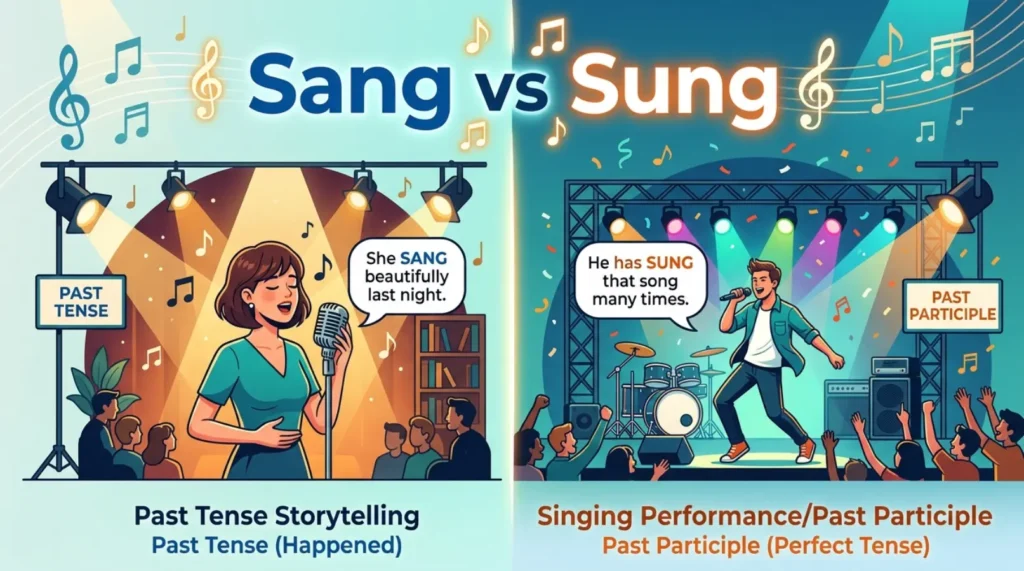
- Sang = simple past tense (no helping verb needed): “She sang a beautiful song.”
- Sung = past participle (always needs a helping verb like has, have, had, was, were): “They have sung that song before.”
- Never say “She sung a song” without a helping verb — it is incorrect.
- Never say “She has sang” — always use “sung” with helping verbs.
- The key rule: sang = standalone past, sung = with a helper verb.
What Does “Sing” Mean? (Base Form)
Before we compare sang or sung, let us understand the root word: sing.
Sing means to make musical sounds with your voice. It is the base form of the verb. You use it in the present tense.
Examples:
- “I sing in the shower every morning.”
- “Birds sing at sunrise.”
- “She loves to sing at weddings.”
Now, sing changes its form depending on the time of the action. That is where sang and sung come in.
What Is “Sang”? Definition and Meaning
Sang is the simple past tense of “sing.”
You use sang when talking about a completed action in the past. Importantly, sang stands alone. It does not need a helping verb.
Think of it this way: sang = something that happened and is done.
Examples:
- “He sang a lovely song at the concert last night.”
- “The choir sang beautifully at the church.”
- “She sang the national anthem at the game.”
- “I sang my baby to sleep.”
Notice that each sentence works perfectly without any extra helper word. That is the key feature of sang.
What Is “Sung”? Definition and Meaning
Sung is the past participle of “sing.”
This is the form you use with helping verbs. Common helping verbs include: has, have, had, was, were, is, are, be, been.
Without a helping verb, sung sounds awkward and is grammatically wrong.
Examples:
- “She has sung at Carnegie Hall many times.”
- “That song has been sung at every graduation for 20 years.”
- “They had sung three songs before the rain started.”
- “The anthem was sung by a local artist.”
- “I have never sung in front of a large crowd.”
Every time you see sung, look for the helping verb next to it. They always travel together.
Sang vs. Sung: Simple Comparison Table
| Feature | Sang | Sung |
| Verb form | Simple past tense | Past participle |
| Needs helping verb? | No | Yes (has, have, had, was, were) |
| Stands alone? | Yes | No |
| Example | She sang at the party. | She has sung at the party. |
| Common mistake | “She has sang.” ❌ | “She sung a song.” ❌ |
| Correct usage | “She sang a song.” ✅ | “She has sung a song.” ✅ |
This table is your quick cheat sheet. Save it and refer back whenever you are unsure.
Real-Life Examples of Sang and Sung
Let us look at how both words appear in everyday situations.
First, using sang in real life:
The students sang Happy Birthday to their teacher.
My grandmother sang folk songs every evening.
The band sang three encores at the concert.
Next, using sung in real life:
That lullaby has been sung in our family for generations.
The song was sung live for the first time last night.
I have sung this hymn since I was a child.
Now consider a tricky real-life scenario:
Imagine you want to say, She __ the song twice. Ask yourself, is there a helping verb? No. So the correct form is sang. She sang the song twice is correct.
On the other hand, try this example:
She has __ the song twice. Here, there is a helping verb, has. So the correct form is sung. She has sung the song twice is correct.
Common Mistakes People Make With Sang and Sung
Many learners often confuse these two forms, especially in spoken and written English. Below are the most frequent errors explained in simple terms.
- First mistake: Using sung without a helping verb
She sung the lullaby to her child is incorrect. The correct form is She sang the lullaby to her child. - Next issue: Using sang with a helping verb
He has sang in three competitions is incorrect. Instead, He has sung in three competitions is correct. - Another common confusion: Mixing up singed and sung
To clarify, singed means slightly burned and is unrelated to the verb sing. For example, The candle singed his hair is correct. However, The candle singed a song makes no sense. - Finally, missing the helping verb altogether
The carol been sung at Christmas is incorrect because it is missing has. The correct sentence is The carol has been sung at Christmas.
The Irregular Verb: Sing, Sang, Sung
Sing is an irregular verb. That means it does not follow the usual “-ed” rule.
Most regular verbs follow this pattern:
- Walk → walked → walked
But irregular verbs like “sing” follow a different pattern:
- Sing → sang → sung
This three-form pattern is called the principal parts of a verb. Many English learners find irregular verbs difficult. Furthermore, the vowel change (i → a → u) is a helpful way to remember the pattern.
Other irregular verbs that follow a similar vowel pattern:
- Ring → rang → rung
- Drink → drank → drunk
- Spring → sprang → sprung
- Swim → swam → swum
When you learn one of these, you learn all of them more easily.
How to Remember Sang vs Sung: Tips and Tricks
To make the difference easier, here are some simple memory tricks that will help you choose the correct form with confidence.
First, use the has/have test
Before using sung, check if you can place has or have before it. For example, She has sung is correct. On the other hand, She has sang is incorrect because sang never follows has or have.
Next, remember the A-U rule
A stands for alone, which means sang can stand alone without a helper verb. U stands for under a helper, which means sung always goes under a helping verb like has, have, or had.
In addition, connect it with similar verb patterns
For example, ring changes to rang and rung. Similarly, sing follows the same pattern as sang and sung, which makes it easier to remember.
Finally, read your sentence out loud
Your ear can often detect mistakes naturally. For instance, if She has sang sounds incorrect to you, trust that instinct because it is grammatically wrong.
Sang and Sung in Different Types of Sentences
Let us explore how these forms appear in different sentence structures.
Affirmative sentences:
- “The children sang carols in December.” (past simple)
- “She has sung at many events.” (present perfect)
Negative sentences:
- “He did not sing yesterday.” (Note: “did not sing” — not “did not sang”)
- “They have not sung that song yet.”
Questions:
- “Did she sing at the ceremony?” (not “Did she sang”)
- “Has he sung the new version of the song?”
Passive voice:
- “The anthem was sung by the students.”
- “That tune has been sung in this hall for decades.”
Synonyms for Sang and Sung
Sometimes you want to use a different word. Here are some synonyms and related expressions:
Synonyms for “sang” (past action of singing):
- Performed, crooned, chanted, hummed, vocalized, belted out, serenaded
Synonyms for “sung” (past participle context):
- Performed, rendered, delivered, vocalized, crooned (in perfect tense context)
Related expressions:
- She belted out the chorus. (sang loudly)
- He crooned softly into the microphone. (sang gently)
- They chanted the words in unison. (sang repetitively)
Using synonyms helps you avoid keyword repetition and also enriches your writing.
Usage in Daily Life and Writing
You will come across sang and sung in many places:
- Casual conversation: “Did you hear how she sang at the wedding?”
- News and media: “The star has sung at three Super Bowls.”
- Literature and poetry: “He sang of battles long ago.”
- Social media captions: “We sang all night and it was magical!”
- Academic writing: “The choir has sung this piece for twenty consecutive years.”
Additionally, in song lyrics and poetry, writers sometimes bend grammar rules for rhythm. However, in formal writing, always follow the standard rules above.
Expert Insight: Why This Distinction Matters
Grammar experts and writing coaches agree — verb form errors are among the most common in English writing. According to most style guides, including the Chicago Manual of Style and Grammarly’s usage guidelines, mixing up past tense and past participle forms is a sign of careless writing.
Using the wrong form can:
- Undermine your credibility in professional emails
- Lower your score on English exams
- Confuse your readers
Moreover, mastering irregular verbs like sing-sang-sung improves your overall fluency. It also signals to readers — and employers — that you take your language seriously.
Furthermore, for students preparing for IELTS, TOEFL, SAT, or any standardized English test, knowing the correct verb forms is absolutely essential.
Frequently Asked Questions (FAQ)
Q1: Is it “she sang” or “she sung”?
It depends on the sentence. Without a helping verb, always use “sang”: “She sang at the concert.” With a helping verb, use “sung”: “She has sung at the concert.”
Q2: Can I say “he has sang”?
No. “Has sang” is always incorrect. The correct form is “has sung.” Never use “sang” after a helping verb.
Q3: What is the past tense of “sing”?
The simple past tense is “sang.” The past participle is “sung.” Both are past forms, but they serve different grammatical roles.
Q4: Is “sung” a word?
Yes, absolutely. “Sung” is the past participle of “sing.” However, it always needs a helping verb to function correctly in a sentence.
Q5: Why is “sing” an irregular verb?
English irregular verbs come from Old English and Germanic roots. Over centuries, their forms changed in unique ways instead of following the regular “-ed” pattern. “Sing” follows the same vowel-change pattern as ring, drink, and swim.
Q6: What is the difference between past tense and past participle?
Past tense describes a completed action: “She sang.” Past participle is used with helping verbs to form perfect or passive tenses: “She has sung” or “The song was sung.”
Q7: Can “sung” ever be used without a helping verb?
In informal or poetic language, you may sometimes see it used loosely. However, in standard grammar, “sung” always requires a helping verb. Avoid using it alone in formal writing.
Q8: What about “have sung” vs. “had sung”?
Both are correct but mean slightly different things. “Have sung” (present perfect) connects the past action to the present. “Had sung” (past perfect) refers to an action completed before another past action.
Conclusion
In summary the difference between sang and sung comes down to one simple rule. Sang stands alone while sung needs help.
First use sang when describing a past action without any helping verb. Use sung when a helping verb such as has have had was or were is present. Both words are past forms of the irregular verb sing but they play different roles in a sentence.
Moreover remember the A U trick. A stands for alone which means sang is used without a helper. U stands for under a helper which means sung always appears with a helping verb.
Finally practice with real life examples and you will master this rule quickly. So next time someone asks you about sang or sung you will know exactly what to say and more importantly what to write.