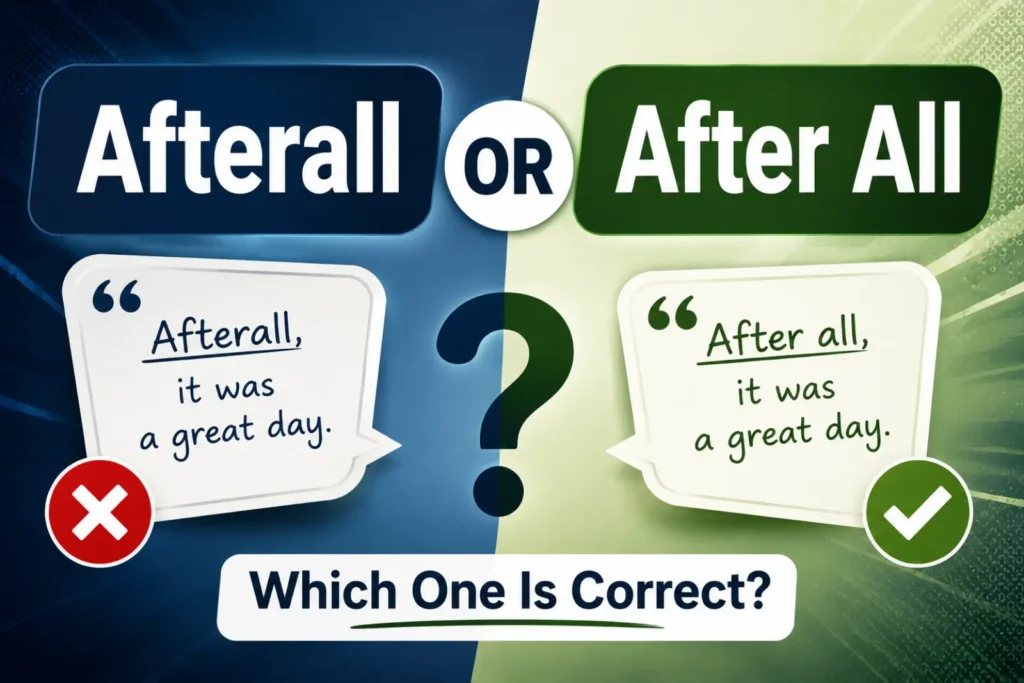
Afterall or after all is a common grammar question that confuses many English learners and writers. At first, both versions look similar. However, only one form is accepted in standard English writing.
This mistake appears in emails, school assignments, blog posts, and social media comments. Because the words sound the same when spoken, many people combine them into a single word.
The good news is that the rule is simple. Once you understand how the phrase works, you can avoid this error in every situation. Whether you write professionally or casually, using the correct form improves clarity and credibility.
This guide explains the difference, shows real-world examples, highlights common mistakes, and shares helpful memory tricks to make the correct spelling easy to remember.
Quick Summary Box
- After all is the correct spelling.
- Afterall is generally considered incorrect.
- “After all” is a two-word phrase.
- The phrase often means “in spite of everything.”
- It can also mean “when everything is considered.”
- Most dictionaries list “after all” as the standard form.
- Professional writing should always use two words.
Featured Snippet Answer
Is It Afterall or After All?
After all is the correct spelling in modern English. It should always appear as two separate words. The single-word form afterall is generally considered a spelling mistake and is not accepted in standard grammar.
What Does “After All” Mean?
The phrase “after all” has a few related meanings.
Most commonly, it means:
- Considering everything
- Despite previous doubts
- In the end
- When all facts are known
Examples:
- We decided to go after all.
- She was right after all.
- After all, everyone makes mistakes.
The phrase often introduces a reason or final conclusion.

Why Writers Mix Up Afterall and After All
English contains many compound words.
Examples include:
- Therefore
- However
- Nevertheless
Because these words appear as one unit, some writers assume “afterall” follows the same pattern.
However, English treats “after all” differently.
It remains a two-word expression.
The confusion comes mainly from pronunciation rather than grammar.
Afterall vs After All Comparison Table
| Feature | Afterall | After All |
| Standard English | No | Yes |
| Dictionary Approved | No | Yes |
| Academic Writing | No | Yes |
| Business Writing | No | Yes |
| Grammar Correct | No | Yes |
| Recommended Usage | No | Yes |
The table clearly shows which form belongs in proper writing.
How “After All” Functions in a Sentence
This phrase can play different roles depending on context.
Showing a Final Decision
Example:
We chose the beach vacation after all.
Introducing a Reason
Example:
After all, preparation leads to success.
Expressing Surprise
Example:
He knew the answer after all.
In each case, the phrase helps connect ideas smoothly.
Everyday Examples of Correct Usage
Seeing the phrase in context makes learning easier.
At School
She passed the test after all.
At Work
The meeting happened after all.
With Friends
They joined us after all.
During Travel
The flight left on time after all.
These examples reflect natural conversation and writing.
Common Grammar Mistakes Related to “After All”
Many writers make similar errors.
Writing It as One Word
Incorrect:
- Afterall, I was busy.
Correct:
- After all, I was busy.
Forgetting the Comma
When the phrase starts a sentence, a comma often improves readability.
Example:
- After all, we planned this event together.
Using It Too Often
Repeating the phrase excessively can weaken writing.
Use it only when it adds meaning.
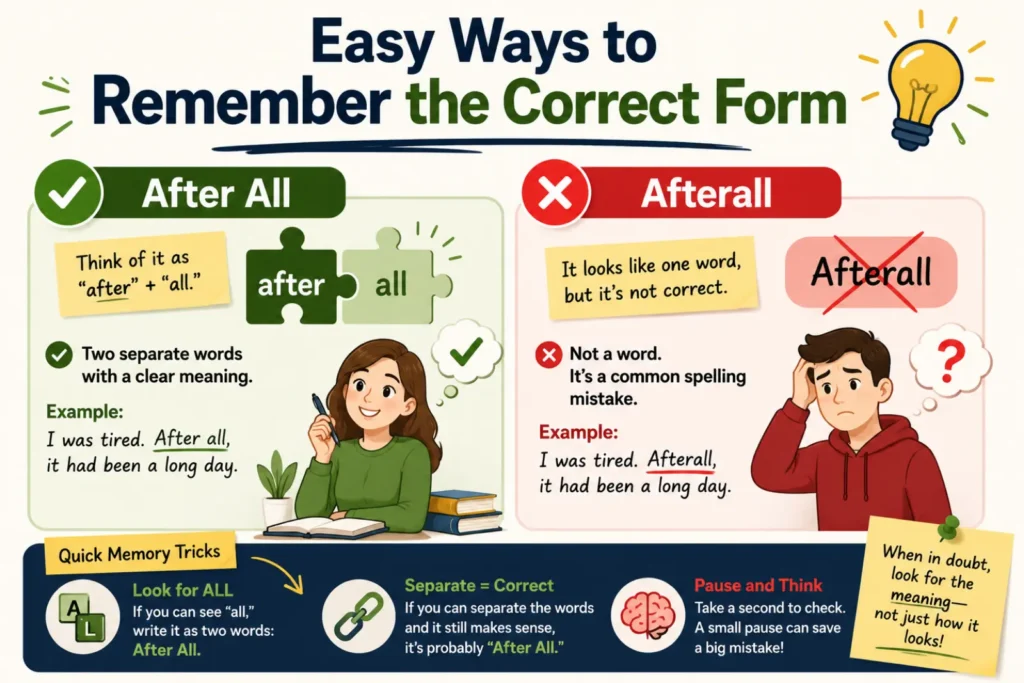
Easy Ways to Remember the Correct Form
Simple memory tricks can prevent future mistakes.
Think of Two Separate Ideas
“After” and “all” each have their own meaning.
Together, they form a phrase.
Use the Space Test
Ask yourself:
Can these words stand alone?
Yes.
That helps remind you they remain separate.
Read Professional Writing
Books, newspapers, and magazines consistently use “after all.”
Regular exposure reinforces the correct spelling.
When to Use “After All” in Daily Communication
The phrase appears frequently in both spoken and written English.
Common situations include:
- Giving explanations
- Sharing conclusions
- Supporting an argument
- Correcting assumptions
- Adding emphasis
Because it sounds natural and conversational, it remains popular across many writing styles.
Similar Expressions and Alternatives
Sometimes another phrase may fit better.
Depending on context, consider:
- In the end
- Ultimately
- Considering everything
- Despite that
- Nevertheless
- As it turns out
- All things considered
- When all is said and done
These alternatives help create variety in writing.
Related Grammar Rules Worth Knowing
Many English phrases look like compound words but stay separate.
Examples include:
| Correct Form | Incorrect Form |
| In fact | Infact |
| At least | Atleast |
| Each other | Eachother |
| After all | Afterall |
Recognizing these patterns helps improve overall writing accuracy.
Synonyms and Semantic Variations
Search engines often connect related terms with this topic.
Useful semantic phrases include:
- correct spelling of after all
- after all grammar rule
- after all meaning
- common spelling mistakes
- English writing tips
- grammar usage guide
- proper phrase structure
- writing accuracy
- English language rules
- punctuation and grammar
These related terms strengthen topical relevance.
Expert Writing Insight
Professional editors focus on consistency.
Small spelling mistakes can reduce trust, especially in formal documents.
While readers usually understand the meaning of “afterall,” they may view it as careless writing.
Strong writers pay attention to details.
Using correct grammar improves:
- Readability
- Professionalism
- Search engine quality signals
- User experience
These benefits matter for students, bloggers, business owners, and content creators alike.
Frequently Asked Questions
Is afterall a real word?
No. Standard English uses “after all” as two words.
Should I write after all or afterall?
Always write “after all.”
Why is afterall incorrect?
English grammar recognizes the phrase as two separate words.
Can I start a sentence with after all?
Yes. It commonly introduces an explanation.
Is there a comma after after all?
Often, yes, when it begins a sentence.
Do dictionaries include afterall?
Most dictionaries treat it as a misspelling.
Is after all formal or informal?
It works in both formal and informal writing.
What does after all mean?
It usually means “considering everything” or “in the end.”
Why This Small Grammar Rule Matters
Correct spelling creates a stronger impression.
Readers notice grammar errors quickly.
Even minor mistakes can distract from your message.
Fortunately, this particular rule is easy to master.
Once you remember that “after all” contains two words, you can use it confidently in every type of writing.
Over time, these small improvements build stronger communication skills.
Conclusion
When comparing afterall or after all, the correct choice is clear. Standard English uses after all as a two-word phrase. The combined version, afterall, is generally considered incorrect and should be avoided in professional, academic, and everyday writing.
The phrase often means “considering everything” or “in the end.” It appears in conversations, articles, books, and business communication. Learning the correct form helps improve grammar accuracy and writing confidence. Fortunately, the rule is simple to remember. Keep the two words separate, and you will avoid one of the most common spelling mistakes in English. Small grammar improvements like this can make your writing clearer, stronger, and more trustworthy.