
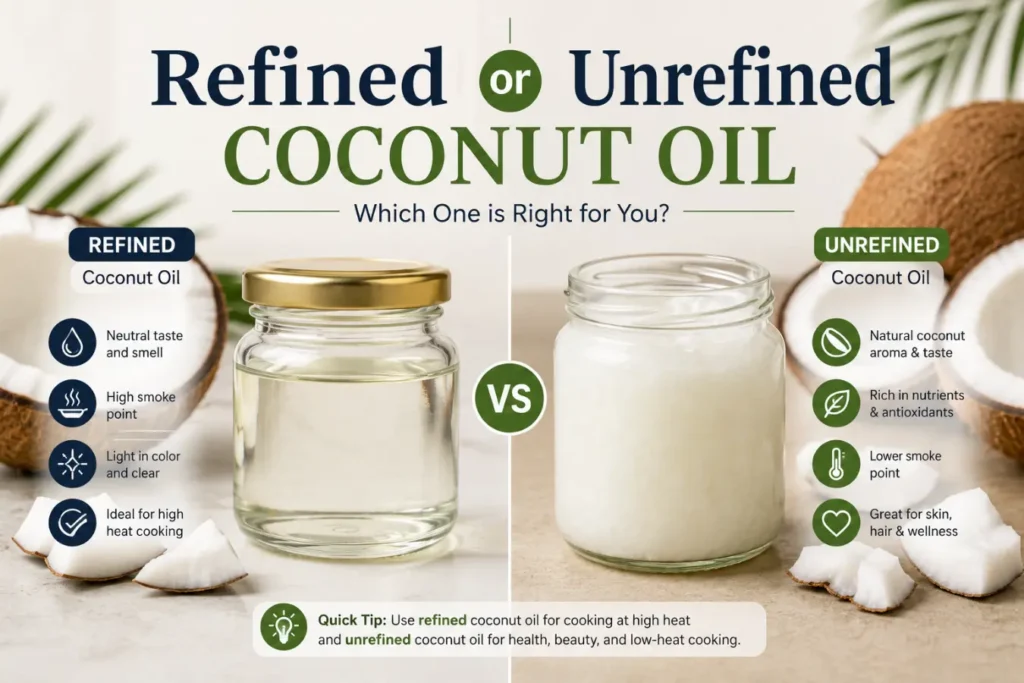
Refined or unrefined coconut oil is a common question for people who want the best oil for cooking, baking, or skincare. Both types come from coconuts, but they go through different processing methods. As a result, they have different flavors, smells, and uses.
Many people feel confused when choosing between these two options. Some want a strong coconut taste. Others need an oil that works well at high temperatures.
The good news is that both types offer benefits. However, the right choice depends on your needs. In this guide, you will learn the key differences, benefits, uses, and expert tips. By the end, you will know exactly which coconut oil fits your lifestyle.
Quick Summary Box
What Is the Difference Between Refined and Unrefined Coconut Oil?
- Both come from coconut meat.
- Unrefined coconut oil receives minimal processing.
- Refined coconut oil goes through extra processing.
- Unrefined oil has a strong coconut flavor and aroma.
- Refined oil has a neutral taste and smell.
- Refined oil usually has a higher smoke point.
- Both contain medium-chain triglycerides (MCTs).
- Choice depends on cooking style and personal preference.
What Is Coconut Oil?
Coconut oil is a natural oil extracted from coconut meat. People use it for cooking, baking, skincare, and hair care.
It contains healthy fats called medium-chain triglycerides. These fats provide quick energy and make coconut oil popular among health-conscious consumers.
Coconut oil stays solid at cooler temperatures and melts when warmed.
What Does Refined Coconut Oil Mean?
Refined coconut oil comes from dried coconut meat, often called copra.
Manufacturers clean, filter, and refine the oil to remove impurities. This process reduces the coconut smell and flavor.
Key Features of Refined Coconut Oil
- Neutral taste
- Mild aroma
- Higher smoke point
- Suitable for frying
- Longer shelf stability
Many restaurants and food manufacturers prefer refined coconut oil because it does not change the flavor of foods.
What Does Unrefined Coconut Oil Mean?
Unrefined coconut oil is often called virgin coconut oil.
Manufacturers extract it from fresh coconut meat with minimal processing. This helps preserve its natural aroma and flavor.
Key Features of Unrefined Coconut Oil
- Strong coconut taste
- Natural coconut scent
- Less processing
- Rich coconut flavor
- Popular for skincare and baking
Many people choose virgin coconut oil because it feels more natural.
Refined vs Unrefined Coconut Oil: Comparison Table
| Feature | Refined Coconut Oil | Unrefined Coconut Oil |
| Processing | More processed | Minimally processed |
| Flavor | Neutral | Strong coconut flavor |
| Aroma | Mild | Strong coconut scent |
| Smoke Point | Around 400°F to 450°F | Around 350°F |
| Best For | Frying, sautéing | Baking, skincare |
| Appearance | Clear and mild | Slight coconut aroma |
| Nutrients | Similar fats | Similar fats |
| Cost | Often lower | Often higher |
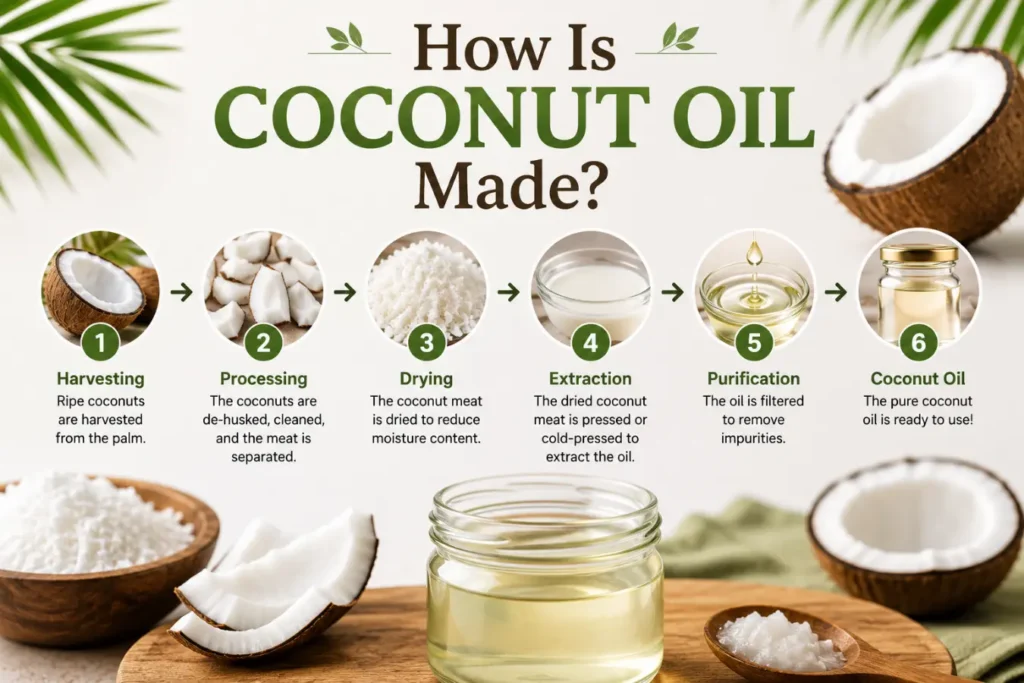
How Is Coconut Oil Made?
The production process creates the biggest difference between the two types.
Refined Oil Process
- Coconut meat is dried.
- Oil is extracted.
- The oil is filtered and refined.
- Odors and flavors are removed.
Unrefined Oil Process
- Fresh coconut meat is collected.
- Oil is extracted quickly.
- Minimal processing occurs.
- Natural flavor remains.
Because of these steps, each oil serves different purposes.
Which Coconut Oil Is Better for Cooking?
The answer depends on the recipe.
Choose Refined Coconut Oil When:
- Frying foods
- Deep frying
- Stir-frying
- Cooking at high heat
- You want no coconut flavor
Choose Unrefined Coconut Oil When:
- Baking cookies
- Making desserts
- Preparing smoothies
- Creating coconut-flavored recipes
For example, if you fry vegetables, refined oil works well. However, if you bake coconut muffins, virgin coconut oil adds extra flavor.
Which Coconut Oil Is Better for Skin Care?
Many people use coconut oil as a natural moisturizer.
Unrefined coconut oil often remains the preferred choice because it undergoes less processing.
Common Skin Uses
- Moisturizing dry skin
- Lip care
- Makeup removal
- Massage oil
- Body moisturizer
However, some people prefer refined oil because it has less scent.
Always perform a patch test before applying coconut oil to sensitive skin.
Which Coconut Oil Is Better for Hair?
Both types can help improve hair appearance.
Benefits for Hair
- Adds shine
- Helps reduce dryness
- Supports smoother hair
- Improves manageability
Unrefined coconut oil remains popular because many users enjoy its natural coconut fragrance.
For example, people often apply a small amount before shampooing to help reduce protein loss.
Health Benefits of Coconut Oil
Research continues to explore coconut oil’s health effects. While moderation is important, coconut oil offers several potential benefits.
Possible Benefits
- Provides quick energy
- Contains MCTs
- Supports cooking versatility
- May increase feelings of fullness
- Useful in ketogenic diets
A balanced diet remains the most important factor for overall health.
Real-Life Examples: When to Use Each Type
Scenario 1: Deep Frying Chicken
Use refined coconut oil.
The higher smoke point handles heat better and prevents a coconut flavor from affecting the food.
Scenario 2: Baking Coconut Cake
Use unrefined coconut oil.
The natural coconut taste enhances the recipe.
Scenario 3: Daily Skin Moisturizer
Use unrefined coconut oil if you enjoy a natural scent.
Scenario 4: Restaurant Cooking
Use refined coconut oil for a neutral flavor profile.
Common Mistakes People Make
Many consumers choose the wrong oil because they misunderstand the labels.
Mistake 1: Assuming One Is Always Healthier
Both contain similar fat profiles.
Mistake 2: Ignoring Smoke Point
Low smoke point oils may not perform well during high-heat cooking.
Mistake 3: Expecting No Flavor From Virgin Oil
Unrefined oil has a noticeable coconut taste.
Mistake 4: Using Too Much
Coconut oil remains calorie-dense. Moderation matters.
Mistake 5: Not Reading Labels
Some products include blends or additives.
Tips for Choosing the Right Coconut Oil
Follow these simple tips before buying.
Look for:
- Organic certification if preferred
- Clear ingredient lists
- Cold-pressed labels
- Virgin coconut oil for natural flavor
- Refined oil for neutral cooking
Also, store coconut oil in a cool and dry place.
Synonyms and Related Terms
People often search for coconut oil using different terms.
Common Synonyms
- Virgin coconut oil
- Pure coconut oil
- Cold-pressed coconut oil
- Processed coconut oil
- Natural coconut oil
Related Search Terms
- Coconut oil benefits
- Virgin coconut oil vs refined coconut oil
- Best coconut oil for cooking
- Best coconut oil for skin
- Coconut oil smoke point
- Organic coconut oil
- MCT-rich oils
- Coconut oil uses
Expert Insights: What Nutrition and Cooking Experts Recommend
Experts usually recommend matching the oil to the intended use.
For high-temperature cooking, refined coconut oil often works best because of its higher smoke point.
For baking, skincare, and recipes that benefit from coconut flavor, unrefined coconut oil often becomes the preferred option.
The most important factor is quality. Choose a trusted brand that provides clear sourcing and processing information.
When used appropriately, both types can fit into a healthy lifestyle.
Frequently Asked Questions (FAQs)
Is refined coconut oil unhealthy?
No. Refined coconut oil still contains coconut-derived fats. It simply undergoes additional processing.
Does unrefined coconut oil taste like coconut?
Yes. It has a stronger coconut flavor and aroma.
Which coconut oil is best for frying?
Refined coconut oil is generally better for high-heat frying.
Can I use unrefined coconut oil on my skin?
Yes. Many people use it as a natural moisturizer.
Is virgin coconut oil the same as unrefined coconut oil?
In most cases, yes. Virgin coconut oil is commonly considered unrefined.
Which coconut oil is better for baking?
Unrefined coconut oil works well when you want coconut flavor.
Do both oils contain MCTs?
Yes. Both types contain medium-chain triglycerides.
How long does coconut oil last?
Most coconut oils remain stable for a long time when stored properly.
Final Thoughts
Choosing refined or unrefined coconut oil depends on how you plan to use it. Both options come from coconuts and provide similar fat content. However, they differ in flavor, aroma, and processing methods.
Refined coconut oil works best for high-heat cooking and recipes that need a neutral taste. On the other hand, unrefined coconut oil offers a rich coconut flavor and remains popular for baking, skincare, and hair care.
Before buying, consider your cooking style, personal preferences, and intended use. A quality product will deliver the best results regardless of which type you choose. When selected correctly, refined or unrefined coconut oil can become a useful and versatile addition to your kitchen and daily routine.