
VTI or VOO is a common question among investors who want simple ETF choices. Both funds offer a way to invest in the stock market. They are low-cost, popular, and built for long-term growth. However, they follow different indexes and include different companies.
Many beginners feel confused when choosing between these two ETFs. The good news is that the difference is easy to understand. VTI covers almost the entire U.S. stock market. VOO focuses on the largest 500 U.S. companies.
This guide explains VTI and VOO in simple words. You will learn their benefits, differences, risks, and best uses. By the end, you can decide which ETF fits your investing goals.
Quick Summary Box
- VTI tracks the total U.S. stock market.
- VOO tracks the S&P 500 index.
- Both ETFs have low fees and strong histories.
- VTI includes large, medium, and small companies.
- VOO focuses mainly on large companies.
- Both work well for long-term investing.
- The best choice depends on your goals.
What Does VTI or VOO Mean?
VTI and VOO are exchange-traded funds (ETFs). They allow people to buy many stocks with one investment.
Vanguard Group created both funds. These ETFs are popular because they offer diversification and low costs.
VTI stands for Vanguard Total Stock Market ETF. It follows the CRSP US Total Market Index. It includes thousands of U.S. companies.
VOO stands for Vanguard S&P 500 ETF. It follows the S&P 500 Index. It includes about 500 large American companies.
Both funds aim to grow wealth over time. They do not try to beat the market. Instead, they copy their chosen index.
VTI Explained in Simple Words
VTI is a total market ETF. It gives investors exposure to almost the entire U.S. stock market.
Think of VTI as a big basket. This basket holds large companies, medium companies, and small companies.
For example, VTI may include:
- Technology companies
- Healthcare companies
- Consumer brands
- Financial companies
- Small businesses
Because VTI owns many companies, it spreads risk across the market.
If one company performs poorly, other companies may balance the impact.
This makes VTI attractive for investors who want broad market exposure.
VOO Explained in Simple Words
VOO is an S&P 500 ETF. It invests in the 500 largest publicly traded U.S. companies.
These companies include many market leaders. Examples include major technology, healthcare, and financial firms.
VOO focuses on established businesses with large market values.
Many investors choose VOO because the S&P 500 has historically delivered strong long-term results.
However, VOO does not include smaller companies. It mainly follows large-cap stocks.
VTI vs VOO Comparison Table
| Feature | VTI | VOO |
| Full Name | Vanguard Total Stock Market ETF | Vanguard S&P 500 ETF |
| Tracks | Total U.S. market | S&P 500 index |
| Company Size | Large, medium, small | Mostly large |
| Number of Holdings | Thousands | Around 500 |
| Diversification | Higher | High |
| Risk Level | Broad market risk | Large-company risk |
| Expense Cost | Very low | Very low |
| Best For | Total market investors | S&P 500 investors |
Key Differences Between VTI and VOO
The biggest difference is market coverage.
VTI owns almost every part of the U.S. stock market. It includes small companies that may grow in the future.
VOO only owns large companies. These businesses are already major players.
Because of this, VTI offers slightly wider diversification.
On the other hand, VOO gives exposure to companies that dominate the U.S. economy.
The performance difference between them is often small because large companies make up a big part of both funds.
Real-Life Examples of Choosing VTI or VOO
Imagine two investors.
Sarah wants one simple fund for retirement. She wants exposure to the whole U.S. market. VTI may match her goal.
Mike prefers investing in the biggest American companies. He believes large companies will continue growing. VOO may fit his strategy.
A young investor with decades ahead may like broad market exposure.
A person who prefers simplicity may choose either fund.
The right choice depends on personal goals, not popularity.
Benefits of Investing in VTI
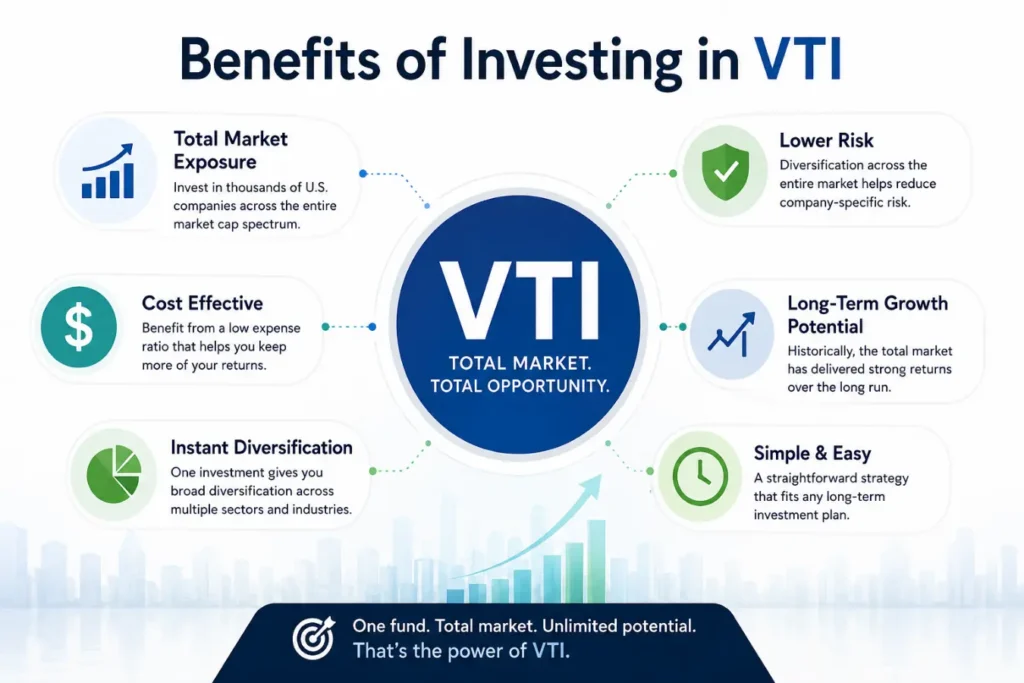
VTI offers several advantages.
Wide Diversification
VTI covers thousands of companies. This reduces dependence on a few businesses.
Exposure to Small Companies
Small companies can grow faster. VTI includes this part of the market.
Simple Portfolio Choice
Many investors use VTI as their main stock investment.
Low Cost
VTI has a very low expense ratio. Lower costs help investors keep more returns.
Benefits of Investing in VOO
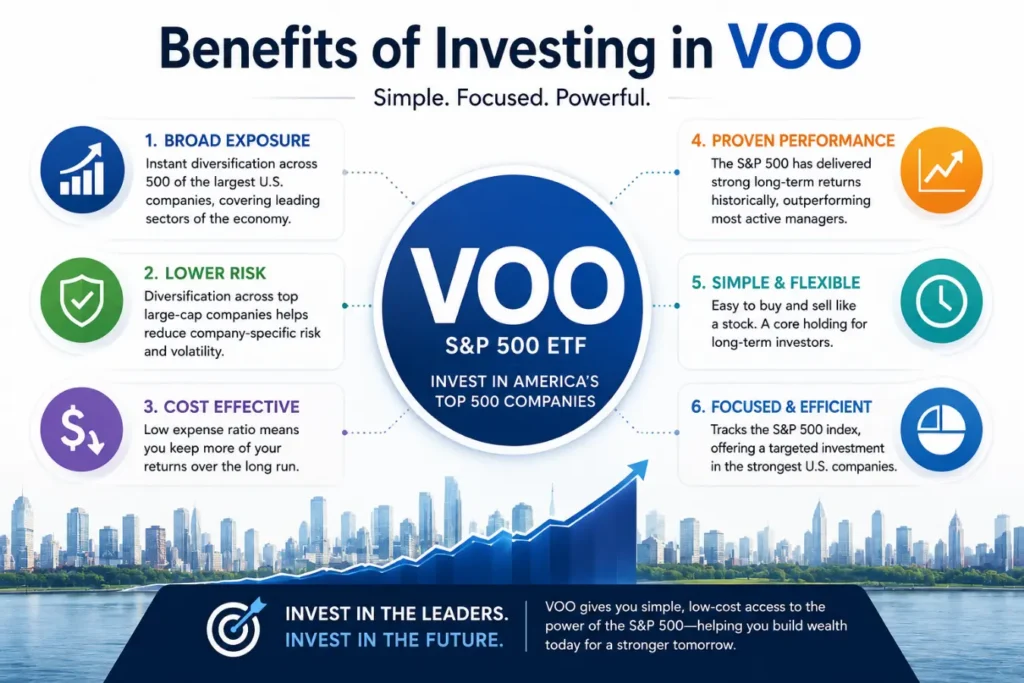
VOO also has strong benefits.
Strong Large-Cap Exposure
VOO focuses on established market leaders.
Simple Strategy
Investors can own major U.S. companies with one ETF.
Historical Market Connection
The S&P 500 is widely followed by investors.
Low Fees
VOO also provides a low-cost investing option.
Common Mistakes Investors Make
Many beginners make simple mistakes when comparing ETFs.
Choosing Only Based on Past Returns
Past performance does not guarantee future results.
Buying Too Many Similar Funds
Owning VTI and VOO together may create overlap. Both contain many of the same companies.
Ignoring Investment Goals
An ETF should match your timeline and risk comfort.
Checking Prices Too Often
Long-term investing usually works better with patience.
Forgetting Diversification
A complete portfolio may include more than one asset type.
VTI or VOO for Beginners: Which Is Easier?
Both ETFs are beginner-friendly.
New investors often like them because they are simple.
You do not need to pick individual stocks. The ETF does the work for you.
VTI may feel more complete because it covers more companies.
VOO may feel easier because many people recognize the S&P 500.
Either option can be a strong starting point.
How VTI and VOO Fit Into Daily Investing
Many people use ETFs through:
- Retirement accounts
- Brokerage accounts
- Automatic monthly investing
- Long-term savings plans
A common approach is investing regularly over many years.
This method helps investors avoid trying to predict short-term market moves.
Consistency often matters more than choosing the “perfect” ETF.
Synonyms and Related Terms
Common terms related to VTI and VOO include:
- Stock market ETF
- Index fund
- Passive investing
- S&P 500 fund
- Total market fund
- U.S. equity ETF
- Long-term investment fund
- Diversified portfolio
These terms help explain the wider investing topic.
Expert Insights on VTI and VOO
Experts often highlight three important ideas.
First, costs matter. Low fees can improve long-term results.
Second, diversification reduces unnecessary risk.
Third, investors should focus on goals instead of short-term market changes.
Both VTI and VOO follow simple investing principles. They avoid complicated strategies.
A strong plan usually matters more than choosing between two similar ETFs.
Frequently Asked Questions About VTI or VOO
Is VTI better than VOO?
VTI is better for investors who want the entire U.S. market. VOO works well for investors focused on large companies.
Can I own both VTI and VOO?
Yes, but they overlap heavily. Many investors choose one to keep things simple.
Which ETF has lower risk?
Both have similar market risks. VTI has broader coverage, while VOO focuses on large companies.
Is VOO only for beginners?
No. Many experienced investors also use VOO as part of their strategy.
Does VTI include the S&P 500?
Yes. VTI includes most S&P 500 companies because they are part of the total market.
Which ETF is better for retirement?
Both can work for retirement. The best choice depends on your full retirement plan.
Do VTI and VOO pay dividends?
Yes. Both ETFs distribute dividends from the companies they hold.
Which one should I buy?
Choose based on your goals, comfort level, and investment strategy.
Conclusion
VTI or VOO is a common choice for investors seeking simple and effective ETFs. Both funds offer low costs, diversification, and access to the U.S. stock market.
VTI gives broader exposure because it covers almost the entire market. VOO focuses on large companies in the S&P 500.
Neither ETF is automatically the winner. The better choice depends on what you want from your portfolio.
For many long-term investors, either option can be a strong foundation. The key is staying consistent and thinking long term. A simple investment plan often beats a complicated one.