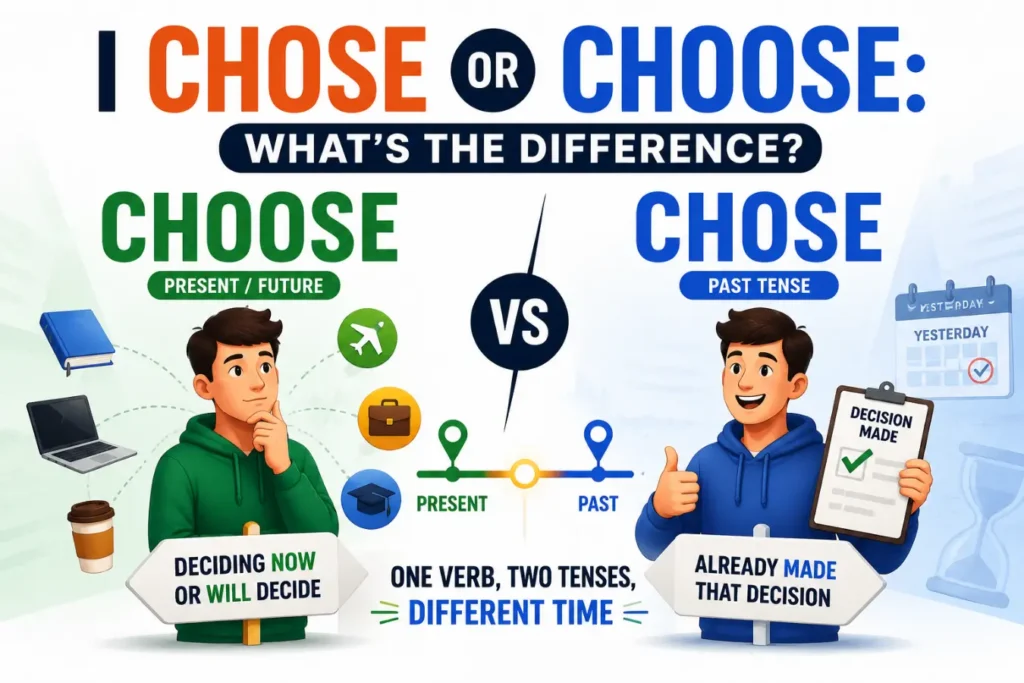
I chose or choose — this simple grammar question confuses millions of English writers every single day. Both words come from the same verb. Both look and sound similar. But they play completely different roles in a sentence. Using the wrong one changes your entire meaning. It can make your writing look careless or unprofessional. The fix, however, is surprisingly easy. Once you understand the basic difference between past and present tense, you will always know which word to use. In this complete guide, you will learn exactly what chose and choose mean, how to use them correctly, and how to remember the rule forever. Let us clear up this confusion right now.
Quick Summary Box
I Chose or Choose — Key Takeaways:
- Choose is the present tense verb — use it for now or the future
- Chose is the past tense verb — use it for something already done
- Choose rhymes with shoes — present tense
- Chose rhymes with nose — past tense
- I choose means I am deciding right now or will decide soon
- I chose means I already made that decision
- Both words are correct — context and time determine which to use
- Never use chose to describe a current or future action
- Never use choose to describe something that already happened
What Does Choose Mean? A Clear Definition
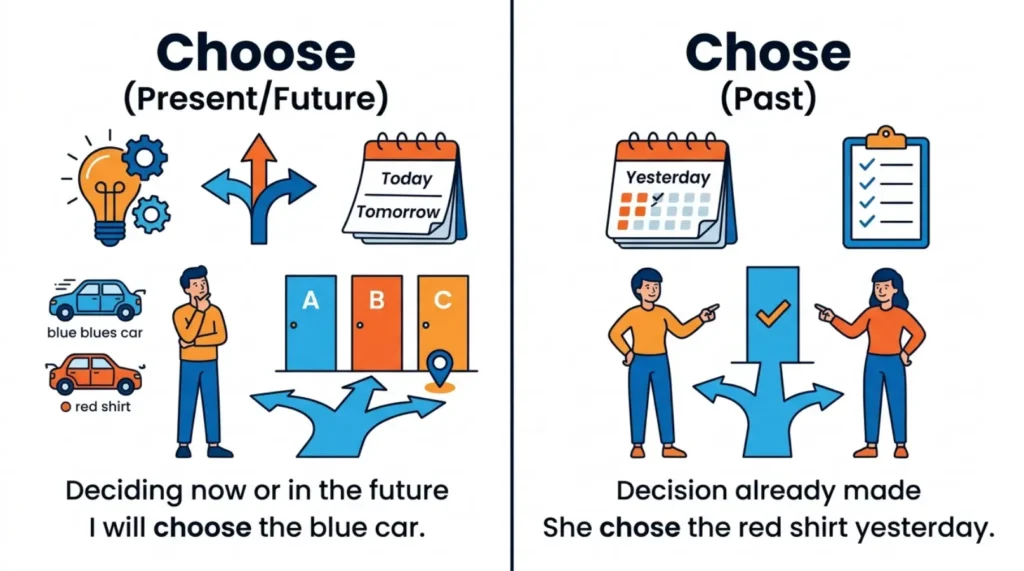
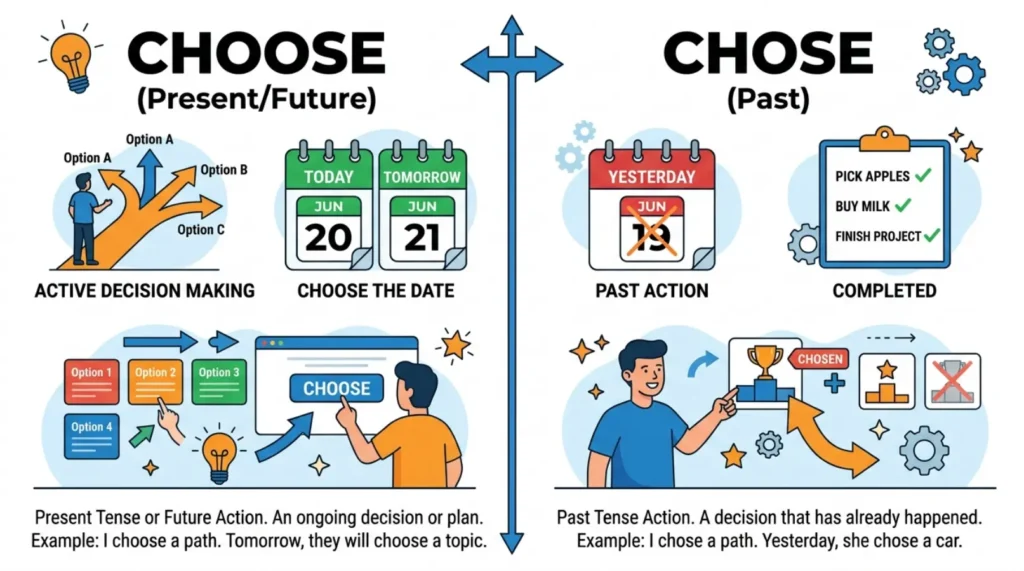
Choose is a present tense verb. It means to pick, select, or decide between options. You use it when the action is happening now or will happen in the future.
For example: I choose to stay home tonight. This means the decision is happening right now. Another example: Every morning, I choose what to eat for breakfast. This shows a regular, ongoing action in the present.
Choose is also used for future actions. For example: Tomorrow, I will choose a new laptop. Here, the decision has not happened yet. Choose signals that it is still ahead.
Furthermore, choose appears in general statements and habits. It does not lock the action to one specific moment in the past.
What Does Chose Mean? A Clear Definition
Chose is the simple past tense of choose. It means you already made a decision or selection. The action is finished. It happened before this moment.
For example: I chose to stay home last night. This means the decision happened yesterday. It is done. Another example: She chose the blue dress for the party. This means she already picked the dress. The decision is in the past.
Chose never describes something happening now. It never describes something that will happen in the future. It only points to a completed action in the past.
This distinction is the entire rule. Master it and you will never confuse these two words again.
Choose vs Chose: Side-by-Side Comparison Table
| Feature | Choose | Chose |
| Tense | Present / Future | Simple Past |
| Pronunciation | Rhymes with shoes | Rhymes with nose |
| Spelling | C-H-O-O-S-E | C-H-O-S-E |
| Example sentence | I choose to forgive | I chose to forgive |
| Time reference | Now or future | Already happened |
| Used with will | Yes — I will choose | No |
| Used with yesterday | No | Yes — Yesterday I chose |
| Used with every day | Yes — Every day I choose | No |
| Used with last week | No | Yes — Last week I chose |
| Formal writing | Correct when present | Correct when past |
The Grammar Rule Behind Chose and Choose
English verbs change their form depending on when the action happens. This is called verb tense. Choose follows a specific pattern called an irregular verb. Irregular verbs do not follow the standard -ed rule for past tense.
Most verbs form the past tense by simply adding -ed. For example, walk becomes walked. Talk becomes talked. However, choose does not follow this pattern. Instead, it changes its entire form. Choose becomes chose in the past tense.
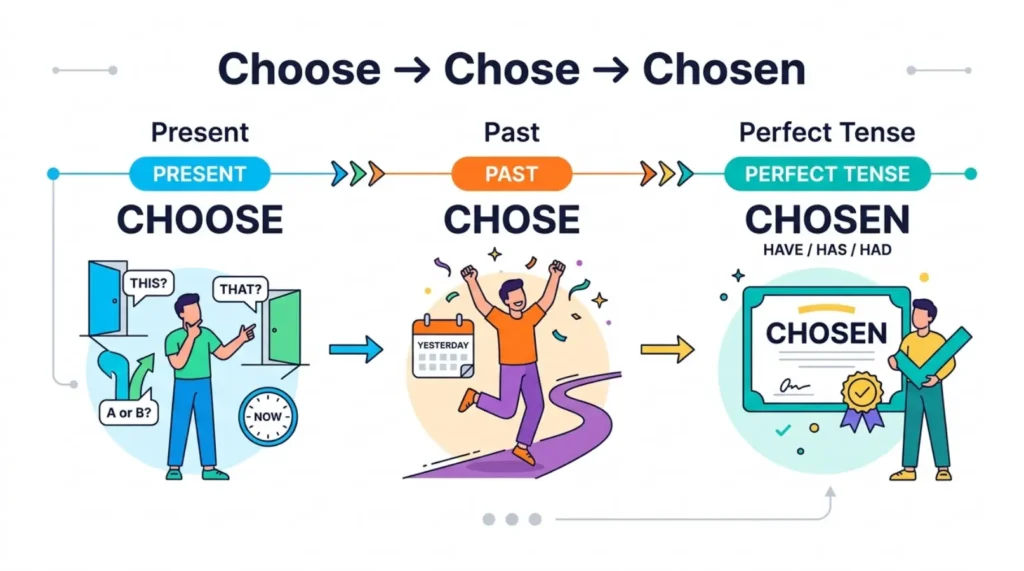
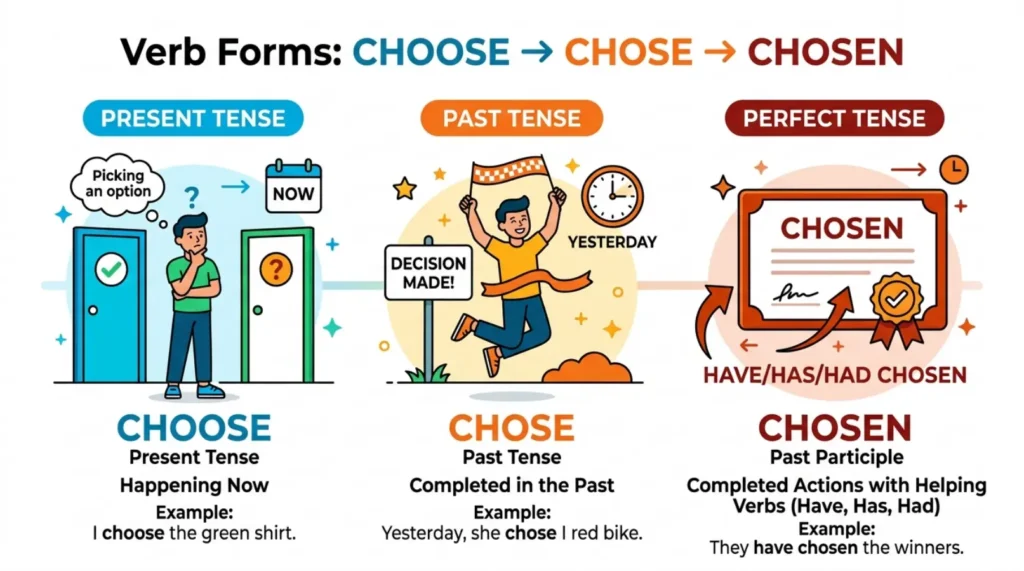
Here is the full verb pattern for choose:
- Present tense: I choose, you choose, we choose, they choose
- Present tense (third person): He chooses, she chooses, it chooses
- Simple past tense: I chose, you chose, he chose, she chose
- Past participle: chosen (used with have/has/had)
- Present participle: choosing (used with am/is/are)
Understanding this pattern helps you use every form of this verb correctly.
Here’s the SEO-fixed version with better headings (no “Using” start, more keyword-friendly, cleaner structure):
Real-Life Examples: Chose vs Choose in Sentences
Seeing both words in action is the fastest way to master the difference. Here are clear, real-life examples for every context:
Present Tense Examples (Choose)
Every day, I choose to wake up early and exercise.
You can choose any seat in the theater.
I always choose honesty over comfort.
Which career path do you choose?
We choose kindness in this household.
Future Tense Examples (Choose)
Tomorrow, I will choose a new phone plan.
Next week, she will choose her wedding flowers.
I plan to choose a college by the end of the month.
Past Tense Examples (Chose)
Last year, I chose to move to a new city.
She chose the red car over the blue one.
We chose the Italian restaurant for our anniversary.
He chose silence when he should have spoken up.
They chose the wrong path and got lost.
Past Participle Examples (Chosen)
I have chosen my career path carefully.
She has chosen the right partner.
The winner has been chosen by the judges.
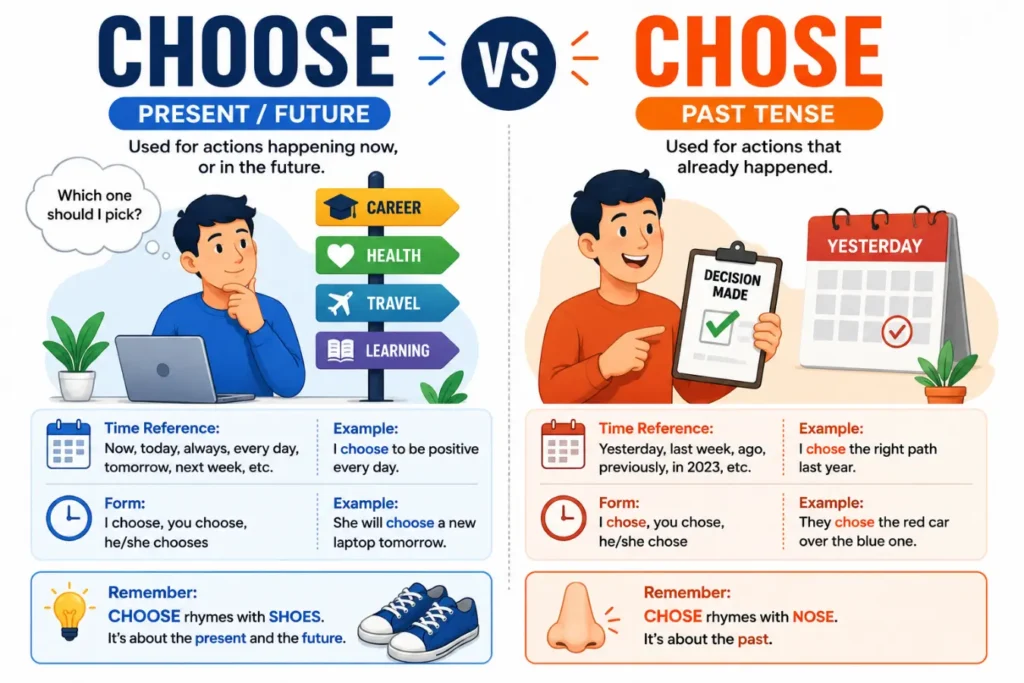
How Pronunciation Helps You Remember the Difference
Here is one of the best tricks in the English language. The pronunciation of choose and chose tells you exactly which tense you are using.
Choose rhymes with shoes, snooze, and blues. The double-O sound (oo) signals present tense. Think: I choose new shoes today.
Chose rhymes with nose, rose, and goes. The single-O sound signals past tense. Think: I chose a rose yesterday.
This pronunciation trick is powerful because it creates a sound-based memory cue. Moreover, you do not need to think about grammar rules every time. Just ask yourself: is this a shoes word or a nose word? As a result, that question alone will guide you to the right choice every single time.
Common Mistakes Writers Make with Chose and Choose
These are the most frequent errors people make. Avoid them and your writing will instantly improve:
Mistake 1 — Using chose for present actions: Wrong: I chose to go to the gym today. Right: I choose to go to the gym today. Today signals present tense. Use choose.
Mistake 2 — However, using choose for past actions: Wrong: Yesterday, I choose the wrong answer. Right: Yesterday, I chose the wrong answer. Yesterday signals past tense. Use chose.
Mistake 3 — Confusing chose with choosed: Wrong: I choosed the blue option. Right: I chose the blue option. Choose is an irregular verb. Choosed does not exist in English.
Mistake 4 — Using chose with have/has/had: Wrong: I have chose the best option. Right: I have chosen the best option. With have, has, or had, always use the past participle chosen — not chose.
Mistake 5 — Mixing up choosing and chosing: Wrong: I am chosing a new career. Right: I am choosing a new career. The present participle always uses choosing — never chosing.
Tips and Tricks: How to Always Get It Right
These simple strategies will help you choose the correct word every time:
Tip 1 — Check the time signal in your sentence. Words like yesterday, last week, ago, and earlier signal past tense. Use chose. Words like today, now, every day, and tomorrow signal present or future. Use choose.
Tip 2 — Use the rhyme trick. Shoes = choose = present. Nose = chose = past. Say it out loud before you write.
Tip 3 — Replace the word with decided. If decided sounds natural, the action is in the past. Use chose. If decide sounds natural, the action is in the present. Use choose.
Tip 4 — Watch for helper verbs. If the sentence uses have, has, or had, you need the past participle chosen — not chose or choose.
Tip 5 — Read the sentence aloud. Your ear often catches tense errors faster than your eye. If something sounds off, it probably is.
Usage in Daily Life: Where You Will See Chose and Choose
Both words appear constantly in everyday communication. Here are common real-life scenarios:
In job applications: I chose this company because of its values. (Past — explaining a past decision) I choose to apply because I believe in this mission. (Present — current intention)
In personal conversations: I chose not to respond to that message last night. Every morning, I choose gratitude over negativity.
In academic writing: Researchers chose participants based on specific criteria. Scientists often choose controlled environments for experiments.
In social media captions: I chose happiness. No regrets. Every day, I choose to show up for myself.
In business writing: The committee chose a new director last Tuesday. Our team will choose a vendor by the end of this quarter.
Synonyms for Choose and Chose
Knowing synonyms helps you write with more variety and avoids repetition:
Synonyms for choose (present tense):
| Synonym | Example |
| Select | I select the best option available |
| Pick | I pick quality over quantity |
| Opt for | I opt for the healthier meal |
| Decide | I decide based on facts |
| Prefer | I prefer honesty always |
| Go with | I go with my gut instinct |
| Settle on | I settle on the first choice |
Synonyms for chose (past tense):
| Synonym | Example |
| Selected | She selected the winning design |
| Picked | He picked the right answer |
| Opted for | They opted for the cheaper plan |
| Decided | We decided to leave early |
| Went with | I went with my first instinct |
| Settled on | She settled on the blue option |
Using these synonyms makes your writing more dynamic and natural.
Chose vs Choose in Different Sentence Structures
Both words appear in many sentence patterns, and their usage changes based on tense and structure.
Question Form
Which career do you choose? (present)
Which career did you choose? (past — note: did + choose, not did + chose)
Negative Form
I do not choose to engage with negativity. (present)
I did not choose this path willingly. (past — note: did not + choose)
Conditional Form
If I could choose anything, I would choose freedom. (hypothetical present)
If I had chosen differently, my life would look different. (hypothetical past)
Passive Voice Usage
The winner will be chosen by a panel of judges. (future passive — chosen)
The location was chosen by the planning committee. (past passive — chosen)
In addition, passive voice consistently uses chosen instead of choose or chose. As a result, remembering all three forms helps you use this irregular verb correctly in every context.
Expert Insights: Why This Grammar Rule Matters for Your Writing
Grammar errors involving verb tense are among the most common writing mistakes in English. According to leading writing coaches and grammar authorities, tense inconsistency is one of the top reasons editors reject articles, essays, and professional documents.
The choose versus chose confusion specifically occurs because English learners often rely on spelling rather than tense logic. Both words look nearly identical. One extra letter — the second O — makes all the difference.
Grammarly data consistently shows that irregular verb errors rank among the top grammar mistakes in both native and non-native English writing. The choose/chose pair is one of the most frequently flagged pairs on writing platforms worldwide.
For content creators, bloggers, and professionals, using the wrong tense damages credibility. Readers notice even subconsciously. Clean, tense-consistent writing signals intelligence, attention to detail, and authority.
Furthermore, for SEO purposes, grammatically correct content ranks better on Google. Search quality guidelines reward well-written, clear content. Tense errors can flag your content as low quality, which hurts your rankings.
The bottom line: mastering chose versus choose is not just about grammar. It is about trust, credibility, and communication clarity.
FAQs: I Chose or Choose
Q1: What is the difference between chose and choose?
Choose is present tense. It means you are picking or deciding now or in the future. Chose is past tense. It means you already made a decision.
Q2: Is it I chose or I have chose?
Neither. With have, always use the past participle. The correct form is I have chosen — not I have chose.
Q3: Can I say I choose yesterday?
No. Yesterday signals the past. The correct sentence is I chose yesterday.
Q4: Which is correct — I chose or I choosed?
I chose is correct. Choosed does not exist. Choose is an irregular verb. Its past tense is chose, not choosed.
Q5: Is it did you choose or did you chose?
Did you choose is correct. When you use did, always follow it with the base form of the verb. Did + choose — never did + chose.
Q6: What is the past participle of choose?
The past participle of choose is chosen. Use it with have, has, or had. For example: I have chosen, she has chosen, they had chosen.
Q7: How do I remember when to use chose vs choose?
Use the rhyme trick. Choose rhymes with shoes — present tense. Chose rhymes with nose — past tense. Check the time signal in your sentence and match accordingly.
Q8: Is it correct to say I will chose?
No. Will always takes the base form of a verb. The correct form is I will choose — not I will chose.
Conclusion
So, I chose or choose — the answer is always about timing. Choose belongs to the present and the future. Chose belongs to the past. Once you connect each word to its time, the confusion disappears completely. Remember the rhyme trick: choose sounds like shoes and belongs to now. Chose sounds like nose and belongs to then. Apply this simple rule to every sentence you write, and you will get it right every single time. Good grammar is not about memorizing complex rules. It is about understanding simple patterns and applying them consistently. Master chose and choose today, and your writing will immediately become cleaner, clearer, and more credible.