Ahold or a hold — this is one of the most searched grammar questions on the internet today. Many writers, students, and professionals get confused between these two forms. They look similar. They sound the same. But they are not always interchangeable. Using the wrong one can make your writing look sloppy or unprofessional. The good news is that the rule is simple once you understand it. In this guide, you will learn exactly what each form means, when to use it, and how to remember the difference forever. Whether you are writing an email, an essay, or a social media post, this article will clear up the confusion once and for all.
Quick Summary Box
Ahold or A Hold — Key Takeaways:
- A hold (two words) is the grammatically standard form in most contexts
- Ahold (one word) is an informal, American English variation
- Both forms are used in the phrase get ahold of or get a hold of
- A hold works in all formal writing — essays, business emails, reports
- Ahold is acceptable in casual speech and informal American writing
- Neither form is technically wrong, but context determines which fits
- Major style guides prefer a hold in formal writing
- The phrase get ahold of someone means to contact or reach that person
What Does Ahold Mean? A Simple Definition
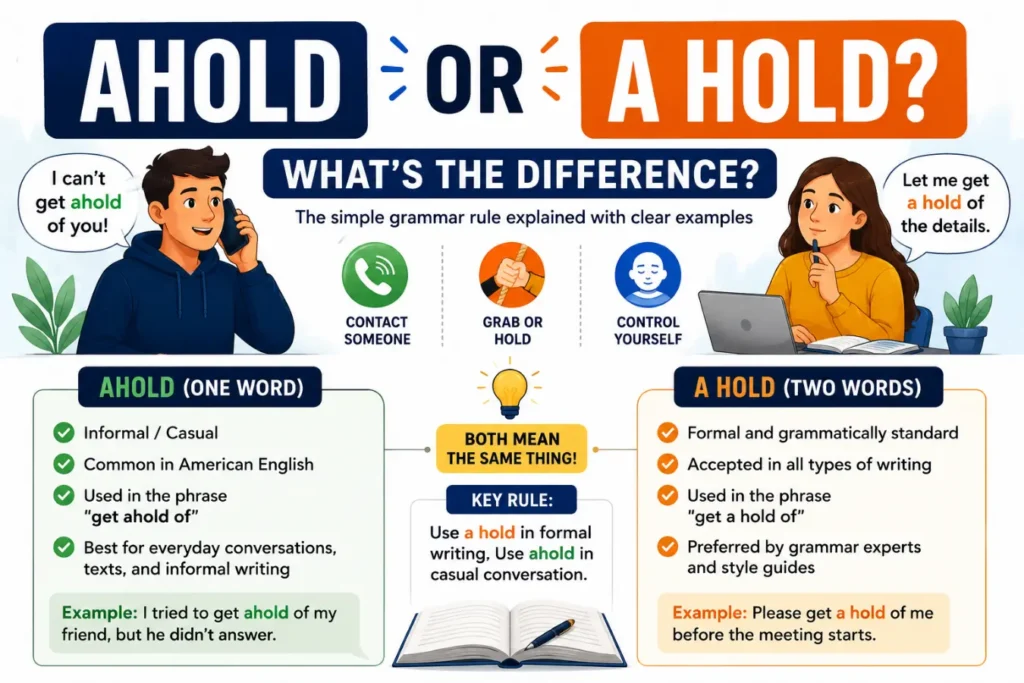
Ahold is an informal American English word. It means to grasp, grab, or make contact with something or someone. It most often appears in the phrase get ahold of. For example: I couldn’t get ahold of my doctor. Here, ahold means to reach or contact someone.
The word combines a and hold into a single unit. This is called a compound word. It evolved through everyday spoken American English. Over time, it found its way into casual written English too. However, most formal grammar guides still prefer the two-word version.
What Does A Hold Mean? The Standard Form Explained
A hold is the two-word version of the same idea. It functions as a noun phrase. Hold is the noun. A is the article in front of it. Together, they mean the act of grasping or gripping something.
For example: Get a hold of yourself. This means calm down or regain control. Another example: She got a hold of the rope. This means she physically grabbed the rope.
A hold is the more versatile form. It works in formal writing, academic papers, and professional communication. Most grammar experts recommend using a hold in any formal or semi-formal setting.
Ahold vs A Hold: Direct Comparison Table
| Feature | Ahold | A Hold |
| Form | One word (compound) | Two words (noun phrase) |
| Register | Informal / Casual | Formal and Informal |
| Common in | American English | All English dialects |
| Example | Get ahold of me | Get a hold of me |
| Formal writing | Not recommended | Recommended |
| Grammar style guides | Rarely listed | Widely accepted |
| Speech | Very common | Very common |
| Business email | Avoid | Use this |
| Fiction / Dialogue | Acceptable | Acceptable |
| Academic writing | Avoid | Use this |
The Origin of Ahold: Where Did This Word Come From?
Ahold has roots in American regional dialects. It developed over time in spoken English. People naturally blended a and hold together for speed and ease. This is a common linguistic process called agglutination — where two words merge into one.
You will find ahold in American literature, especially in dialogue. Authors use it to give characters an authentic, conversational voice. Over time, its use spread from speech into casual writing. Today, many Americans use it without even thinking about it. It feels natural because they have heard it their whole lives.
However, it never made a firm entry into formal grammar. As a result, it sits in a gray zone — widely understood but not universally accepted.
Real-Life Examples: Ahold and A Hold in Sentences
Seeing both forms in action makes the difference much clearer. Here are real-life sentence examples for both:
Examples using ahold:
- I tried to get ahold of the manager, but he was busy.
- Can you get ahold of Sarah and tell her the meeting is canceled?
- He grabbed ahold of the railing before he fell.
- We need to get ahold of some extra chairs for the party.
Examples using a hold:
- She managed to get a hold of the slippery rope.
- Please get a hold of me before noon.
- The wrestler got a hold of his opponent and pinned him down.
- You need to get a hold of your emotions right now.
- The shipping company placed a hold on the package.
Notice that a hold reads more clearly in formal situations. Ahold sounds natural in conversation or casual text messages.
How to Use Get Ahold Of vs Get A Hold Of
Both get ahold of and get a hold of express the same ideas. These phrases carry three distinct meanings depending on context. Understanding each meaning helps you use the phrase correctly.
Meaning 1 — To contact someone:
I have been trying to get a hold of you all day. This means you have been trying to reach or contact someone.
Meaning 2 — To physically grab something:
She got a hold of the ladder before it fell. This means she physically grabbed or gripped the ladder.
Meaning 3 — To control emotions or a situation:
You need to get a hold of yourself. This means calm down, regain composure, or take control.
All three meanings work with both ahold and a hold. The context decides which meaning applies.
Common Mistakes Writers Make with Ahold and A Hold
Many people make the same errors when using these forms. Here are the most frequent mistakes to avoid:
Mistake 1 — Using ahold in formal writing: Formal essays, business emails, and academic papers call for a hold. Using ahold in these contexts looks unprofessional.
Mistake 2 — Treating them as completely different words: Some writers think they mean different things. They do not. They are just stylistic variations of the same expression.
Mistake 3 — Forgetting the phrase entirely: Some writers awkwardly rephrase sentences to avoid the issue. This leads to clunky writing. Just pick the right form and use it confidently.
Mistake 4 — Writing ahold in an overly formal tone: In casual speech or texting, ahold written as one word is perfectly fine. But in a professional report, it sticks out immediately.
Mistake 5 — Confusing a hold with other uses of hold: Hold has many uses in English. A hold specifically refers to the act of grasping or the concept of contact. Do not confuse it with on hold, hold on, or hold back, which carry different meanings.
Tips and Tricks: How to Always Choose the Right Form
Follow these simple tips and you will never make the wrong choice again:
- Tip 1 — Ask yourself: Is this formal or casual? Formal = a hold. Casual = either form works.
- Tip 2 — When in doubt, use two words. A hold is always grammatically safe. You can never go wrong with it.
- Tip 3 — Read it aloud. Both forms sound the same when spoken. If the sentence sounds right out loud, the meaning is correct.
- Tip 4 — Check your style guide. If you write for a publication, check its style guide. AP Style, Chicago Manual of Style, and MLA all favor a hold.
- Tip 5 — Use ahold in dialogue. If you write fiction and want authentic American dialogue, ahold adds a natural spoken quality to your characters voices.
Usage in Daily Life: Where You Will See These Phrases
Both forms show up constantly in everyday language. Here is where you will encounter them most often:
This phrase pops up across every area of life. From casual chats to professional settings, both forms appear constantly in everyday communication.
During phone conversations, for instance, someone might say: Let me get a hold of the office and confirm the details. Here the phrase signals a quick professional follow-up.
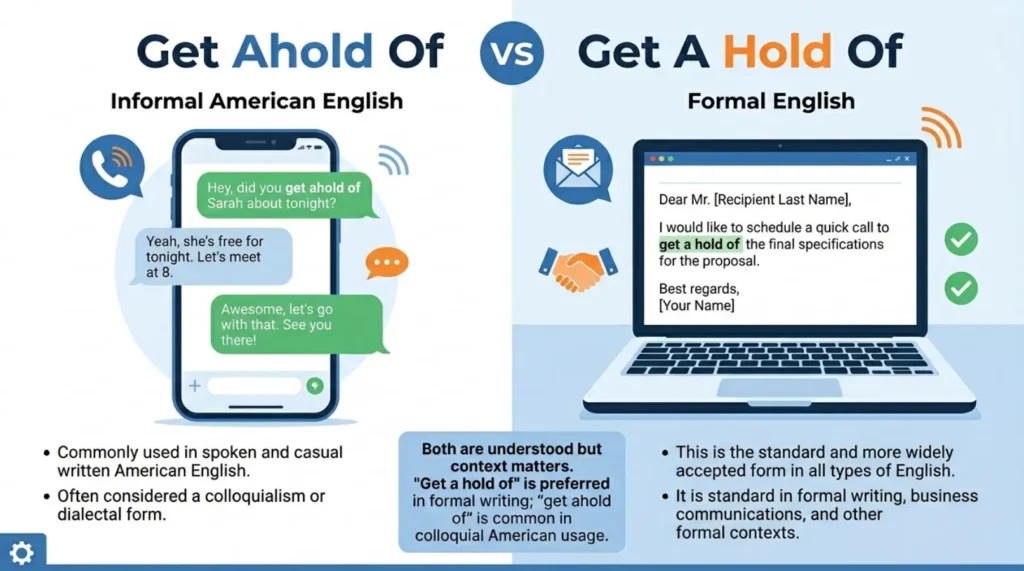
Switching to something more casual, a typical text message might read: Hey, can you get ahold of Jake for me? That one word difference instantly makes the tone feel relaxed and conversational.
In professional emails, however, the two-word form always reads better. A standard closing line like: Please feel free to get a hold of me at your earliest convenience sounds polished and credible.
Beyond the office, sports commentary uses it constantly. A commentator might say: The defender got a hold of the ball and cleared it brilliantly.
Meanwhile, in self-help and motivational content, the phrase takes on an emotional layer. Coaches and writers often say: You need to get a hold of your spending habits before it is too late.
Finally, in news writing, the phrase signals failed contact attempts. A journalist might report: Reporters tried to get a hold of the spokesperson but received no comment by deadline.
Knowing which form to use across all these situations keeps your communication clean, credible, and appropriate for every audience.
Synonyms and Related Phrases You Should Know
Understanding synonyms helps you vary your writing naturally. Here are words and phrases that carry similar meanings to ahold and a hold:
| Synonym / Phrase | Meaning |
| Reach | To contact someone |
| Contact | To get in touch |
| Grasp | To physically grip something |
| Grab | To seize or take hold |
| Get in touch with | To communicate with someone |
| Track down | To find and contact someone |
| Connect with | To reach or communicate |
| Seize | To take firm hold of something |
| Lay hands on | To physically obtain something |
| Calm down | Alternative to get a hold of yourself |
Using these synonyms helps you avoid repetition and keeps your writing fresh and readable.
Ahold or A Hold in Different English Dialects
English varies around the world. This affects how ahold and a hold are used:
American English: Both forms are common. Ahold is very natural in casual American speech. Most Americans use it daily without thinking twice.
British English: A hold is far more common. British English speakers rarely use ahold as a single word. It sounds distinctly American to British ears.
Australian English: A hold is the standard form. Ahold exists but is less frequent.
Canadian English: Similar to American English. Both forms are used. Ahold appears in casual Canadian speech regularly.
So if you write for an international audience, stick with a hold. It is universally understood and accepted across all dialects of English.
Expert Insights: What Grammar Authorities Say
Grammar experts and major style guides weigh in clearly on this topic.
Merriam-Webster Dictionary lists ahold as an informal variant of a hold. It acknowledges the word but flags its informal nature. The dictionary example sentence uses it in the phrase get ahold of.
The Chicago Manual of Style and AP Stylebook both lean toward a hold in formal contexts. Neither explicitly bans ahold, but their examples consistently use the two-word form.
Grammarly, one of the most-used writing tools in the world, flags ahold as informal and suggests a hold as the preferred alternative in professional writing.
The expert consensus: Use a hold in professional, academic, and formal writing. Save ahold for casual conversation, dialogue in fiction, and informal digital communication like texts or social media.
This distinction matters because word choice signals credibility. Formal writing that uses informal constructions can undermine the writer’s authority. Small choices like this add up to a stronger, more professional overall impression.
FAQs: Ahold or A Hold
Q1: Is ahold a real word?
Yes. Merriam-Webster lists ahold as a valid informal American English word. It is widely used in everyday speech and casual writing.
Q2: Which is correct — get ahold of or get a hold of?
Both are correct. Get a hold of is preferred in formal writing. Get ahold of is widely accepted in casual American English.
Q3: Can I use ahold in a business email?
It is better to use a hold in business emails. It reads as more professional and polished to most readers.
Q4: What does get a hold of yourself mean?
It means calm down, regain control, or collect your emotions. It is often used when someone is panicking or overreacting.
Q5: Is ahold used in British English?
Rarely. British English speakers almost exclusively use a hold. Ahold sounds distinctly American to most British readers and speakers.
Q6: Can a hold be used as a noun on its own?
Yes. She kept a hold on the rope uses a hold as a standard noun phrase. It works independently beyond the phrase get a hold of.
Q7: Does on hold mean the same as a hold?
No. On hold means paused or waiting — like a phone call on hold. A hold refers to grasping or contacting. They are different phrases with different meanings.
Q8: How do I remember which to use?
Simple rule: two words for formal writing. One word for casual writing. When in doubt, always choose a hold.
Conclusion
So, ahold or a hold — which one should you use? The answer depends entirely on your context. Both forms are widely understood and used by millions of English speakers every day. However, a hold is the safer, more universally accepted choice. It works in formal writing, professional settings, and across all English dialects. Ahold is perfectly fine in casual American speech and informal writing. The key takeaway is simple: when in doubt, go with two words. Get a hold of will never let you down in any context. Keep this guide bookmarked, and you will never second-guess yourself on this grammar question again.