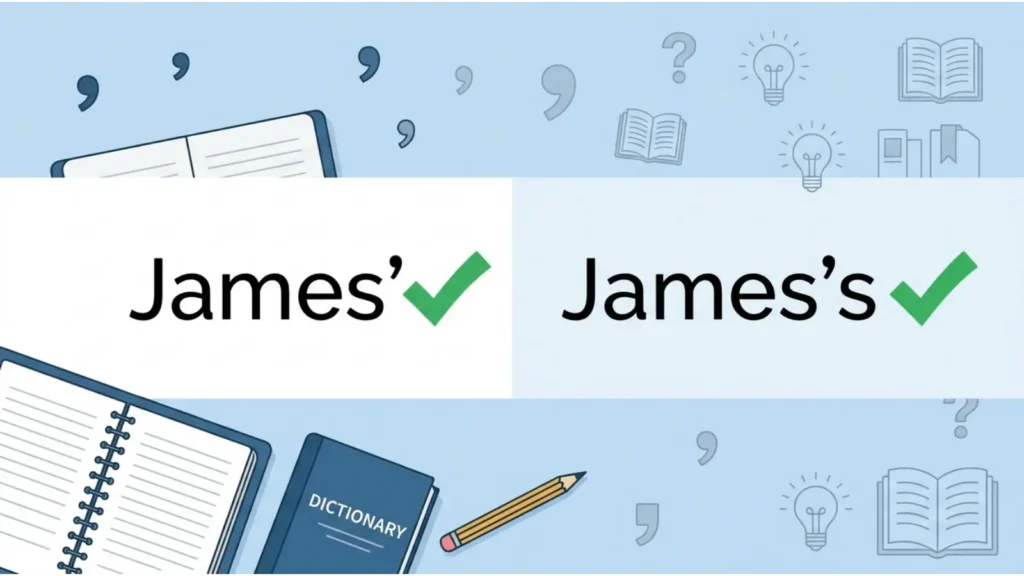
James’ or James’s is a common grammar question that confuses many writers. If you have ever wondered which form is correct, you are not alone. Both forms appear in books, articles, and everyday writing. As a result, many people feel unsure when showing possession with names ending in “s.”
The good news is that grammar style guides provide clear rules. However, different guides sometimes recommend different forms. That is why you may see both versions used.
In this guide, you will learn the difference between James’ and James’s, when to use each one, and which form most grammar experts prefer. You will also find examples, comparison tables, common mistakes, and expert writing tips to help you use possessives correctly.
Quick Summary Box
- James’s is the preferred possessive form in most modern style guides.
- James’ is accepted in some style guides.
- Both forms show ownership or possession.
- James’s follows the standard possessive rule for singular nouns.
- Different publishers may use different style rules.
- Consistency matters more than personal preference.
- Most teachers recommend James’s in everyday writing.
- Always follow the style guide required for your work.
What Does “James’ or James’s” Mean?
The phrase James’ or James’s refers to two ways of showing possession for the name James.
Possession means ownership.
For example:
- James’s car
- James’ car
Both examples mean the car belongs to James.
The difference comes from grammar style choices rather than meaning.
What Is a Possessive Noun?
A possessive noun shows ownership.
Examples include:
- Sarah’s book
- David’s phone
- Emma’s jacket
The apostrophe helps indicate possession.
Most singular nouns form the possessive by adding:
‘s
For example:
- Mark → Mark’s
- Lisa → Lisa’s
- James → James’s
This rule forms the basis of modern English possessives.
James’ or James’s? The Simple Answer
The simple answer is:
James’s is usually correct in modern English.
Most major grammar authorities recommend adding ‘s to singular nouns, even when they end with the letter “s.”
Examples:
- James’s house
- James’s bicycle
- James’s dog
However, some style guides allow:
- James’ house
- James’ bicycle
- James’ dog
Therefore, both forms can be correct depending on the writing style.
Why Do Both Forms Exist?
English grammar has evolved over time.
Historically, many writers preferred adding only an apostrophe after names ending in “s.”
Examples:
- Charles’
- James’
- Thomas’
Later, many grammar experts favored adding ‘s to all singular nouns.
This approach created consistency.
As a result, both traditions still appear today.
James’ vs James’s Comparison Table
| Feature | James’s | James’ |
| Shows possession | Yes | Yes |
| Modern grammar preference | Yes | Sometimes |
| Used by many teachers | Yes | Less often |
| Common in everyday writing | Yes | Sometimes |
| Easier pronunciation match | Yes | No |
| Accepted by some style guides | Yes | Yes |
| Recommended for students | Yes | Usually |
The table shows why many writers choose James’s today.

What Major Style Guides Say
Different style guides handle possessives differently.
Chicago Manual of Style
The Chicago Manual of Style recommends:
James’s
Example:
- James’s notebook
MLA Style
MLA also prefers:
James’s
Example:
- James’s essay
APA Style
APA generally follows the standard singular possessive rule.
Example:
- James’s research
AP Style
AP Style often prefers:
James’
Example:
- James’ report
Therefore, the correct choice may depend on the style guide you follow.
Why James’s Is Often Preferred
Many grammar experts prefer James’s for several reasons.
It Follows Standard Rules
Most singular nouns simply add ‘s.
It Reflects Pronunciation
People usually say:
“James-iz”
The extra “s” matches how the word sounds.
It Improves Consistency
Writers can apply one rule to all singular nouns.
This reduces confusion.
Because of these benefits, James’s remains the preferred form in many settings.
Real-Life Examples of Possessive Form “James’s”
Here are simple and clear real-life examples that show how we use James’s to show ownership or belonging in different situations.
School Example
James completed all his homework on time.
James’s teacher praised his effort in class.
The teacher also checked James’s notebook carefully.
This shows that the work belongs to James.
Workplace Example
James gave a strong presentation during the meeting.
His manager appreciated James’s ideas and planning.
The team also liked James’s professional approach.
In this case, James’s work and skills are being discussed.
Home Situation
At home, James keeps his bicycle in the garage.
James’s room is always clean and well-organized.
His family often uses James’s laptop for small tasks.
These examples show personal belongings and space.
Sports Example
During the match, James wore his team jersey proudly.
James’s jersey was seen hanging in the locker room after the game.
Fans also noticed James’s performance on the field.
This shows ownership in a sports context.
Real-Life Examples of James’
Some publications use the shorter form.
Examples:
- James’ office is on the second floor.
- James’ project won an award.
- James’ schedule changed today.
These examples are not wrong if the chosen style guide allows them.
Common Mistakes People Make
Writers often make several possessive errors.
Forgetting the Apostrophe
Incorrect:
- James car
Correct:
- James’s car
Using a Plural Form
Incorrect:
- Jameses car
Correct:
- James’s car
Mixing Style Rules
Incorrect:
- James’s book and Charles’ notebook in the same document without a style reason.
Choose one style and stay consistent.
Adding Extra Apostrophes
Incorrect:
- James’s’ car
Correct:
- James’s car
Avoiding these mistakes improves writing quality.
Easy Trick to Remember the Rule
Try this simple method.
Ask yourself:
“Is James one person or more than one?”
If the answer is one person, add:
‘s
Example:
- James’s laptop
This trick works for most names.
Examples:
- Chris’s bike
- Thomas’s coat
- Lucas’s room
The rule remains simple and consistent.
How Possessives Work With Other Names Ending in S
Many names end with the letter “s.”
Examples include:
- Chris
- Thomas
- Lucas
- Charles
- Alexis
Modern grammar typically forms possessives like this:
| Name | Possessive Form |
| Chris | Chris’s |
| Thomas | Thomas’s |
| Lucas | Lucas’s |
| Charles | Charles’s |
| Alexis | Alexis’s |
James follows the same pattern.
James’ or James’s in Daily Writing
You may use possessive forms in many situations.
Examples include:
- Emails
- School papers
- Blog posts
- Business reports
- Social media captions
- Personal letters
Most everyday writing benefits from using James’s because it follows modern grammar standards.
However, always follow required style guidelines.
Expert Insights on Possessive Grammar
Language experts generally recommend clarity and consistency.
Many editors prefer James’s because it follows standard possessive rules.
Professional writers often use the style guide required by their publisher.
Students usually benefit from learning the standard form first.
Therefore, James’s remains the safest choice when no style guide is specified.
Good grammar builds credibility and improves readability.
Synonyms and Related Grammar Terms
People searching for this topic may also look for:
- Possessive noun rules
- Apostrophe grammar
- Singular possessive nouns
- Proper noun possessives
- English punctuation rules
- Apostrophe usage
- Grammar for names ending in s
- Possessive form examples
- James possessive form
- Apostrophe placement rules
Frequently Asked Questions
Is James’s grammatically correct?
Yes. Most modern grammar guides consider James’s correct.
Is James’ also correct?
Yes. Some style guides accept James’.
Which is more common today?
James’s is more common in modern English writing.
Why do some writers use James’?
Certain style guides prefer dropping the extra “s.”
What do teachers usually recommend?
Most teachers recommend James’s.
How do I know which form to use?
Follow the style guide required for your work.
Is James’s used in academic writing?
Yes. Many academic styles prefer James’s.
Can both forms appear in published books?
Yes. Different publishers follow different style guides.
Conclusion
The debate over James’ or James’s often comes down to style preferences. Both forms can be correct, but James’s is the preferred choice in most modern grammar guides. It follows the standard rule for singular possessive nouns and matches normal pronunciation.
Meanwhile, some style guides, especially AP Style, allow James’. That is why you may see both forms in books, newspapers, and online content. The key is consistency. Once you choose a style, use it throughout your writing.
If no specific style guide applies, James’s is usually the safest option. Following this rule will help your writing look polished, professional, and grammatically correct.