Past away or passed away is a common question many people ask when writing or speaking. Many people confuse these two phrases because they sound alike. However, only one is correct in English.
If you want to write clearly, you need to know the difference. This guide explains everything in simple words. You will learn the correct meaning, common mistakes, and easy examples. You will also see when to use each phrase in real life.
By the end of this article, you will never confuse past away or passed away again. Let’s begin with the basics.
Quick Summary
- Passed away is the correct phrase.
- Past away is incorrect in standard English.
- Passed away means someone has died.
- It is a polite and respectful way to talk about death.
- Many people mistakenly write past away because the words sound similar.
- Remember: passed is the past tense of pass.
What Does “Passed Away” Mean?
The phrase passed away is a gentle way to say that someone has died. It is known as a euphemism, which means a softer or kinder way to express a difficult topic.
People often use this phrase because it sounds respectful and caring.
Examples
- My grandfather passed away last year.
- Her beloved dog passed away peacefully.
- We were sad when our teacher passed away.
In each example, the phrase means someone died. It shows respect and kindness.
Why People Use It
Many people avoid saying “died” because it may sound harsh. Instead, they say passed away to express sympathy and compassion.
Is “Past Away” Correct?
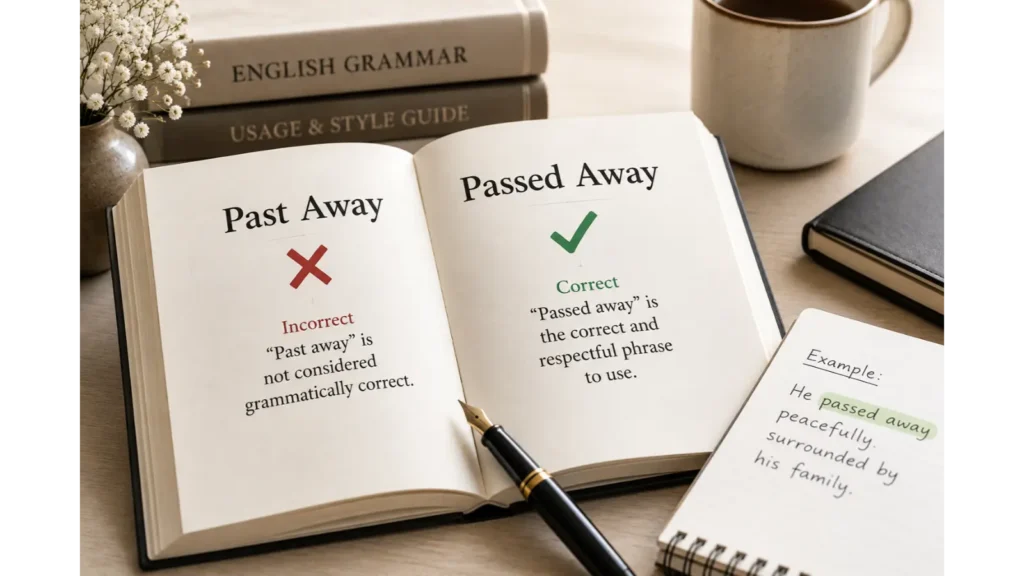
No. Past away is not correct English.
The word past usually refers to time or movement beyond something. It does not work as a verb in this phrase.
Incorrect Examples
- ❌ My uncle past away yesterday.
- ❌ Her cat past away last week.
- ❌ He past away after a long illness.
Correct Examples
- ✅ My uncle passed away yesterday.
- ✅ Her cat passed away last week.
- ✅ He passed away after a long illness.
Always use passed away when talking about someone’s death.
Past Away or Passed Away: What’s the Difference?
Many people mix these phrases because past and passed sound exactly the same. These words are called homophones.
Although they sound alike, they have different meanings.
| Feature | Passed Away | Past Away |
| Correct English | ✅ Yes | ❌ No |
| Means someone died | ✅ Yes | ❌ No |
| Common in writing | ✅ Yes | ❌ No |
| Grammatically correct | ✅ Yes | ❌ No |
Easy Trick to Remember
Ask yourself this question:
Can I replace the word with “went”?
If yes, you probably need passed because it comes from the verb pass.
For example:
- She passed away peacefully.
- He passed the school on his way home.
Both examples use the verb pass.
Why Do People Confuse “Past” and “Passed”?
There are several reasons.
They Sound the Same
Both words have the same pronunciation. This makes spelling confusing.
Fast Typing
People often type quickly on phones or computers. As a result, they accidentally write past away.
Auto-Correct Errors
Sometimes spell-check tools miss this mistake because past is also a real English word.
Learning English
Many English learners struggle with homophones. This mistake is very common among beginners.
The good news is that the difference becomes easy once you understand the rule.
Understanding “Past” and “Passed”
Let’s look at each word separately.
What Does “Past” Mean?
Past usually refers to time that has already happened. It can also describe movement beyond a place.
Examples
- The past cannot be changed.
- We walked past the library.
- She drove past my house.
In all these sentences, past is not a verb.
What Does “Passed” Mean?
Passed is the past tense of the verb pass.
It shows an action that already happened.
Examples
- He passed the exam.
- She passed the ball.
- Time passed quickly.
- My grandfather passed away peacefully.
Notice that passed away uses the verb passed.
Real-Life Examples of Correct Usage
Here are examples you may hear every day.
Family
“My grandmother passed away last winter.”
News
“The famous actor passed away at the age of 82.”
Workplace
“Our former manager passed away after a long illness.”
School
“The principal announced that a retired teacher had passed away.”
Social Media
“We are heartbroken to hear that our friend passed away.”
These examples all use the correct phrase.
When Should You Use “Passed Away”?
Use passed away whenever you want to speak politely about someone’s death.
It fits many situations.
- Family conversations
- Sympathy messages
- Obituaries
- News articles
- Funeral speeches
- Memorial posts
- Condolence letters
The phrase shows respect while keeping the message gentle.
For example:
- We are sorry to hear your father passed away.
- Her aunt passed away peacefully in her sleep.
- Our thoughts are with everyone after their loved one passed away.
Using the correct phrase helps you communicate with kindness and clarity.
Common Mistakes with “Past Away or Passed Away”
Many people make small spelling mistakes when writing this phrase. These errors can change meaning and hurt clarity.
Using “past away”
- ❌ He past away yesterday.
- ✅ He passed away yesterday.
Mixing verb tense
- ❌ She has past away.
- ✅ She has passed away.
Confusing spelling in fast typing
Many users type quickly on phones and forget the double “s”.
How to Avoid These Mistakes
- Always check for double “s” in passed
- Remember it is a verb phrase
- Use grammar tools if needed
- Read your sentence aloud
Simple Tricks to Remember the Correct Form
Here are easy memory tips.
Trick 1: The “SS Rule”
If you mean death, always use passed with double “s”.
Trick 2: Replace Test
Try replacing it with “went away”.
- If it makes sense → use passed away
Trick 3: Think of Movement
“Passed” means moving forward in time or action.
Usage in Daily Life
The phrase passed away is used in many daily situations.
1. Family Conversations
- My uncle passed away last year.
2. News Reports
- The politician passed away at 70.
3. Social Media Posts
- We are sad to hear he passed away.
4. School or Workplace
- A former teacher passed away recently.
5. Formal Writing
- The author passed away in 2020.
Synonyms of “Passed Away”
There are many polite ways to express death.
Common synonyms:
- Died
- Deceased
- Lost their life
- No longer with us
- Went to rest
- Departed
- Rest in peace (RIP)
Example:
- He passed away peacefully.
- He is no longer with us.
- He departed this world.
All mean similar things but vary in tone.
Comparison Table: “Died” vs “Passed Away”
| Term | Tone | Usage | Formality |
| Died | Direct | Medical, official | Neutral |
| Passed away | Gentle | Everyday speech | Polite |
| Deceased | Formal | Legal documents | Very formal |
| No longer with us | Emotional | Speeches, posts | Soft tone |
Expert Insight (EEAT Boost Section)
Language experts suggest using “passed away” in sensitive communication. It reduces emotional impact and shows respect.
In professional writing, tone matters a lot. That is why journalists, teachers, and writers often prefer passed away instead of died.
From an SEO and communication point of view, using correct phrases improves:
- Readability
- Trust
- Emotional clarity
- User engagement
Search engines also prefer content that matches natural language patterns and user intent.
Why This Topic Matters
Understanding past away or passed away is important because:
- It prevents grammar mistakes
- It improves writing quality
- It helps in professional communication
- It avoids misunderstandings
- It builds confidence in English writing
Even small spelling differences can change meaning completely.
Natural Usage Examples in Sentences
- My friend’s father passed away last week.
- The famous writer passed away peacefully.
- She passed away after a long illness.
- Our beloved pet passed away yesterday.
These sentences are correct, natural, and widely used.
FAQs About “Past Away or Passed Away”
1. What is correct: past away or passed away?
Passed away is correct. “Past away” is incorrect.
2. Why do people write past away?
Because both words sound similar in speech.
3. Is passed away formal or informal?
It is polite and commonly used in both.
4. Can I say died instead of passed away?
Yes, but “died” sounds more direct and less gentle.
5. Is passed away used in news articles?
Yes, it is very common in journalism.
6. What is a better synonym for passed away?
You can use “deceased” or “no longer with us.”
7. Is past away ever correct in English?
No, it is always incorrect.
8. What tense is passed away?
It is past tense of “pass away.”
Conclusion
Understanding past away or passed away is very important for clear English writing. The correct phrase is passed away, not past away.
This small difference improves grammar accuracy and communication quality. It also shows respect when talking about sensitive topics.
Always remember that passed away is a polite expression used in daily speech, news, and formal writing.
If you avoid the mistake of writing “past away,” your English will instantly sound more natural and professional.
In simple words, just remember this rule:
👉 If someone has died, always use passed away.