
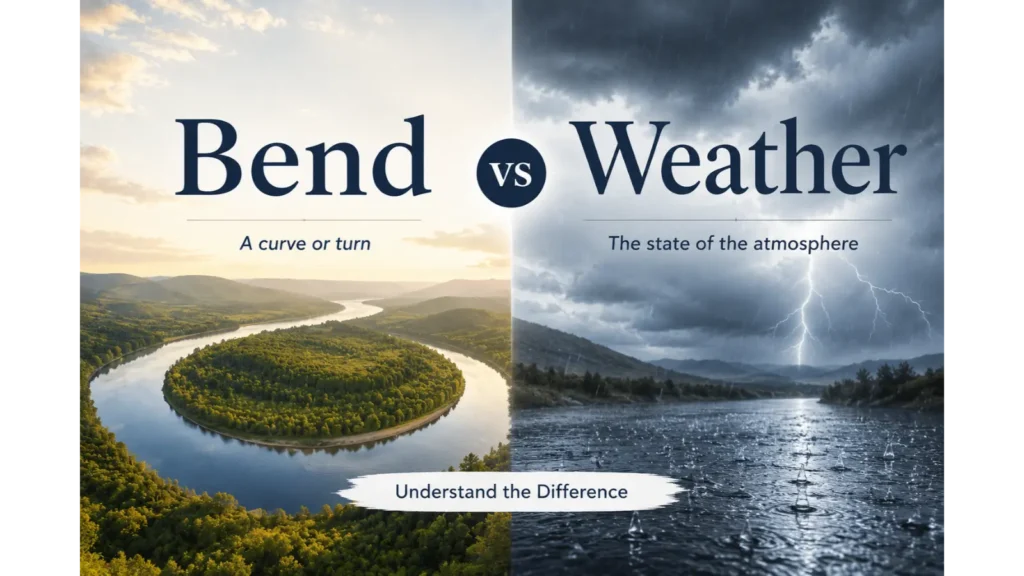
Bend or weather is a confusing phrase for many learners. Moreover, bend or weather often appears in search questions online. Bend or weather meaning depends on context and usage. In this guide, we will clear all confusion in simple English.
Many people think both words are similar, but they are not. They belong to different meanings and uses. This confusion happens due to spelling and pronunciation patterns in English.
In this article, you will learn the correct meaning of both words. You will see real examples, daily usage, and simple comparisons. We will also explain common mistakes and easy memory tricks. By the end, you will clearly understand how to use “bend” and “weather” correctly in real life.
Quick Summary Box
- Bend means to curve or shape something
- Weather means atmospheric conditions like rain, heat, or wind
- Both words have completely different meanings
- “Bend” is about shape and movement
- “Weather” is about climate and nature
- Confusion happens due to spelling similarity in learning queries
- Both words are commonly used in daily English
- Understanding them improves vocabulary and communication
What Does “Bend” Mean?
“Bend” means to make something curve or change shape.
Simple meaning:
👉 To move or shape something into a curve
Examples:
- Please bend the paper carefully.
- The tree bends in strong wind.
- She bends her arm while exercising.
“Bend” can also mean turning direction.
Example:
- The road bends to the right.
It is used in both physical and movement contexts.
What Does “Weather” Mean?
“Weather” means the condition of the air outside.
It includes:
- Rain
- Sunlight
- Wind
- Temperature
- Clouds
Simple meaning:
👉 The condition of the atmosphere
Examples:
- The weather is sunny today.
- Bad weather delayed the flight.
- Cold weather makes people wear jackets.
Weather changes every day.
Bend or Weather: Key Difference Explained
Now let’s understand the main difference clearly.
| Feature | Bend | Weather |
| Meaning | Curve or shape | Climate condition |
| Category | Action/Verb | Nature/Noun |
| Use | Objects, movement | Environment |
| Example | Bend the rod | Rainy weather |
| Field | Physical action | Meteorology |
Simple rule:
- Bend = shape change
- Weather = nature condition
Real-Life Examples of “Bend”
1. Physical Objects
- Bend the wire carefully.
2. Human Body
- He bends his knees while sitting.
3. Nature
- Trees bend during storms.
4. Roads
- The road bends near the hill.
These examples show movement or shape change.
Real-Life Examples of “Weather”
1. Daily Life
- The weather is hot today.
2. Travel
- Bad weather delayed the train.
3. Clothing
- Cold weather needs warm clothes.
4. Farming
- Weather affects crop growth.
Weather impacts many parts of life.
Common Mistakes People Make
Mixing meanings
- ❌ The bend is rainy today
- ✅ The weather is rainy today
Wrong usage in sentences
- ❌ Bend is very cold today
- ✅ Weather is very cold today
Thinking both are related
They are not related in meaning.
Easy Tips to Remember
Shape Rule
- Bend = body or object shape
Sky Rule
- Weather = sky and atmosphere
Daily Thinking
- If you can touch it → bend
- If you feel it outside → weather
Usage in Daily Life
Bend in Daily Life
- Exercise and fitness
- Construction work
- Driving and roads
- Crafting and design
Weather in Daily Life
- Clothing choices
- Travel planning
- Farming decisions
- Event planning
Both words are used very often but in different situations.
Synonyms and Related Words
Bend Synonyms:
- Curve
- Twist
- Turn
- Flex
- Arc
Synonyms of Weather:
- Climate condition
- Atmosphere
- Weather conditions
- Forecast environment
- Seasonal state
Comparison with Real Context
Example 1:
- Bend the metal rod to fit
- Weather is too cold for work
Example 2:
- The tree will bend in wind
- Weather may bring rain tomorrow
These examples show clear difference.
Why “Bend or Weather” Confusion Happens
Many learners search bend or weather because:
- English spelling confusion
- Similar word patterns in typing
- Auto-correct suggestions
- Lack of vocabulary knowledge
This confusion is common in beginner English learning.
Expert Insight (EEAT Section)
Language experts explain that confusion between words like “bend” and “weather” comes from limited contextual learning.
In linguistics, words must be learned through usage, not memorization only.
Understanding bend or weather helps improve:
- Vocabulary clarity
- Sentence accuracy
- Communication confidence
- Writing fluency
From an SEO and learning perspective, clear differentiation between unrelated words improves user intent satisfaction and reading comprehension.
FAQs (People Also Ask)
1. What is the meaning of bend?
It means to curve or shape something.
2. What is the meaning of weather?
It means atmospheric conditions like rain or sun.
3. Is bend related to weather?
No, both have different meanings.
4. Can weather be used as a verb?
No, weather is usually a noun.
5. What is an example of bend?
She bends the paper carefully.
6. What is an example of weather?
The weather is very cold today.
7. Why do people confuse bend or weather?
Because of spelling confusion in search queries.
8. Which is correct in daily use?
Both are correct, but in different contexts.
Conclusion
Understanding bend or weather is simple once you learn their meanings. “Bend” refers to changing shape or direction. “Weather” refers to atmospheric conditions like rain, wind, or sun.
Both words are important in English but used in different situations. Many learners confuse them because they sound unrelated in meaning but appear in similar search patterns.
Once you remember the simple rule—bend is shape and weather is nature—you will never mix them again.
So next time you see bend or weather, you will clearly understand the difference and use each word correctly in daily life.