Eyeing or eying is a common English spelling confusion many people search online. The term eyeing or eying is often used when someone is looking at something with interest. The correct form is “eyeing,” but “eying” is also accepted in some writing styles. In this guide on eyeing or eying, we will explain both forms in very simple English.
The phrase eyeing or eying comes from the word “eye,” which means to look carefully. People use it when they watch, observe, or show interest in something. For example, someone may be eyeing a new phone or eying a job opportunity.
In this article, you will clearly understand eyeing or eying, their meaning, usage, examples, and correct grammar rules. Everything is explained in short and easy sentences for better learning.
Quick Summary Box
- “Eyeing” and “eying” both come from the word eye
- Both mean looking at something with interest
- “Eyeing” is more common in modern English
- “Eying” is older but still correct in some styles
- Used in daily English conversation
- Common in writing, speech, and storytelling
- Means observing or watching closely
What Does Eyeing or Eying Mean?
The phrase eyeing or eying means to look at something carefully or with interest.
In simple words:
- You want something
- You are watching it closely
- You are thinking about it
This word is often used in everyday English. It is part of modern usage in English Grammar.
Example:
- She is eyeing a new dress in the shop.
- He is eying the last piece of cake.
Both forms show strong attention or desire.
Eyeing vs Eying: What is the Difference?
Many learners get confused between the two forms.
Here is the simple truth:
- “Eyeing” is the most common spelling today
- “Eying” is an older or simplified form
- Both come from the verb “to eye”
- Both are grammatically accepted
However, in modern writing, eyeing is preferred.
Why Do People Write Eyeing or Eying?

People often search eyeing or eying because:
- They hear both versions in speech
- Spelling rules feel unclear
- English pronunciation drops the letter “e” sound
- Social media uses both forms
- Learners mix old and modern usage
So, confusion is normal for beginners.
Grammar Explanation in Simple Words
The word “eyeing” is a present participle form of the verb “eye.”
In English Grammar:
- Base verb: eye
- Present participle: eyeing / eying
- Meaning: watching or observing
When we add “-ing,” we show ongoing action.
Example:
- She is eyeing the prize.
- They are eyeing each other in competition.
Common Uses in Real Situations
You can see this word in daily life easily.
Examples:
- A child eyeing candy in a shop
- A worker eyeing a promotion
- A student eyeing high grades
- A player eyeing the trophy
- A shopper eyeing discounts
These examples show desire or interest.
Eyeing or Eying in Daily Life
We use this phrase in many situations.
Common uses:
- Shopping decisions
- Job opportunities
- Food choices
- Competition and sports
- Fashion and lifestyle
It shows strong attention toward something.
Comparison Table: Eyeing vs Eying
| Feature | Eyeing | Eying |
| Correctness | Correct | Correct (less common) |
| Usage today | Very common | Less common |
| Style | Modern English | Older English style |
| Meaning | Looking with interest | Same meaning |
| Grammar use | Present participle | Present participle |
So, both are correct in meaning, but “eyeing” is preferred.
Common Mistakes People Make
Many learners get confused about the correct spelling.
Common errors:
- Thinking “eying” is wrong
- Using “eyeing” incorrectly in tense
- Confusing it with “watching”
- Overusing in formal writing
- Spelling it as “eyingg”
Avoiding these mistakes improves your English skills.
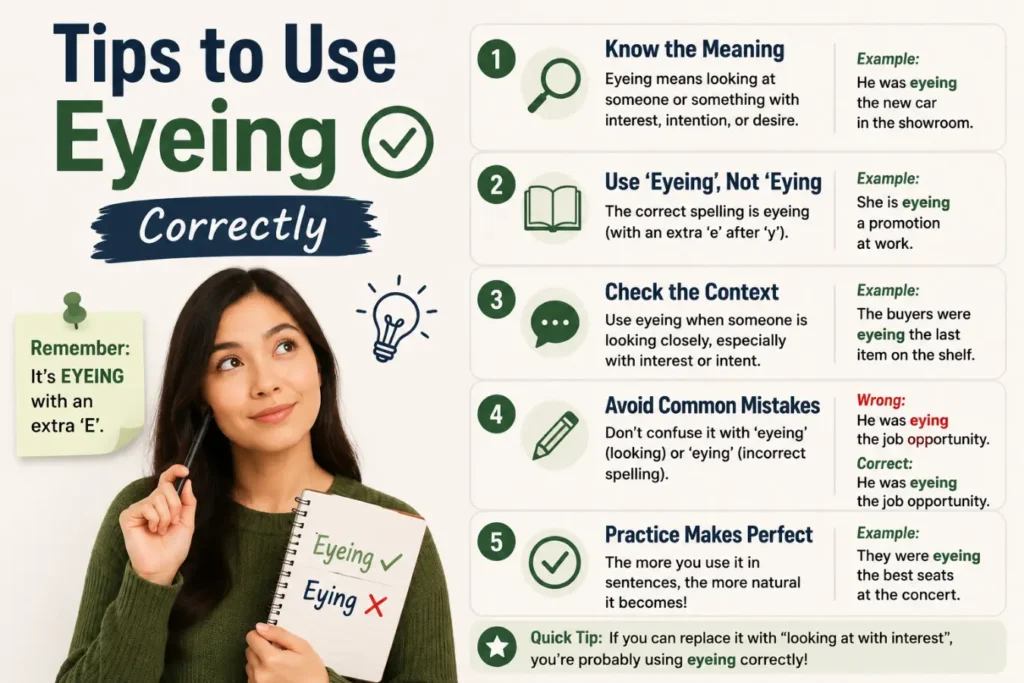
Tips to Use Eyeing Correctly
Here are simple tips:
- Use “eyeing” in modern writing
- Think of it as “looking with interest”
- Use it in informal and creative sentences
- Avoid overuse in formal essays
- Practice with daily examples
These tips help you sound natural in English.
Synonyms of Eyeing or Eying
There are many similar words you can use.
Synonyms include:
- Watching
- Observing
- Staring at
- Noticing
- Checking out
- Keeping an eye on
These words help avoid repetition.
Eyeing in Real-Life Situations
Here are simple real-life scenarios:
- A buyer eyeing a new smartphone
- A student eyeing exam results
- A player eyeing victory in a match
- A traveler eyeing a vacation spot
- A worker eyeing a job promotion
These examples show natural usage.
Expert Insights on Eyeing or Eying
Language experts in English Grammar explain that both forms developed from the verb “eye.”
Key expert points:
- Language changes over time
- Modern English prefers simpler spelling
- “Eyeing” is widely accepted in education and media
- “Eying” appears in older texts and literature
For SEO writing and academic use, “eyeing” is the safest choice.
Understanding this helps improve writing quality and clarity. It also improves communication in both formal and informal English.
Why This Topic Matters
Understanding eyeing or eying is important for learners, writers, and professionals.
It helps you:
- Write correct English
- Improve grammar knowledge
- Avoid spelling confusion
- Sound more natural in communication
This topic also improves your SEO writing skills because many users search for it. Clear understanding builds strong language authority and confidence.
FAQs About Eyeing or Eying
1. What is correct, eyeing or eying?
Both are correct, but “eyeing” is more commonly used.
2. What does eyeing mean?
It means looking at something with interest or desire.
3. Is eying wrong in English?
No, but it is less common than eyeing.
4. Can I use eyeing in formal writing?
Yes, “eyeing” is widely accepted in modern English.
5. Why do people use eying?
It comes from older spelling and pronunciation habits.
6. Is eyeing a verb or noun?
It is a verb form (present participle).
7. What is another word for eyeing?
Watching, observing, or noticing are similar words.
8. How do I use eyeing in a sentence?
Example: She is eyeing a new phone in the store.
Conclusion
The topic of eyeing or eying is simple once you understand it clearly. Both forms come from the verb “eye,” which means to look at something with interest. However, “eyeing” is the most common and preferred spelling in modern English.
You can use this word in daily life when talking about shopping, goals, or interests. It shows attention and desire in a natural way. Understanding eyeing or eying improves your grammar and writing confidence.
In short, remember this: both forms exist, but “eyeing” is the best choice for most situations. Using the correct form helps you write clearer and more professional English.