

Have you ever typed “journeys or journies” and stopped to wonder which spelling is right? You are not alone. Many people make this mistake every day. The correct spelling is journeys, and this article explains exactly why. In addition, we will cover the meaning, usage, examples, and common errors. By the end, you will never confuse these two spellings again. This guide is simple, clear, and easy to follow. So let us get started right away.
Quick Summary Box
Featured Snippet Target
- The correct plural of “journey” is journeys, not “journies.”
- “Journies” is a spelling mistake and does not exist in standard English.
- The rule: words ending in a vowel + Y → just add S, not “ies.”
- Example: journey → journeys / monkey → monkeys / turkey → turkeys
- “Journey” means a trip, travel, or process of moving from one place to another.
What Does “Journey” Mean?
A journey is the act of traveling from one place to another. It can be a short trip or a long adventure. However, the word is not limited to physical travel. It also describes a personal experience or life process.
For example, learning a new skill is a journey. Similarly, recovering from illness is also a journey. The word carries a deep and meaningful sense in everyday English.
Simple definition: A journey is a trip or a process of change and growth.
Journeys or Journies – What Is the Correct Spelling?
Let us answer the main question directly.
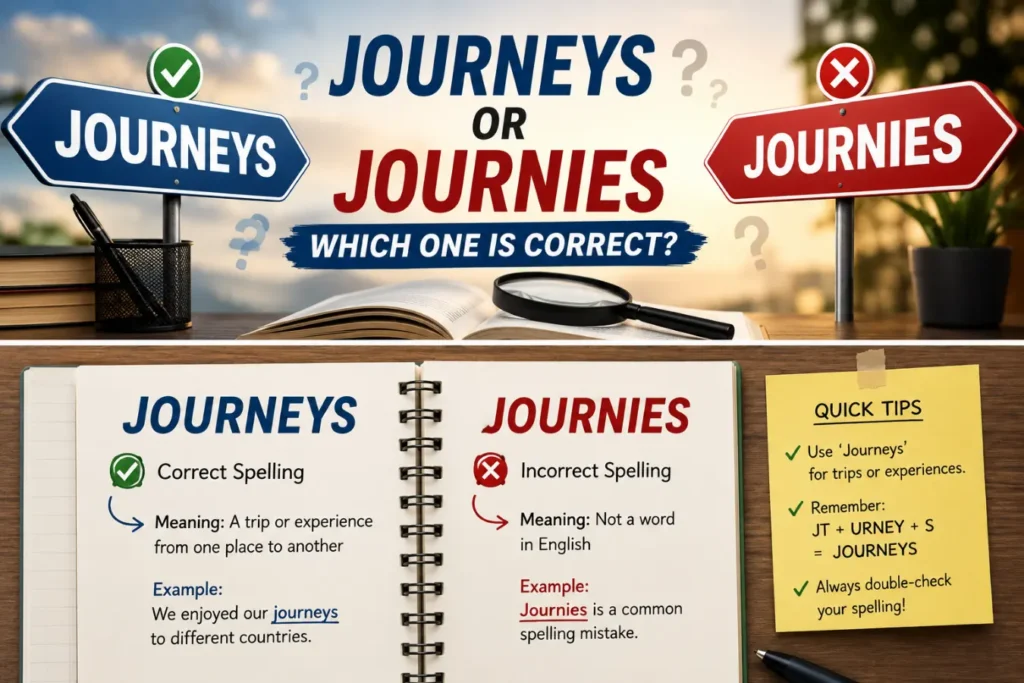
The correct spelling is journeys.
“Journies” is incorrect and a very common spelling mistake. Many people confuse it because of a general grammar rule in English. That rule says words ending in Y change to “ies” in plural form.
However, that rule only applies to consonant + Y words. Since “journey” ends in vowel + Y (the vowel is “e”), you simply add S.
Correct: journeys
Incorrect: journies
This is an important spelling rule to remember in English writing.
The Simple Grammar Rule Behind the Spelling
English plural rules for words ending in Y follow two patterns.
Rule 1 – Consonant + Y → Remove Y, add “ies”
baby → babies
city → cities
story → stories
Rule 2 – Vowel + Y → Add “S”
journey → journeys
monkey → monkeys
turkey → turkeys
valley → valleys
donkey → donkeys
Since “journey” ends in E-Y, it follows Rule 2. Therefore, we simply add S to make it journeys.
Once you understand this rule, spelling becomes much easier and more natural.
Real-Life Examples of “Journeys” Used Correctly
Seeing a word in context always helps you remember it better. Here are some real-life examples:
- Our journeys have shaped who we are today.
- The train offers comfortable journeys across the country.
- Long journeys can be tiring but also rewarding.
- She documented her solo journeys in a travel blog.
- The company helps customers track their journeys from start to finish.
- Both their journeys began in the same small town.
- These short journeys are perfect for weekend travel.
In all these examples, “journeys” fits naturally. On the other hand, “journies” would look incorrect and unnatural.
Comparison Table – Journeys vs Journies
| Feature | Journeys | Journies |
| Correct spelling | Yes | No |
| Exists in dictionary | Yes | No |
| Grammar rule applied | Vowel + Y → add S | Incorrect rule |
| Used in formal writing | Yes | No |
| Used in casual writing | Yes | Avoid |
| Accepted by spellcheck | Yes | No |
This comparison clearly shows that journeys is always correct.
Common Mistakes People Make
Many writers still make errors with this word. Let us look at the most common ones.
Mistake 1 – Writing “journies” instead of “journeys”
This happens when people apply the wrong plural rule.
Mistake 2 – Confusing similar word patterns
Words like “monkey → monkeys” follow the same rule. Mixing patterns often leads to confusion.
Mistake 3 – Using “journey’s” instead of “journeys”
“Journey’s” is possessive, not plural.
Example: The journey’s end was beautiful.
If you mean more than one journey, always write journeys without an apostrophe.
Mistake 4 – Applying the -ies rule blindly
Not all Y-ending words follow the same rule. It depends on the letter before Y.
How to Remember the Correct Spelling – Tips and Tricks
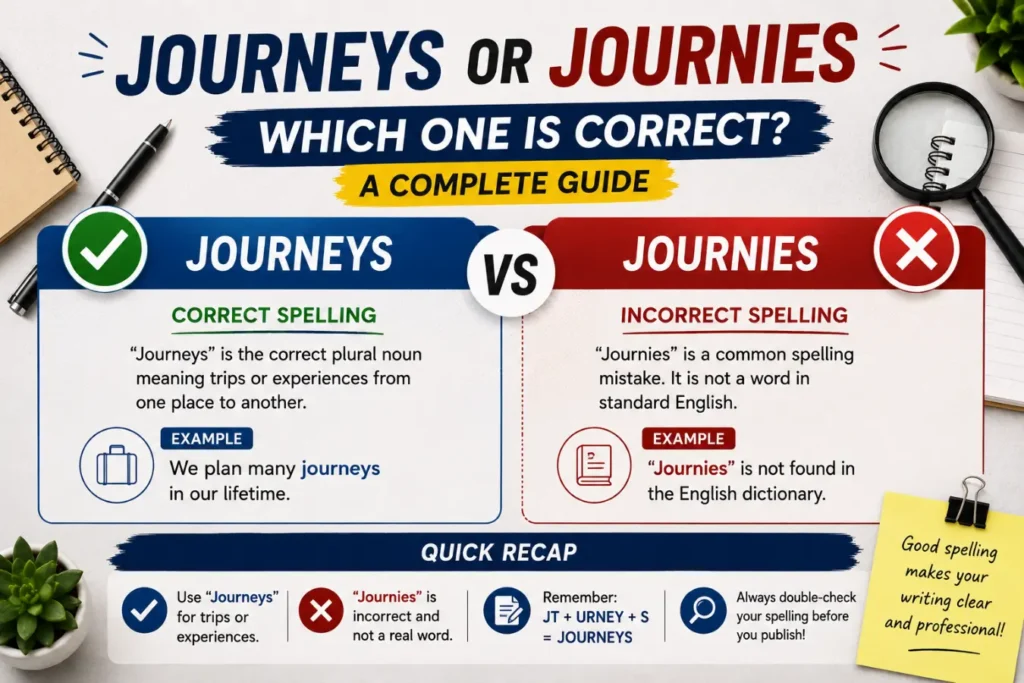
Here are some easy tricks to help you remember:
Tip 1 – Use the vowel test
Check the letter before Y. If it is a vowel, just add S.
Tip 2 – Think of monkey → monkeys
Since monkey becomes monkeys, journey also becomes journeys.
Tip 3 – Read it out loud
“Journeys” sounds natural. “Journies” feels incorrect.
Tip 4 – Use spell check tools
Tools like Grammarly or Google Docs will always flag “journies.”
Tip 5 – Repetition technique
Write “journeys” a few times to strengthen memory.
Synonyms for Journey and Journeys
Using synonyms improves writing variety.
Synonyms for a single journey:
trip, voyage, expedition, adventure, excursion, trek, passage, quest, odyssey, sojourn
Synonyms for multiple journeys:
trips, voyages, expeditions, adventures, excursions, treks
However, “journeys” remains one of the most natural and widely used terms.
How “Journeys” Is Used in Daily Life
The word “journeys” appears in many areas of life.
In travel writing, it describes experiences across countries and cultures. Similarly, in business, it refers to customer journeys. Moreover, in personal development, it reflects growth and progress.
- Her blog covers solo journeys across Asia.
- Customer journeys are essential in marketing.
- Our journeys toward success are never straight.
- The greatest journeys begin with a single step.
- Students experience learning journeys every day.
- Patient journeys help improve healthcare systems.
Clearly, “journeys” is not just about travel. It also represents growth and experience.
Expert Insights – Why Correct Spelling Matters for SEO and Credibility
Correct spelling is more than grammar. It directly affects SEO and credibility.
For bloggers, using “journies” can reduce search visibility because search engines detect spelling errors. As a result, content quality may drop.
For professionals, spelling mistakes can reduce trust in emails, reports, or resumes.
For marketers, the keyword “journeys or journies” has high search volume because users are confused. Content that clearly explains it can rank well and appear in featured snippets.
In short, accurate spelling builds trust, and trust improves rankings.
FAQ – People Also Ask
Q1: Is “journies” ever correct?
No, “journies” is always incorrect.
Q2: What is the plural of journey?
The plural is journeys.
Q3: Why do people write “journies”?
Because they wrongly apply the -ies rule.
Q4: What is the difference between journeys and journey’s?
Journeys is plural, while journey’s is possessive.
Q5: Can I use journeys in formal writing?
Yes, it is correct in all writing styles.
Q6: Is journey countable?
Yes, it is a countable noun.
Q7: What are related keywords?
Travel, trip, voyage, adventure, expedition, life journey, customer journey.
Q8: Example sentence?
Her journeys inspired millions around the world.
Conclusion
So the answer is simple and clear. Journeys is the correct spelling, while journies is incorrect. The rule is easy: when a word ends in vowel + Y, you simply add S. Since journey ends in E-Y, it becomes journeys.
Whether you are writing a blog, essay, or professional document, always use journeys. Good spelling improves clarity, builds trust, and strengthens SEO performance.
Now that you know the rule, you will never be confused again. Happy writing — and happy journeys!