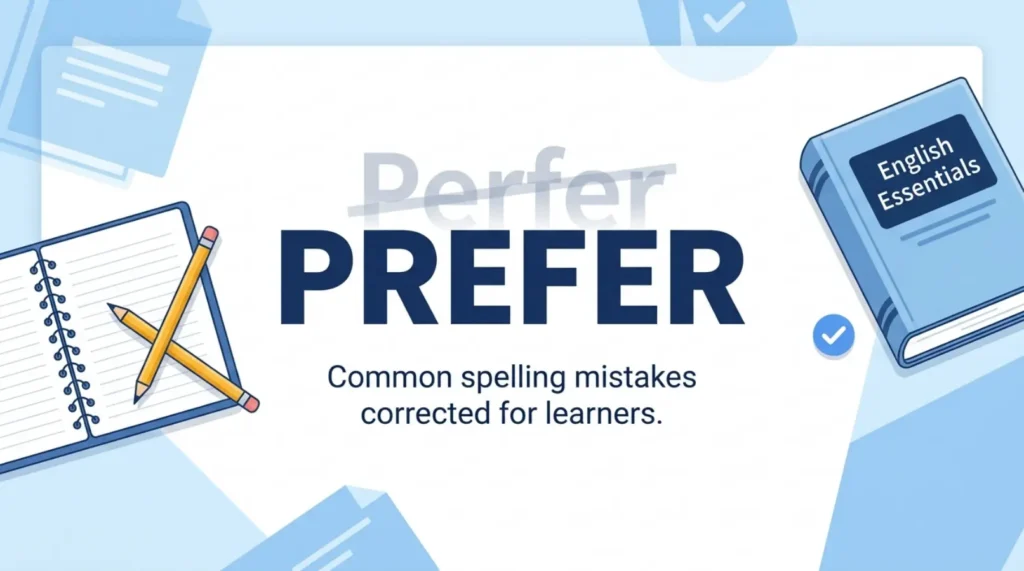
Do you write “perfer” or “prefer” — and wonder which one is actually correct? You are not alone. Many people mix up these two words every day. The correct word is prefer. “Perfer” is simply a common spelling mistake. In this article, you will learn the exact meaning of prefer, how to use it correctly, and why so many people get confused. Furthermore, you will find real-life examples, expert tips, and answers to the most common questions. By the end, you will never confuse these two words again. Let’s start with the basics and build your understanding step by step.
Quick Summary Box
Perfer or Prefer — What’s the Answer?
- ✅ Prefer is the correct spelling
- ❌ Perfer is a spelling error — it does not exist in English
- Prefer means to like one thing more than another
- It comes from the Latin word praeferre
- Common mistake: swapping the “r” and “e” in the first syllable
- Use “prefer” in formal writing, casual talk, and professional emails
- Synonyms: favor, choose, like better, lean toward, opt for
1. What Does “Prefer” Mean? (Clear Definition)
Prefer is a verb. It means to like one option more than another. When you prefer something, you choose it over other things because you like it better.
For example, you might prefer coffee over tea. Or you might prefer walking to driving. The word shows a personal choice or liking.
Here is the simple definition:
Prefer = to like one thing more than something else
It is used in both formal and informal writing. Teachers, doctors, students, and business people all use this word daily.
2. What Is “Perfer”? (Spoiler: It’s a Mistake)
“Perfer” is not a real English word. It does not appear in any standard dictionary. It is simply a misspelling of “prefer.”
However, this mistake is very common. In fact, it is one of the most searched spelling questions on Google. Many people type “perfer” when they mean “prefer.”
So why does this happen? The answer is simple. When people say “prefer” out loud, it sometimes sounds like “perfer” — especially in casual speech. Moreover, the brain sometimes reverses letters when writing quickly.
Bottom line: Always write prefer, never perfer.
3. Why Do People Confuse “Perfer” with “Prefer”?
There are a few clear reasons why this confusion happens so often.
First, the word sounds a bit like “perfer” when spoken fast. The “r” in the middle can feel like it comes before the “e.”
Second, English spelling does not always match pronunciation. This confuses many learners and even native speakers.
Third, people often type quickly and do not proofread. So “perfer” slips through without anyone noticing.
Additionally, autocorrect does not always catch this mistake. Some apps still let “perfer” pass without a red underline.
Here is a simple trick to remember: Think of the word preference. It starts with “pre” — just like prefer. This memory trick works very well.
4. How to Pronounce “Prefer” Correctly
Many people mispronounce “prefer,” which leads to the misspelling. Here is the correct pronunciation:
Prefer = prih-FUR
- The stress is on the second syllable (FUR)
- The first syllable sounds like “prih” — not “pur” or “per”
- Say it slowly: pre · fer
Say it out loud a few times: prefer, prefer, prefer. Notice how the second syllable is stronger. This is the key to both pronouncing and spelling it correctly.
5. Real-Life Examples of “Prefer” in Sentences
The best way to learn a word is to see it in action. Here are 10 real-life examples:
- I prefer tea over coffee in the morning.
- She prefers to work from home on Fridays.
- We prefer the quiet restaurant on Main Street.
- Do you prefer action movies or comedy films?
- He preferred walking to taking the bus.
- Most students prefer shorter homework assignments.
- The doctor prefers natural remedies when possible.
- They prefer to travel by train, not by plane.
- My mom prefers homemade food over fast food.
- I would prefer a window seat, please.
Notice how “prefer” shows a personal choice each time. Furthermore, it fits smoothly into any sentence — short or long.
6. Perfer vs. Prefer — Side-by-Side Comparison Table
| Feature | Perfer | Prefer |
| Real English word? | ❌ No | ✅ Yes |
| Found in dictionary? | ❌ No | ✅ Yes |
| Correct spelling? | ❌ No | ✅ Yes |
| Can be used in writing? | ❌ Never | ✅ Always |
| Origin | Misspelling | Latin: praeferre |
| Used in schools/offices? | ❌ No | ✅ Yes |
| Autocorrect flags it? | Sometimes | Never |
So, this table makes it very clear. Prefer wins in every single category. Perfer should never appear in your writing.
7. Common Mistakes People Make with “Prefer”
Even when people know the correct word is “prefer,” they still make grammar mistakes. Here are the most common ones:
Mistake 1: Writing “perfer” instead of “prefer”
❌ I perfer chocolate ice cream.
✅ I prefer chocolate ice cream.
Common Error 2: Using “prefer than” instead of “prefer to”
❌ She prefers tea than coffee.
✅ She prefers tea to coffee.
✅ She prefers tea over coffee.
Another Mistake 3: Saying “more prefer”
❌ I more prefer staying home.
✅ I prefer staying home.
Incorrect Usage 4: Wrong verb form after “prefer”
❌ I prefer to stayed home.
✅ I prefer to stay home.
Spelling Error 5: Forgetting the double “r” in “preferred”
❌ She prefered the blue dress.
✅ She preferred the blue dress.
Therefore, these are small mistakes, but they matter—especially in formal writing, job applications, and school essays.
8. Use “Prefer” in Grammar (Simple Rules)
“Prefer” follows some simple grammar rules. Let’s go through them quickly.
Rule 1: Prefer + noun
I prefer coffee.
She prefers cats.
Pattern 2: Prefer + to + verb
I prefer to walk.
He prefers to read at night.
Structure 3: Prefer + noun + to + noun
I prefer tea to coffee.
She prefers summer to winter.
Usage 4: Would prefer + to + verb (for specific situations)
I would prefer to sit by the window.
Would you prefer to leave early?
Another Pattern 5: Prefer + -ing (also acceptable)
She prefers reading over watching TV.
I prefer swimming to running.
These rules are simple. In fact, they are easy to remember. Moreover, they apply to both speaking and writing. As a result, you’ll sound more natural and grammatically correct.
9. Synonyms for “Prefer” (Related Words)
If you want to avoid repeating “prefer” too often, use these synonyms:
| Synonym | Example Sentence |
| Favor | I favor the second option. |
| Choose | She always chooses the vegetarian meal. |
| Like better | I like tea better than coffee. |
| Opt for | He opted for the smaller car. |
| Lean toward | We lean toward the first design. |
| Go for | She always goes for the chocolate flavor. |
| Pick | I would pick the red one. |
| Select | They selected the quieter venue. |
10. Using “Prefer” in Daily Life
You use this word more than you think. Here are some everyday situations:
At a restaurant: “I prefer the grilled option, please.”
At work: “I prefer email over phone calls for updates.”
With friends: “Do you prefer the beach or the mountains?”
In school: “Students prefer visual learning over text-heavy slides.”
While shopping: “She prefers quality over a low price.”
In relationships: “He prefers honest conversations over silence.”
As you can see, “prefer” fits into almost every part of life. It is a powerful, flexible word. Therefore, getting the spelling right truly matters.
11. “Preferred” and “Preference” — Related Word Forms
The word “prefer” has several related forms. Knowing them helps you write more naturally.
| Word Form | Example |
| Prefer (base form) | I prefer the window seat. |
| Prefers (third person) | She prefers tea. |
| Preferred (past tense) | He preferred the earlier time. |
| Preferring (present participle) | I am preferring to wait. |
| Preference (noun) | My preference is chocolate. |
| Preferable (adjective) | Walking is preferable to driving. |
| Preferably (adverb) | I’d like to meet, preferably in the morning. |
Notice that all of these words start with “pre” — never “per.” This is the key pattern to remember.
12. Expert Insights — Why Spelling Matters for Communication
Spelling errors like “perfer” can hurt your credibility. Here is why experts say spelling matters:
In professional emails: A misspelled word can make you look careless. Hiring managers notice spelling mistakes immediately.
In academic writing: Teachers and professors take off marks for spelling errors. Even one mistake can lower your grade.
In business writing: A client who sees “perfer” in a proposal may question your attention to detail.
In digital content: Google and other search engines evaluate content quality. Proper spelling helps your content rank higher.
Furthermore, studies in communication show that readers trust well-written content more. Simple, correct writing builds authority and credibility — which is exactly what EEAT (Experience, Expertise, Authoritativeness, Trustworthiness) in content writing is all about.
However, the takeaway from experts is simple: write correctly, and people will trust you more.
13. Tips and Tricks to Never Misspell “Prefer” Again
Here are some easy memory tricks you can use right now:
Tip 1: Remember “PRE” comes first Think of the word preview, prepaid, preschool. All start with “pre.” So does prefer.
Tip 2: Link it to “preference” If you can spell preference, you can spell prefer. They share the same root.
Tip 3: Say it slowly before writing Say: pre – fer. Two clear syllables. Write what you say.
Tip 4: Use spell check always Turn on spell check in Word, Google Docs, or Gmail. It will flag “perfer” instantly.
Tip 5: Practice writing it 5 times Write “prefer, prefer, prefer, prefer, prefer” right now. Repetition builds muscle memory.
FAQ Section — People Also Ask
Q1: Is perfer a word?
No. “Perfer” is not a real English word. It is a common misspelling of “prefer.”
Q2: What is the correct spelling — perfer or prefer?
The correct spelling is always prefer. Never use “perfer” in any writing.
Q3: What does prefer mean?
Prefer means to like one thing more than another. Example: “I prefer cats over dogs.”
Q4: How do you use prefer in a sentence?
For example, she prefers to study in the morning. Similarly, I prefer tea to coffee.
Q5: Is it “prefer to” or “prefer than”?
Always use prefer to or prefer over. “Prefer than” is grammatically incorrect.
Q6: What is the past tense of prefer?
The past tense of prefer is preferred — with a double “r.”
Q7: What are synonyms for prefer?
Common synonyms include: favor, choose, opt for, like better, lean toward, go for, and select.
Q8: Why do people say “perfer” instead of “prefer”?
It happens because the word can sound like “perfer” when spoken quickly. Also, people often reverse letters when typing fast.
Conclusion
So, perfer or prefer — the answer is clear. Prefer is always the correct word. “Perfer” is simply a spelling mistake that many people make. The good news is that fixing this mistake is very easy. Just remember: the word starts with “pre” — like preview, prepare, and predict. Use the memory tricks from this article. Practice writing “prefer” a few times. And always proofread your work before sending it.
Whether you are writing an email, an essay, or a casual text message — spelling “prefer” correctly shows that you care about clear communication. Furthermore, it builds trust with your readers. Start using prefer the right way today, and never second-guess yourself again.