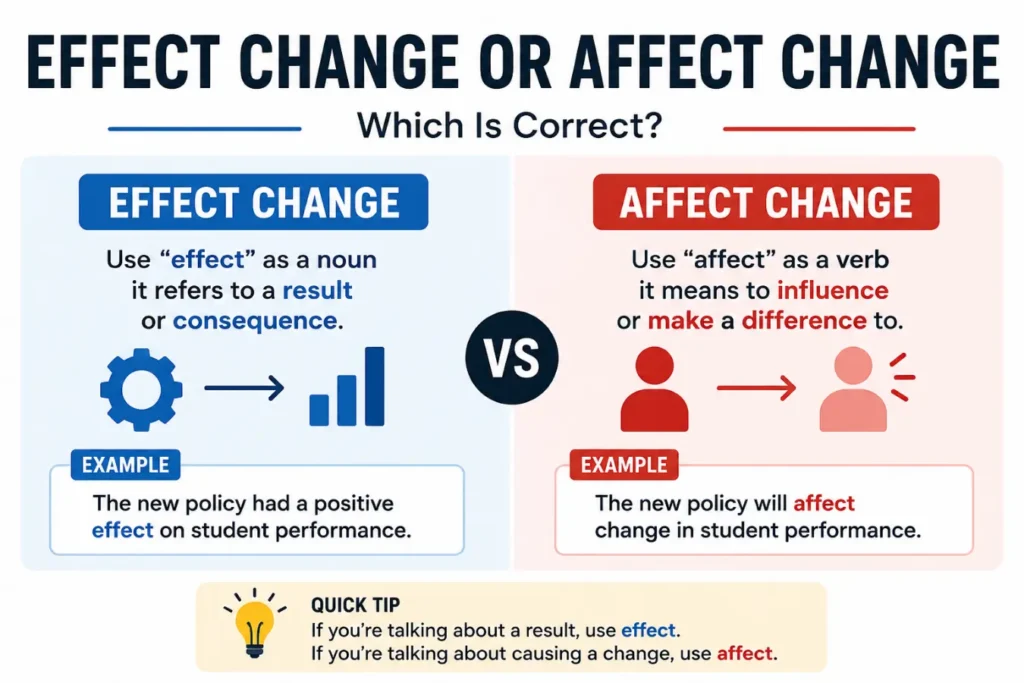
Man or men is a common English grammar question that confuses many learners and writers. The two words look similar, but they have different meanings and uses. Choosing the wrong one can make your sentence sound incorrect.
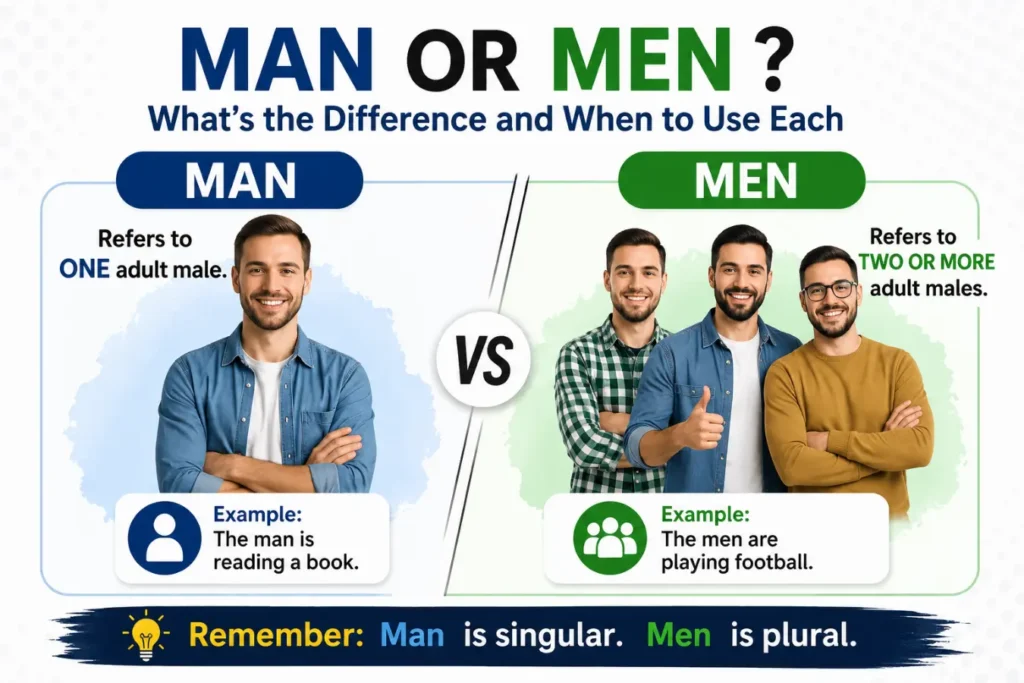
The good news is that the difference is easy to understand. Man refers to one adult male, while men refers to more than one adult male. Once you learn this simple rule, you can use both words correctly in everyday conversations and writing.
This guide explains the difference in clear and simple English. You will also find comparison tables, real-life examples, common mistakes, useful tips, and expert advice. By the end, you will know exactly when to use man and when to use men with confidence.
Quick Summary
- Man is singular.
- Men is plural.
- Use man for one adult male.
- Use men for two or more adult males.
- Both words have different grammar roles.
- The pronunciation also changes slightly.
- Always match the verb with the correct noun.
What Do Man and Men Mean?
Both words refer to adult male humans.
The difference lies in the number.
Man
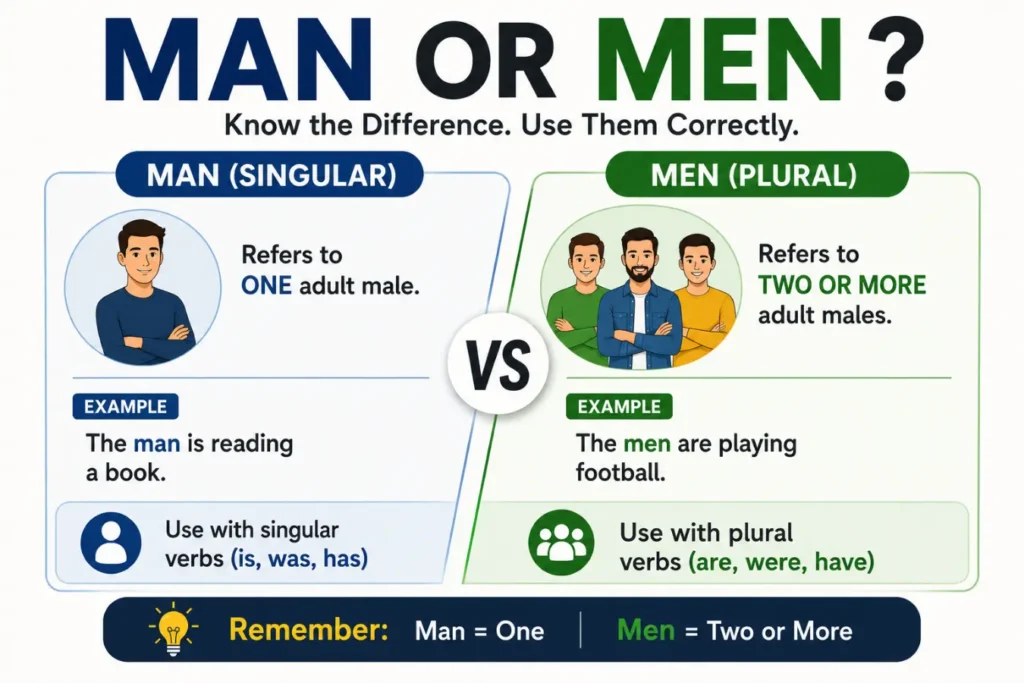
Man means one adult male.
Examples:
- The man opened the door.
- One man helped us.
Men
Men means two or more adult males.
Examples:
- The men carried the boxes.
- Several men waited outside.
This is the same pattern as many other singular and plural nouns in English.
Man or Men: Which One Is Correct?
Both words are correct.
Choose the one that matches the number of people.
- Use man for one person.
- Use men for more than one person.
For example:
✅ One man is walking.
✅ Two men are walking.
The noun and verb should always agree.
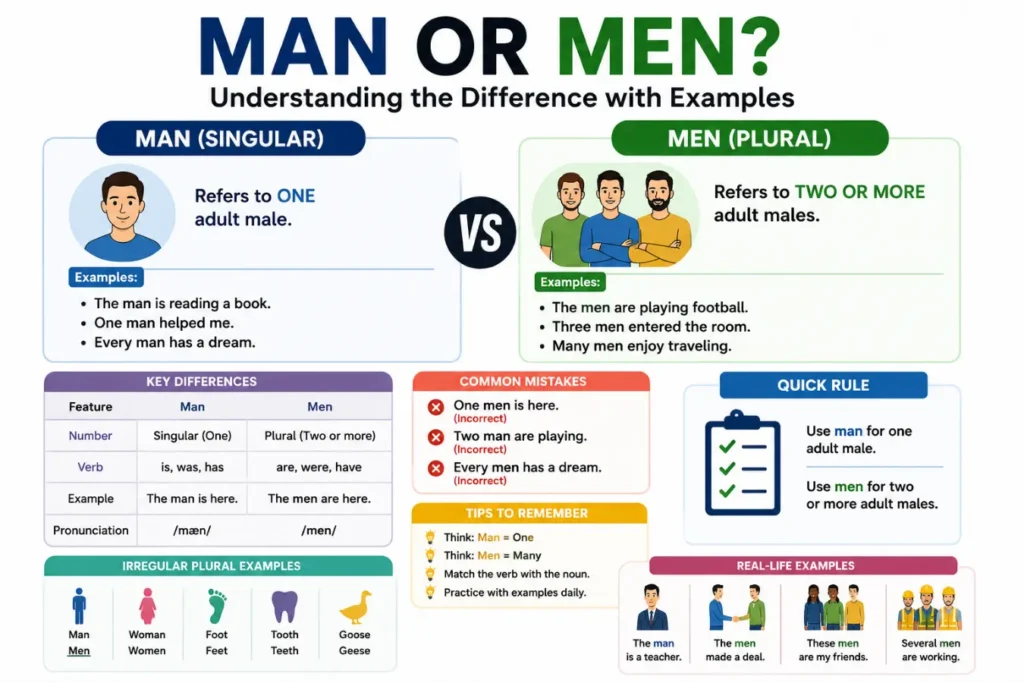
Man vs Men Comparison Table
| Feature | Man | Men |
| Number | Singular | Plural |
| Meaning | One adult male | More than one adult male |
| Verb | Is, was | Are, were |
| Example | The man is here. | The men are here. |
| Grammar | Singular noun | Plural noun |
This comparison helps you choose the correct word quickly.
Why Do People Confuse Man and Men?
The spellings look very similar.
However, English has several irregular plural nouns.
Instead of adding -s, the vowel changes.
Other examples include:
| Singular | Plural |
| Man | Men |
| Woman | Women |
| Foot | Feet |
| Tooth | Teeth |
| Goose | Geese |
Learning these patterns makes English grammar easier.
When Should You Use Man?
Use man whenever you talk about one adult male.
Examples:
- The man smiled.
- One man fixed the car.
- That man works here.
- Every man received a ticket.
Remember to use singular verbs with man.
When Should You Use Men?
Use men whenever you describe two or more adult males.
Examples:
- Three men entered the room.
- The men played football.
- Many men enjoy hiking.
- Those men are doctors.
Always use plural verbs with men.
Real-Life Examples
These examples show the difference clearly.
Example 1
Incorrect:
One men is waiting.
Correct:
One man is waiting.
Example 2
Incorrect:
Two man are working.
Correct:
Two men are working.
Example 3
Incorrect:
Every men has a ticket.
Correct:
Every man has a ticket.
Example 4
Correct:
Several men attended the meeting.
Each sentence follows the correct grammar rule.
Common Mistakes to Avoid
Many learners make these errors.
Avoid the following:
- Using men for one person.
- Using man for a group.
- Matching man with plural verbs.
- Matching men with singular verbs.
- Forgetting that man has an irregular plural.
Checking the noun and verb together helps prevent mistakes.
Tips for Remembering the Difference
These simple tricks make the rule easier.
- Think of man = one.
- Think of men = many.
- Check whether the noun is singular or plural.
- Read your sentence aloud.
- Practice with everyday examples.
Soon, choosing the correct word will become natural.
How to Use Man and Men in Daily Life
You use these words in conversations, emails, books, and schoolwork.
Here are a few everyday examples:
- The man at the store helped me.
- Two men repaired the road.
- Every man received a welcome gift.
- Several men joined the meeting.
- That man is my neighbor.
- The men celebrated the team’s success.
These examples show how the correct word depends on the number of people.
Man and Men in Common Expressions
You will often hear these words in everyday English.
Common Expressions with Man
- Man of the year
- Young man
- Businessman
- Every man for himself
- Man at work
Common Expressions with Men
- Working men
- Businessmen
- Men at work
- Brave men
- Many men
Learning these phrases helps you sound more natural when speaking and writing.
Synonyms
Sometimes you can use another word instead of man or men, depending on the context.
Synonyms for Man
- Adult male
- Gentleman
- Person
- Individual
- Human (in some contexts)
Synonyms for Men
- Adult males
- Gentlemen
- Individuals
- People (when gender is not important)
- Group of men
Choose the synonym carefully because the meaning may change slightly.
Expert Insights
Grammar experts recommend learning irregular plural nouns early because they appear often in everyday English.
Unlike most nouns, man does not become mans. Instead, it changes to men. The same pattern appears in words like woman, foot, and tooth.
A simple way to avoid mistakes is to check the number of people in your sentence. If you are talking about one adult male, use man. If you are talking about two or more, use men.
Reading English books and practicing with simple sentences also helps you remember the correct forms.
Frequently Asked Questions
What is the difference between man and men?
Man is singular and refers to one adult male. Men is plural and refers to two or more adult males.
Is “one men” correct?
No. The correct phrase is one man.
Is “two man” correct?
No. The correct phrase is two men.
Why is the plural of man “men”?
Man is an irregular noun. Instead of adding -s, the vowel changes to form the plural.
Do man and men have different pronunciations?
Yes. Both words sound different, even though they have similar spellings.
Is “man” always used for adults?
Usually, yes. Man refers to an adult male. For a young male, boy is the correct word.
What verb should I use with men?
Use plural verbs such as are, were, have, and do because men is a plural noun.
Conclusion
If you have ever wondered man or men, the answer is simple. Man refers to one adult male, while men refers to two or more adult males. Although the words look similar, they follow different grammar rules. Using the correct form makes your writing clearer and more accurate.
Before choosing a word, check how many people you are describing. If there is only one, use man. If there are two or more, use men. With regular practice and real-life examples, this grammar rule becomes easy to remember and use with confidence.