Center or centre is a spelling question that often confuses English learners and writers. Both words have the same meaning, but they belong to different forms of English. You may notice center in American writing, while centre appears more often in British English. This difference causes many people to wonder which spelling they should choose. Fortunately, the answer is simple. Both spellings are correct when you use them in the right context.
In this guide, you will discover the difference between center and centre, where each spelling is common, and how to avoid common mistakes. You will also find practical examples, a comparison table, useful writing tips, and answers to frequently asked questions. After reading this guide, you can use either spelling with confidence.
Quick Summary
- Center and centre have the same meaning.
- Both spellings are correct.
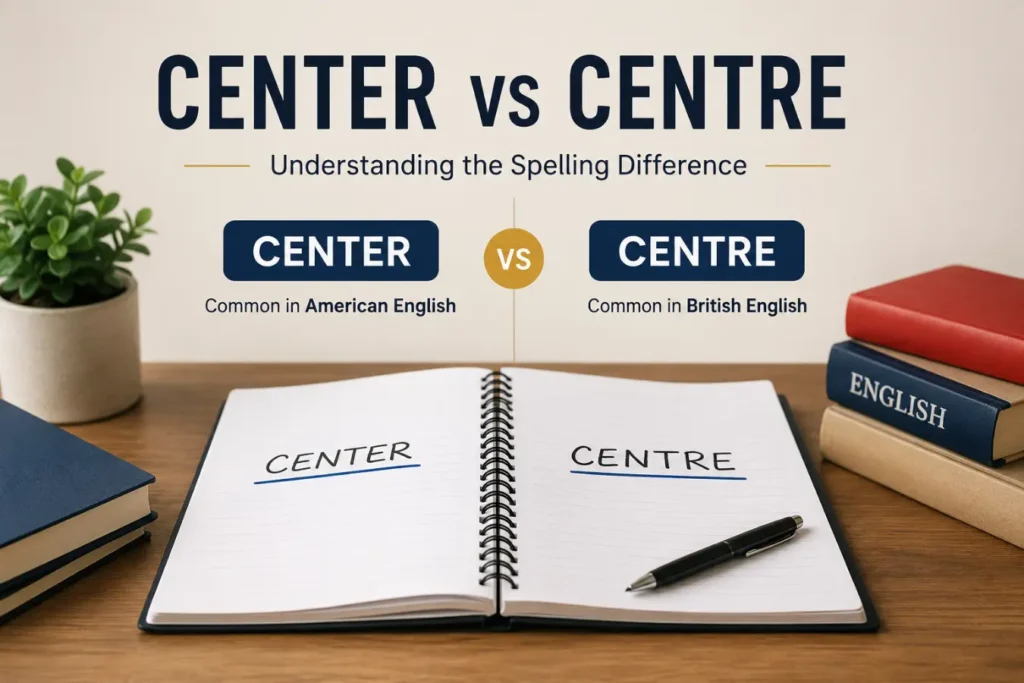
- Center is the American English spelling.
- Centre is the British English spelling.
- Pronunciation stays the same.
- Choose the spelling that matches your audience.
- Stay consistent throughout your writing.
What Does Center or Centre Mean?
Both words refer to the middle point of something.
They can also describe:
- A place where activities happen
- A building for a specific purpose
- The most important part of something
The spelling changes, but the meaning does not.
Center vs Centre: What Is the Difference?
The only difference is the spelling.
American English uses center.
British English uses centre.
Both words follow the same grammar rules.
They also share the same pronunciation.
Center or Centre Comparison Table
| Feature | Center | Centre |
| Meaning | Middle point or place | Middle point or place |
| English style | American English | British English |
| Pronunciation | Same | Same |
| Used in the United States | Yes | Rarely |
| Used in the United Kingdom | Rarely | Yes |
| Correct spelling | Yes | Yes |
This comparison shows that the difference depends on regional spelling.
When Should You Use Center?
Use center if you write for an American audience.
Examples include:
- American schools
- U.S. businesses
- American websites
- U.S. newspapers
Example sentences
- The shopping center opens at 9 a.m.
- Please stand in the center of the room.
- Our sports center offers swimming lessons.
- The city center attracts many visitors.
When Should You Use Centre?
Use centre when writing for readers in countries that follow British English.
Examples include:
- The United Kingdom
- Canada (often)
- Australia
- New Zealand
Example sentences
- The shopping centre closes at 8 p.m.
- Meet me in the centre of the park.
- She works at the community centre.
- The town centre looks beautiful.
Real-Life Examples of Center and Centre
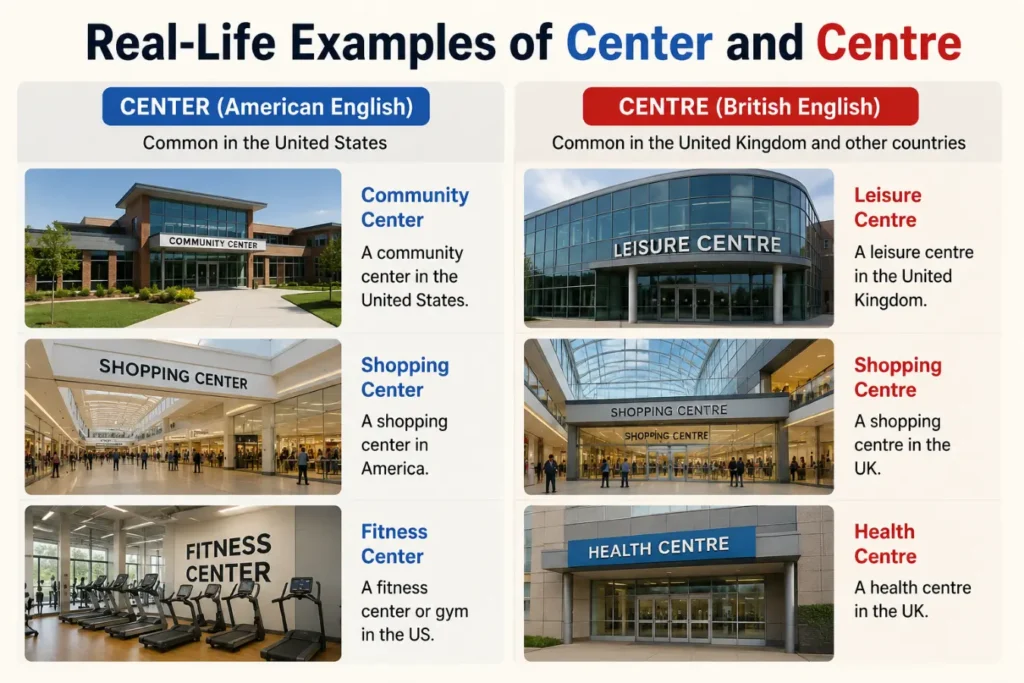
These situations make the difference easier to understand.
Travel
An American guide says:
“The hotel is near the city center.”
A British guide says:
“The hotel is near the city centre.”
Education
A U.S. school advertises a learning center.
A British school advertises a learning centre.
Sports
An American arena has a fitness center.
A British facility has a fitness centre.
The meaning stays exactly the same.
Common Mistakes to Avoid
Many writers make these simple mistakes.
Incorrect
- Using center and centre in the same article.
- Changing spelling halfway through a document.
- Assuming one spelling is incorrect.
Correct
- Choose one spelling.
- Match your audience.
- Keep the same spelling throughout your content.
Consistency makes your writing look more professional.
Easy Tips to Remember the Difference
These memory tricks make the choice simple.
- Center belongs to American English.
- Centre belongs to British English.
- The pronunciation never changes.
- Both spellings have the same meaning.
A quick reminder:
America prefers -er. Britain prefers -re.
How People Use These Words Every Day

You will find these words in many situations.
Examples include:
- Shopping centers
- Community centres
- Medical centers
- Sports centres
- City centers
- Town centres
- Learning centers
- Visitor centres
The spelling depends on the country, not the meaning.
Synonyms of Center and Centre
These words have similar meanings in certain situations.
- Middle
- Core
- Hub
- Heart
- Midpoint
- Focus
- Central point
- Headquarters
- Main area
- Meeting place
Choose the synonym that best fits your sentence.
Expert Insight
Many spelling differences between American and British English follow a clear pattern. Words ending in -er in American English often become -re in British English. Examples include center/centre, theater/theatre, and meter/metre. The key is not choosing the “better” spelling. Instead, write for your audience and remain consistent throughout your document. This approach improves readability and creates a polished writing style.
Frequently Asked Questions
Is it center or centre?
Both are correct. The choice depends on whether you use American or British English.
Which spelling is American?
Center is the American English spelling.
Which spelling is British?
Centre is the British English spelling.
Do center and centre have different meanings?
No. They mean exactly the same thing.
Which spelling should I use in school?
Follow your teacher’s instructions or your school’s preferred style guide.
Can I mix center and centre in one article?
No. Choose one spelling and use it consistently.
Why are there two spellings?
American and British English developed different spelling conventions over time.
Conclusion
The choice between center or centre depends on the type of English you use rather than the meaning of the word. Center follows American English spelling, while centre follows British English spelling. Both versions refer to the middle of something or a place where activities happen. Neither spelling is more correct than the other. Instead, think about your audience before you write. Then use the same spelling throughout your document. Consistent writing improves readability, strengthens professionalism, and prevents confusion. Once you understand this simple spelling difference, you can write with greater confidence in both formal and everyday situations.