
Dragged or Drug: Which Word Is Correct? Easy Grammar Guide
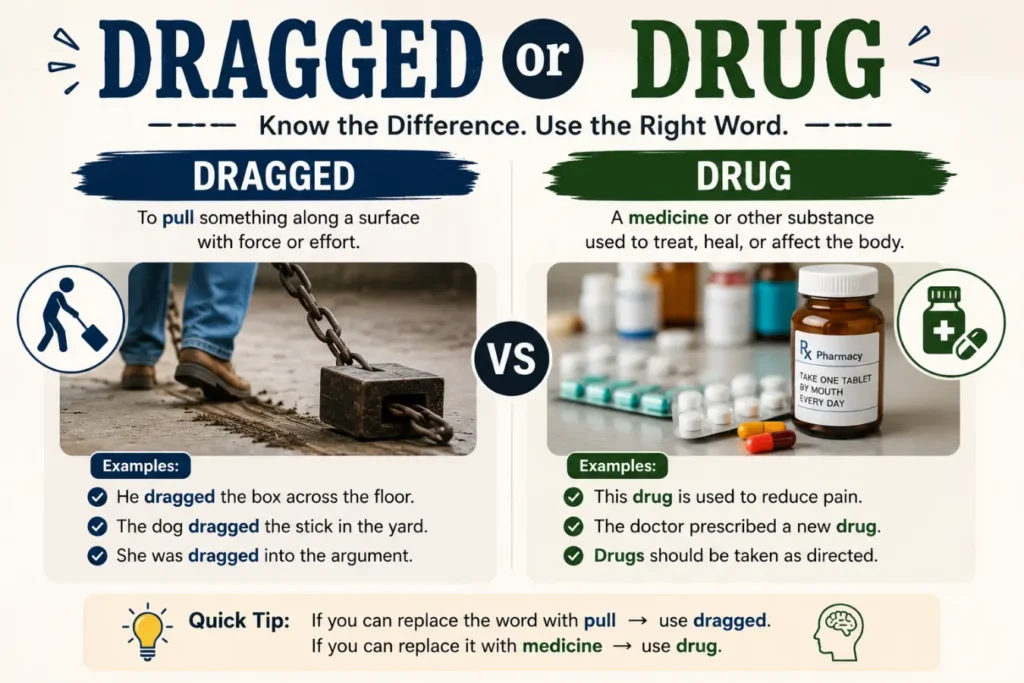
Dragged or drug is a common grammar question that often causes confusion. Both words appear in everyday conversations, but only one is standard in most forms of English. If you have ever wondered whether to write dragged or drug, you are not alone. Many native speakers also mix them up. The good news is that the difference is easy to understand.
In standard English, dragged is the correct past tense and past participle of the verb drag. However, drug appears as a regional past tense in some parts of the United States. This guide explains when each word is appropriate, where people use it, and how to avoid common mistakes. You will also find simple examples, practical tips, and answers to frequently asked questions.
Quick Summary
- Dragged is the standard past tense of drag.
- Drug is a regional dialect form in some areas.
- Formal writing should use dragged.
- Most dictionaries list dragged as the preferred form.
- Drug is common in some American dialects.
- Use dragged in school, business, and professional writing.
- Choose the standard form for clear communication.
What Does Drag Mean?
The verb drag means to pull something along the ground or another surface.
People also use it in a figurative sense.
For example:
- Pull a heavy box
- Move furniture
- Bring someone unwillingly
- Make an activity feel slow
The past tense depends on the variety of English you use.
Dragged or Drug: Which One Is Correct?
The standard answer is simple.
Dragged is the correct past tense and past participle of drag.
Drug appears mainly in regional American speech.
Most grammar guides recommend dragged for formal communication.
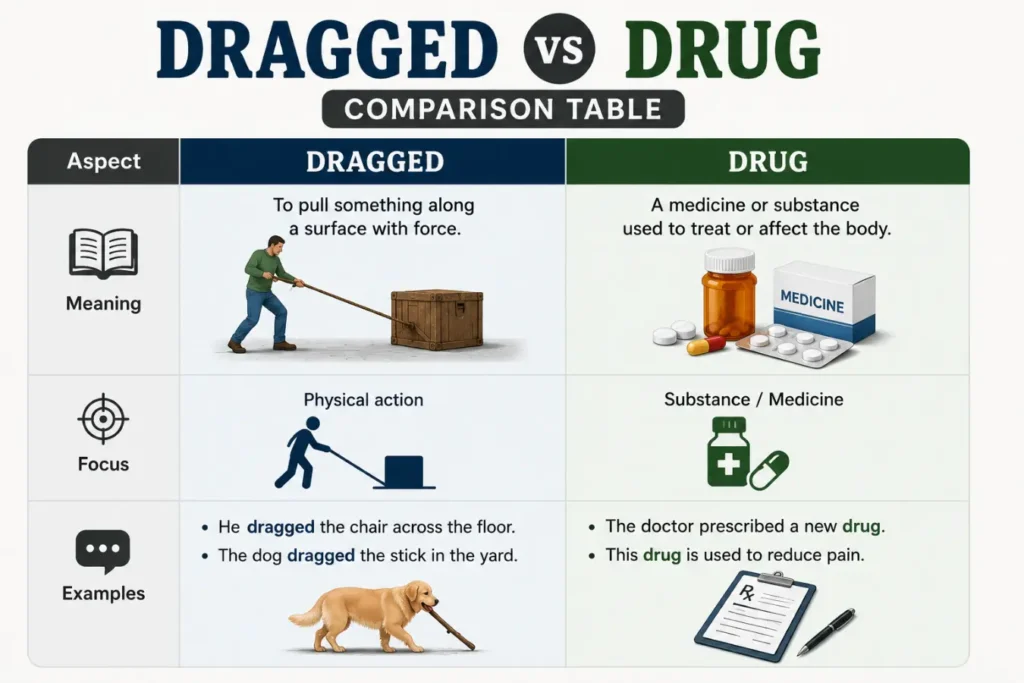
Dragged vs Drug Comparison Table
| Feature | Dragged | Drug |
| Standard English | Yes | No |
| Formal writing | Yes | No |
| Common in school writing | Yes | No |
| Regional American speech | Rarely | Yes |
| Dictionary preference | Yes | Limited |
| Past tense of drag | Yes | Regional usage |
For almost every writing situation, dragged is the safest choice.
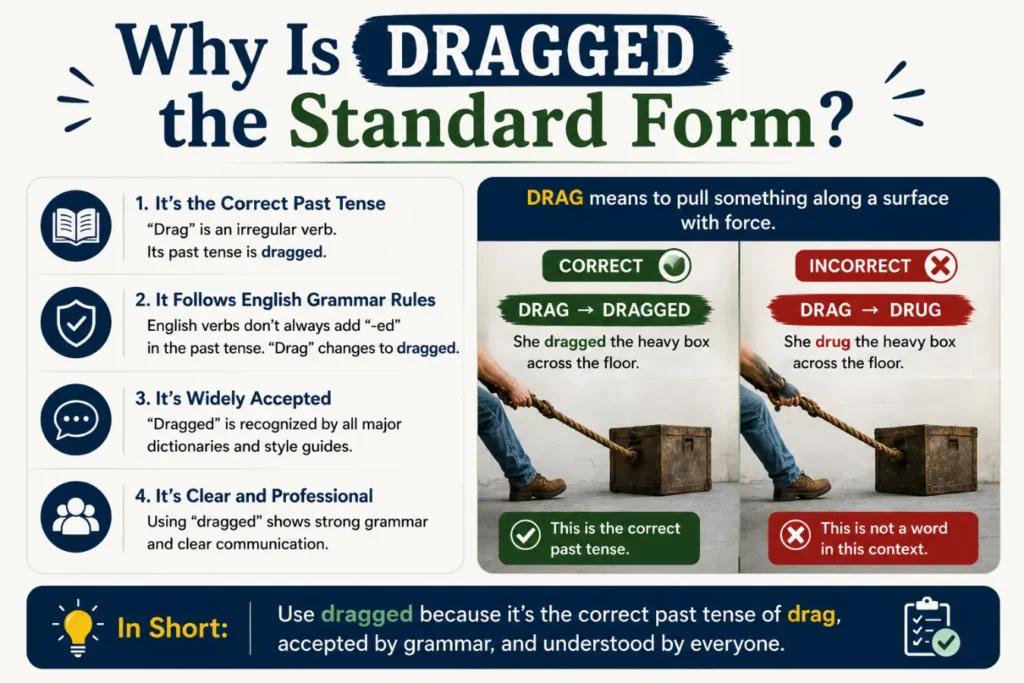
Why Is Dragged the Standard Form?
English follows regular verb patterns.
The verb drag becomes dragged in the past tense by adding -ed.
Examples include:
- Walk → Walked
- Jump → Jumped
- Paint → Painted
- Drag → Dragged
This regular pattern makes dragged the accepted form.
When Do People Use Drug?
Some speakers in parts of the United States use drug as the past tense of drag.
For example:
- “He drug the chair across the floor.”
Although native speakers may say this naturally, most teachers and editors still recommend dragged in writing.
Therefore, avoid drug in formal documents.
Real-Life Examples of Using Dragged or Drug
These examples show the correct usage.
At Home
She dragged the suitcase upstairs.
At School
The students dragged the desks into a circle.
During Moving Day
We dragged the couch into the living room.
Casual Regional Speech
Some people say, “He drug the boat onto the shore.”
The last example reflects regional speech, not standard grammar.
Common Mistakes to Avoid
Many writers repeat the same errors.
Incorrect
- He drug the box across the room. (Formal writing)
- They have drug the table outside.
- She was drug across the floor.
Correct
- He dragged the box across the room.
- They have dragged the table outside.
- She dragged the chair closer.
Using dragged keeps your writing accurate.
Easy Tips to Remember the Correct Word
These tricks make the choice simple.
- Drag is a regular verb.
- Regular verbs usually add -ed.
- Formal English prefers dragged.
- Think of walked, talked, and dragged together.
A quick memory trick:
If the verb is drag, the standard past tense ends in -ed.
How People Use Dragged in Daily Life
The word appears in many situations.
Examples include:
- Moving furniture
- Pulling luggage
- Carrying heavy objects
- Describing slow meetings
- Sports commentary
- Storytelling
- Everyday conversations
The figurative meaning is also common.
Example:
“The meeting dragged on for hours.”
Synonyms of Dragged or Drug
These words have similar meanings depending on the sentence.
- Pulled
- Hauled
- Tugged
- Drew
- Shifted
- Moved
- Carried
- Transported
- Trailed
- Towed
Choose the synonym that fits your context.
Expert Insight
Regional speech adds richness to English, but standard grammar helps everyone understand your writing. While drug remains common in certain American dialects, dragged appears in dictionaries, textbooks, style guides, and professional documents. If you write for a broad audience, choosing the standard form improves clarity and builds credibility. Understanding this difference also helps you recognize regional expressions without adopting them in formal writing.
FAQs for Dragged or Drug
Is it dragged or drug?
Dragged is the correct form in standard English.
Is drug ever correct?
Yes. Some American dialects use drug as the past tense of drag, but formal writing prefers dragged.
What is the past tense of drag?
The standard past tense is dragged.
Can I write drug in an essay?
No. Most teachers and editors expect dragged.
Why do some people say drug?
Regional dialects sometimes use different verb forms in everyday speech.
Is dragged the past participle too?
Yes. Dragged serves as both the past tense and the past participle.
Which word should English learners use?
English learners should always use dragged in speaking and writing.
Conclusion
Choosing between dragged or drug becomes simple once you know the grammar rule. Dragged is the standard past tense and past participle of drag. It appears in dictionaries, textbooks, schools, and professional writing. Although some American dialects use drug, that form remains regional and does not fit most formal situations. Whenever you write an email, essay, article, or business document, dragged is the best choice. Remember that regular verbs usually add -ed, making this rule easy to apply. With regular practice, selecting the correct form will soon become a natural part of your writing.