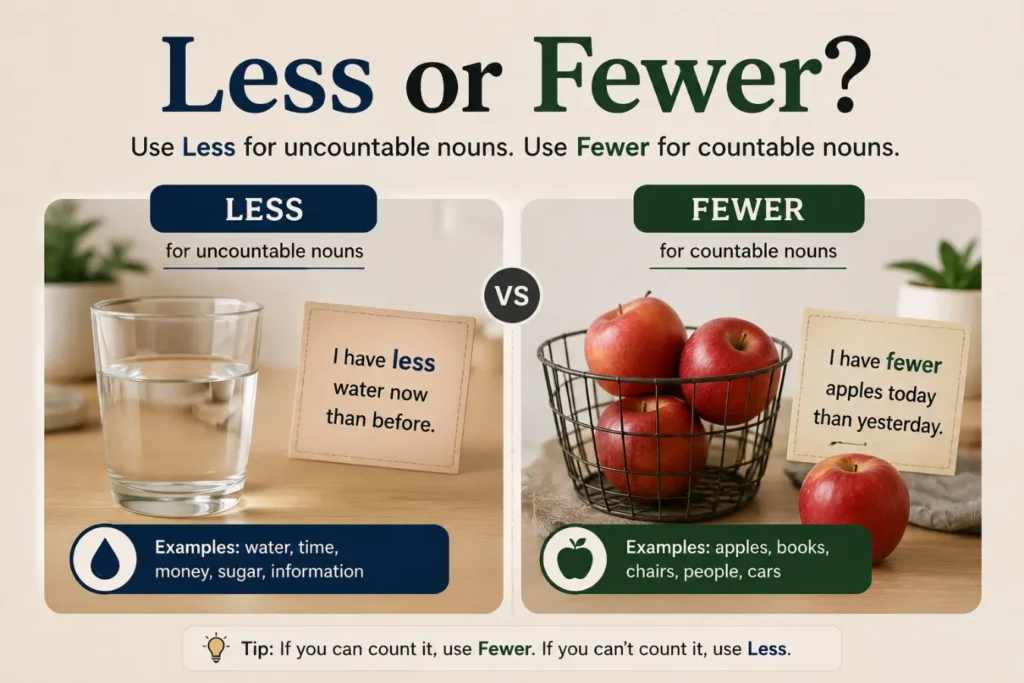
Less or fewer is one of the most common grammar questions in English. These two words seem similar, yet they follow different rules. Many people use them interchangeably, but choosing the wrong one can make your writing sound less accurate. Fortunately, the rule is simple once you understand it. In most cases, fewer goes with things you can count, while less goes with things you cannot count. However, English also includes a few common exceptions. This guide explains the difference in clear, simple language. You will learn when to use each word, discover easy memory tricks, see real-life examples, and avoid common mistakes. By the end of this article, you will feel confident using less and fewer correctly in everyday conversations, schoolwork, and professional writing.
Quick Summary
- Fewer is used with countable nouns.
- Less is used with uncountable nouns.
- Countable nouns include books, apples, and people.
- Uncountable nouns include water, money, and time.
- Some expressions naturally use less.
- Context matters more than memorization.
- Following this rule improves grammar and clarity.
What Do Less and Fewer Mean?
Both words show a smaller amount.
However, they apply to different kinds of nouns.
- Less means a smaller amount of something that cannot be counted individually.
- Fewer means a smaller number of things that you can count one by one.
This simple distinction helps you choose the correct word.
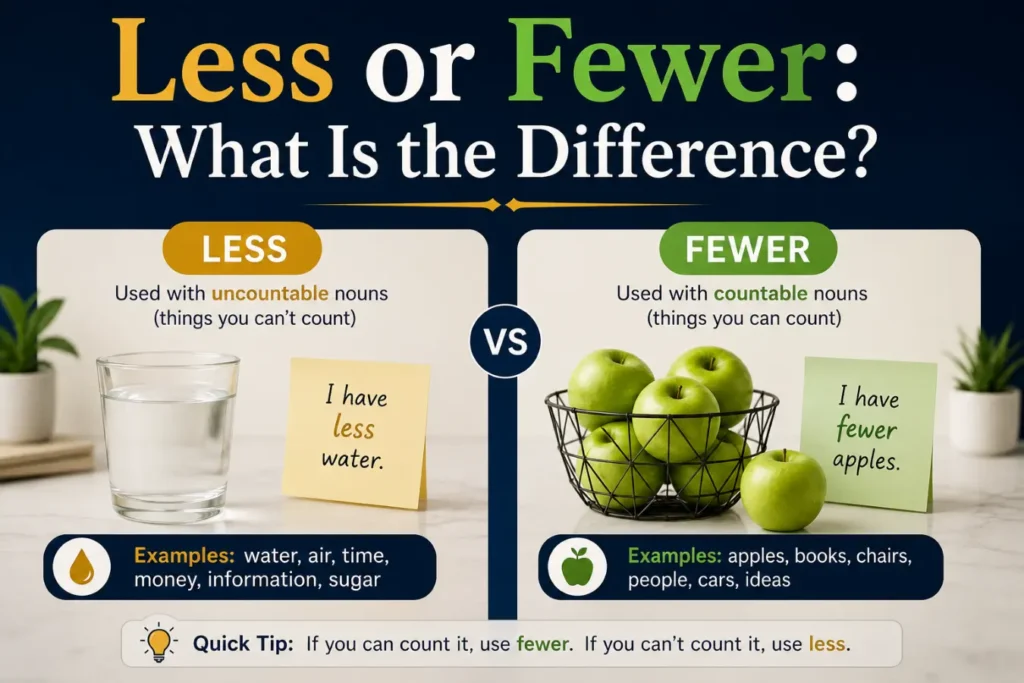
Less or Fewer: What Is the Difference?
The main difference depends on whether the noun is countable.
Use fewer for individual items.
Use less for amounts or substances.
Examples
- Fewer books
- Fewer students
- Less water
- Less sugar
Remember to identify the noun before choosing the word.
Less vs Fewer Comparison Table
| Feature | Less | Fewer |
| Used with | Uncountable nouns | Countable nouns |
| Shows | Smaller amount | Smaller number |
| Example | Less milk | Fewer bottles |
| Formal grammar | Correct | Correct |
| Easy rule | Cannot count | Can count |
This table offers a quick way to remember the grammar rule.
When Should You Use Less?
Use less with nouns that you cannot count separately.
Common examples include:
- Water
- Time
- Money
- Rice
- Air
- Information
- Traffic
Example sentences
- I need less sugar in my coffee.
- We have less time today.
- She spends less money now.
- There is less noise outside.
Each noun refers to an amount instead of individual items.
When Should You Use Fewer?
Use fewer with nouns that you can count.
Common examples include:
- Books
- Cars
- Chairs
- Students
- Apples
- Emails
- Cookies
Example sentences
- There are fewer cars on the road.
- She bought fewer apples.
- We received fewer emails today.
- The class has fewer students this year.
Each noun represents separate items.
Real-Life Examples
These situations make the rule easier to understand.
Grocery Store
Buy fewer oranges but less juice.
School
There are fewer students in today’s class.
Office
We need less paperwork this month.
Home
Use less salt while cooking.
Every example follows the same countable versus uncountable rule.
Common Exceptions to the Rule
English includes a few well-known exceptions.
People often say:
- Less than 10 minutes
- Less than five miles
- Less than $20
Although numbers appear, these expressions describe measurements, time, distance, or money.
Therefore, less sounds natural.
These exceptions appear frequently in everyday English.
Common Mistakes to Avoid
Many learners confuse these words.
Incorrect
- Less books
- Less students
- Fewer water
- Fewer sugar
Correct
- Fewer books
- Fewer students
- Less water
- Less sugar
Checking whether you can count the noun usually solves the problem.
Easy Tips to Remember the Rule
These memory tricks make grammar easier.
- Count it? Use fewer.
- Cannot count it? Use less.
- Think about individual objects.
- Focus on the noun, not the sentence.
A quick reminder:
If you can count it, choose fewer. If you measure it, choose less.
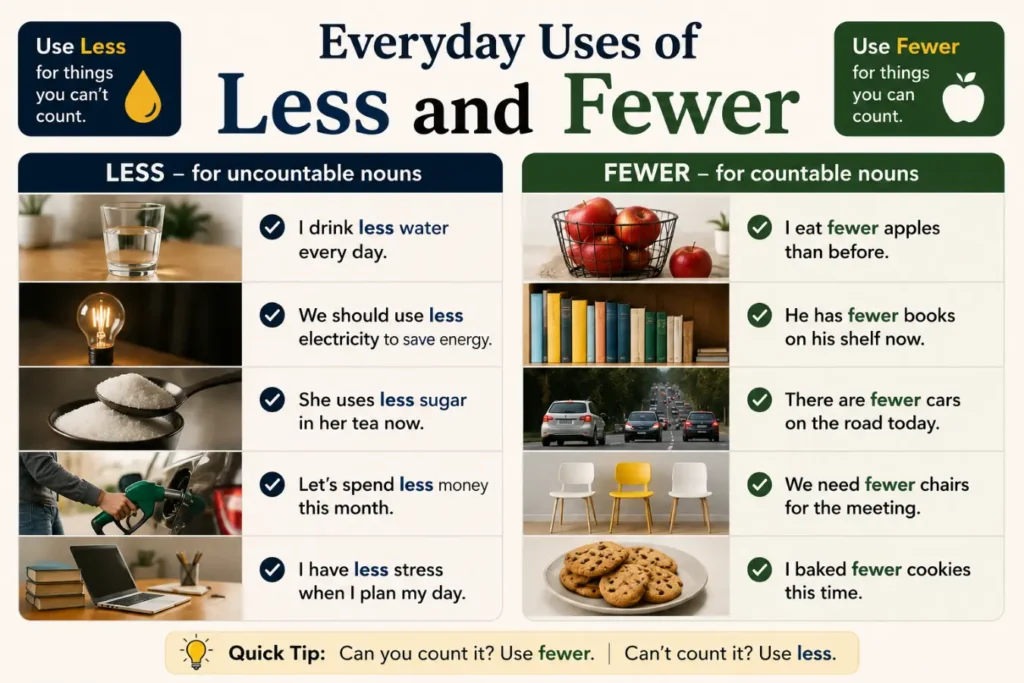
Everyday Uses of Less and Fewer
You will hear these words every day.
Examples include:
- Less traffic
- Less stress
- Less homework
- Fewer mistakes
- Fewer meetings
- Fewer visitors
- Less energy
- Fewer toys
Choosing the correct word makes your writing more natural.
Synonyms and Related Words
These alternatives may fit similar contexts.
Synonyms for Less
- Smaller amount
- Reduced
- Lower
- Limited
- Diminished
Synonyms for Fewer
- Smaller number
- Reduced number
- Not as many
- Limited quantity
- Decreased count
Select the synonym that matches your sentence.
Expert Insight
The less versus fewer rule improves clarity because it separates amounts from numbers. Many native speakers occasionally mix the words in casual conversation, but careful writing follows the traditional grammar rule. Learning this distinction strengthens your grammar, improves academic writing, and helps you communicate more precisely. When proofreading, always identify the noun first before choosing either word.
Frequently Asked Questions
Is it less or fewer people?
Use fewer people because people are countable.
Is it less or fewer water bottles?
Use fewer water bottles because bottles can be counted.
Why do stores say “10 items or less”?
Although many style guides recommend 10 items or fewer, “10 items or less” has become common in everyday language.
Can I say less time?
Yes. Time is generally treated as uncountable in this context.
Is less money correct?
Yes. Money often refers to an amount, so less money is correct.
How do I remember the rule?
Ask yourself whether you can count the noun.
If yes, use fewer.
If no, use less.
Do native speakers always follow this rule?
Not always in casual speech. However, formal writing usually follows the traditional grammar rule.
Conclusion
Understanding less or fewer becomes much easier when you focus on the noun instead of the sentence. Use fewer for things you can count, such as books, chairs, or people. Use less for things you measure, such as water, time, or money. While English includes a few common exceptions, this simple rule works in most situations. Before writing, pause for a moment and ask whether the noun is countable. That small habit will improve your grammar, make your writing more professional, and help you communicate with greater confidence every day.